

Tag Archives: Dan on Thursday

imagedan

From top President of the EU Commission Jean-Claude Juncker blocks UKIP leader Nigel Farage MEP yesterday; Dan Boyle

Last week’s Brexit vote, which the author signalled, was a triumph of hate over responsibility.

Dan Boyle writes:

No surprise but one hell of a mess.

Some voted against the over bearing arrogance of the European Commission. Some recognised the continuing democratic deficit within the EU, although a country with an unelected head of State, second chamber, and without a written constitution is hardly best placed to be flag bearers for democracy.

As with most referenda many voted to get at the government. A government, whoever its new head is to be, that will now have free rein thanks to those who voted with their spleen.

Others spoke about getting rid of red tape. This was code for less consumer entitlements, less workers rights, less environmental standards.

However the phrase that worked, that stuck, was ‘taking our country back’. No code here. For those living in the neglected, discarded communities of Northern England and South Wales the easiest of answers were provided for their continuing plight.

For them it was made all too clear that all their problems were the fault of ‘Johnny Foreigner’.

My recent eight months on John Bull’s first island showed me how ugly public discourse had become there. The louder Nigel Farage and his ilk became the greater the licence given to those whose racist tendencies could now be given full flowering.

It will be difficult to put this genie back in the bottle. A genie, being an utterly inappropriate analogy, not being sufficiently British enough.

It could be that after two years of taking their country back there could be a realisation as to how deep a hole the country has dug itself into. By that stage an independent Scotland will be well on the way to being established, and the newly formed islet of Norn Iron will be nursed into being.

The likelihood is that another referendum will take place, not necessarily to overturn the decision now made, but to offer the alternative to EU membership that will have been agreed.

By that time the Sun will have finally set on the Empire. It may or may not change mindsets. The only certainty is that a terrible ugliness has been reborn. It is a triumph of hate over responsibility.

In Ireland we can’t afford to be too smug about these things. Scratch the surface in many of our discarded communities and we may see similar forces being unleashed.

Maybe the preoccupation with issues of lesser importance that have over involved us recently, have been something of a safety valve.

While I prefer an obsession over water than renewed racism at any time, in both our countries we continue to sideline the more important issues that are further marginalising those communities affected.

We should cry for all our beloved countries.

Dan Boyle is a former Green Party TD and Senator. Follow Dan on Twitter: @sendboyle

Top pic: AP
jeremycorbyn
dan

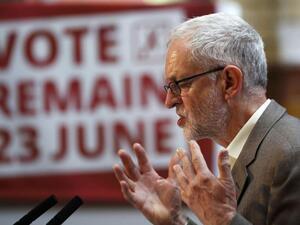
From top: British Labour Party leader Jeremy Corbyn; Dan Boyle

If Britain leaves the EU you can blame the dilettente left.

Dan Boyle writes:

While the Brexit referendum has for the most part been a squalid squabble for the future of the Tory party (egged on by the Sun never sets on the Empire/Little Englanders of UKIP), a sub plot among the religious left has also been unraveling.

The British satirical magazine Private Eye (still miles ahead of its Irish copyist The Phoenix) has a regular character, Dave Spart, an irredentist anarchist/socialist who counter argues every issue, ridiculously, to conform to his obtuse orthodoxy.

I’m reminded of this character when I read the arguments of those in Britain, who position themselves on the left, and who argue for Brexit.

Except, as the contrarians that most of them are, that can’t even say the word Brexit lest they admit who their ideological bedfellows are. To overcome this difficulty they have come up with the term Lexit to maintain ideological purity.

Most involved are the usual suspects – the now cartoon-like George Galloway, the SWP in its People Before Profit incarnation, or Militant Labour/Socialist Party in whatever its current title is.

Add to that the tendency of the debating society left to constantly spilt, amoeba like, and you have all the elements needed for high farce.

I have read arguments from a group styling itself the Socialist Equality Party (is fascist equality possible?). The thrust of its arguments is that Brexit must happen to allow the conditions to exist to bring about a United Socialist States of Europe!

Even among Greens the temptation towards ridiculous argument exists. Its offshoot, no more than 5% of its membership, styles itself Green Leaves. Whether they eat and shoot is a moot question.

The most impenetrable character in this soap opera has been Jeremy Corbyn. I understand how he became Labour Party leader. The need to bury Blairite mendacity and blandness was necessary in that party. Had I been a member I probably would have voted for him.

The problem is he seems to have been voted for because of what he wasn’t rather than what he is. What he is is certainly decent. He is consistent in what he believes, even if much of what he believes should have been left in another era.

What he seems to lack is any degree of passion.Or maybe this is his Machiavellian trait, a half paced half whispered approach to conceal his true intentions.

If that is the case it seems to be working. Most people in Britain don’t believe that he does oppose Brexit. At the very least his style has been laconic. Many of his statements have been open to alternative interpretations.

I feel it has more to do with his accidental leader status. Whatever about his sincerity, or his philosophical consistency, he lacks a gravitas that may end up being the ultimate barrier to his ever being British Prime Minister.

If this referendum is close, and if Brexit succeeds, this dilettante left will have had a lot to do with that.

Dan Boyle is a former Green Party TD and Senator. Follow Dan on Twitter: @sendboyle

00159224dan

From top: Lucinda Creighton at the launch of Renua; Dan Boyle

The increase in support for the populist left in Ireland has been achieved by seeking to promote policies that are recognised in other countries as being right wing.

Dan Boyle writes:

I was asked recently why I thought a populist right wing party hasn’t taken hold in Ireland? Where is our Donald Trump or UKIP or even our Front National?

These questions came on foot of a declaration by Renua Ireland that it had electorally failed because it was seen to be a right wing party.

For much of our history Irish politics has been an ideology free zone. Our main parties have been catch all parties bringing conservative and social democratic elements into their tents. Our ‘centre’ has been more to the right than other European countries.

We now have a centre that’s a bit more left, but not hugely so.

We have developed a populist left. In this we can include Sinn Féin and the PABAPA twins. Political volatility has allowed both groupings to affect empathy with the disadvantaged in our society, without having to seek the responsibility of having to do anything about such inequality.

The increase in support for the populist left in Ireland has also been achieved by such parties articulating, and seeking to promote, policies that are recognised in other countries as being right wing.

In what other country would opposition to capital taxation be seen as left wing? What erstwhile socialist elsewhere would curry favour by suggesting inheritance tax wasn’t socially progressive?

Most wealth is held in capital. Taxing such capital for any progressive has to be a mainstay of any system seeking to bring about greater equality and fairness.

I think the biggest diluting factor in preventing a populist right wing party in Ireland has been the ability of independents to get elected, and currently to do so in large numbers. In terms of international politics this is a uniquely Irish phenomenon.

Independents can say and be anything they want to be. Their’s is the greatest freedom to pander any number of public prejudices.

The outrageous statements that are the stock in trade of our more successful independent politicians, can be a safety valve in venting uncomfortable thoughts existing in society, thoughts that no responsible political party could ever articulate.

Independents have organisations that rarely develop beyond their local strongholds. This has made the prospect of national organisation holding extremely right wing views less likely.

Another factor has been our willingness to subsume elements of right wing government into our own. The Irish Constitution reads in part as a love letter to Portuguese corporatism of the 1930s.

Whenever the idea of an extreme right wing party has been toyed with here it has usually met with derision.

In the 1930s The Blueshirts, as the Army Comrades Association, never even got to contest elections being blended into the new Fine Gael party. Its leader Eoin O’Duffy was shuffled off in a matter of months.

In the 1940s we had Ailtirí na hAiséirghe (Architects of the Revolution). While the party sold thousands of copies of its pamphlets it never came close to winning a Dáil seat. It did win some local council seats with Cork being a particular stronghold, sadly.

These days some followers can be found in the darker recesses of the Internet. The Celtic Cross masquerades as an Irish swastika.

Their thoughts are vile yet somehow we know that by laughing at them they’re never likely to take hold here.

Dan Boyle is a former Green Party TD and Senator. Follow Dan on Twitter: @sendboyle

Rollingnews

00107789

dan

From top: Green Party leader and Minister for the Environment John Gormley following the result of the secend Lisbon Treaty referendum, September, 2009; Dan Boyle

The author examines his own voting record on Europe integration and argues that it was never based on opposition to the idea of a European Union or the need to detach ourselves from it.

Dan Boyle writes:

I was nine years old when Ireland voted to become what was then known as the European Economic Community. I had barely been in the country for a year, my family having moved from the United States to my mother’s hometown of Cork.

Even at that stage I had been socially conditioned enough to realise that you should not tilt against the crowd. The message was simple – Yes to joining was good; No to not joining was bad.

The Labour Party offered what passed for opposition to that proposal then. They and the trade unions also spoke then with the same voice. A neighbour identified himself as a No voter. I thought him mad. In the end less than one in five of those who came out to vote voted No.

The government and the political establishment were pleased with the outcome. They presumed that having voted the people would never have to vote again, the issue having once and finally been decided.

Fourteen years later that establishment reckoned without the dogged determination of Raymond Crotty, who won an important Supreme Court decision that any change to the Treaty of Rome would also be a change to the Irish Constitution, which would always require a referendum of the Irish people.

By then I had reached the physical age (if not the emotional maturity) of being an adult. I got to vote in the referendum on the Single European Act. I voted No.

Labour now in government sought a Yes vote. Of all the political parties represented then in Dáil Éireann, only The Workers Party articulated a No position.

In the subsequent referenda – Maastricht, Amsterdam and Nice (twice), along with The Greens, I continued to vote No. The reasons were many, and to my mind still quite valid.

What they were never was based on opposition to the idea of a European Union or the need to detach ourselves from it.

There was, and continues to be a fear about some nations within the Union being seen as more equal than others. More than a concern of the existence of a democratic deficit.

A headlong rush into aspects of becoming a single unitary state such as a single currency or the idea of a common army; that were either ill thought out or were never necessary, brought about obvious concerns and doubts.

By the time the Treaty of Lisbon required ratification The Greens were in government in Ireland. It caused considerable debate within the party.

I rationalised a Yes vote on the basis that Lisbon at least corrected some of the worst aspects of Nice. I also voted Yes to the Fiscal Treaty. This was despite having voted against Maastricht because of the way a single currency was being introduced in such an unthought through way.

In 2012 we hadn’t a choice to change course.

Having established residence in Wales to participate in the Welsh Assembly election, I find myself now entitled to vote in the Brexit referendum there.

Unlike all the Irish referenda, Brexit isn’t about a better Europe.

It’s about a mythical Britain. It isn’t about protecting or enhancing the role of nation states. It’s about pandering to bitter isolationists whose superior sense of being can’t abide a World where nations need to co-operate with each other.

My having a vote in this referendum may be a quirk, but this is one windmill I will enjoy tilting at.

Dan Boyle is a former Green Party TD and Senator. Follow Dan on Twitter: @sendboyle

90399411
dan

From top: Irish Water CEO John Tierney, 2014; Dan Boyle

Whoever thought setting up Irish Water was an answer to anything must have asking themselves a pretty stupid question.

Dan Boyle writes:

Recently a national protest against homelessness was held. It was attended by hundreds. I would have gone had I been more aware. It is a subject that truly shames us all, and not just the political system.

I have a feeling that when it becomes possible to write the history of this time in a more rounded sense, the amount of anger and energy that has been used on the issue of Water will be seen with some incredulity.

There are those who will claim that water was a binding factor. That it was a clarion call for all the injustices to be found in our society. Some more have convinced themselves that without the issue, and the engagement that has resulted from it, political change on any issue wouldn’t be possible.

And as an issue it has spawned a myriad of sub issues, which of themselves have revealed deep flaws in our democratic structures, as well as our systems of administration.

Whoever thought setting up Irish Water was an answer to anything must have asking themselves a pretty stupid question.

The model of recruiting those shown to be incompetent in their previous roles showed a particular kind of genius. The need to engage consultants by the wagonload underscored a thinking way beyond we ordinary folk.

The barely concealed attempt at fattening up a public utility for the subsequent pleasure of the private sector, added further grist to the mill.

As anger-inducing as these issues were of themselves, they were never the banner items for the dozens of protests that were attended by thousands.

The main point of contention transmitted from these events was that the ‘principle’ of directly paying for water was somehow abhorrent.

The government’s strategy didn’t help of course. It left what it believed to be the easiest issue to be sorted last. It, and especially its key Ministers, seemed to lack any sense of self awareness of a population already pulverised by a series of cack handed policy decisions.

Still public anger remained diffuse. It was never the case that direct payment was ever the issue that most consumed. Unfortunately it became the shorthand for what was was any or a combination of the issues I have mentioned above.

Here I need to confess. I have not paid my water charges either.

I have not done so partially because I have had little confidence that the administrative infrastructure would last, but mostly I was part of that very small subset that wanted to see water metered and directly paid for.

It was the €100 bribe that pushed me over the edge. I imagine each person can speak of a different breaking point, such has been the level of incompetence that has been shown.

Had we been a more mature democracy each of these issues would have been dealt with differently. We still have a lot of growing up to do.

Dan Boyle is a former Green Party TD and Senator. Follow Dan on Twitter: @sendboyle

Rollingnews

90419282dan

From top: Enda Kenny unveiling his junior ministers last week: Dan Boyle

The Taoiseach has missed the opportunity to promote each of his party’s TDs to ministerial rank.

Dan Boyle writes:

Twenty seven of the fifty Fine Gael TDs in Dáil Éireann now hold ministerial rank. Its backbenchers now constitute a minority of its parliamentary party.

In the days of old politics some of these could be partially placated by being appointed to chair one of the many Oireachtas committees that existed.

Oireachtas committees are not as numerous as they once were. This though could change. What will certainly change is the chair of these committees being in the gift of the government of the day.It’s more likely the majority of these roles will be played by opposition TDs. In a more accountable system they all should be.

There are other baubles to appeal to the injured ego. Heading delegations to British Irish Parliamentary Assembly, to the OSCE, to the World Parliamentary Forum; gives potential for foreign travel to mitigate the slighted self importance of some.

The problem for Taoiseach is that he doesn’t seem to be all that interested in accountability. He does care a lot about managing his party. He now has twenty three TDs who are not seen to be that important ‘up in Dublin’.

He should have seen through the courage of his (slight) convictions. He has missed the opportunity of promoting each of his party’s TDs to ministerial rank.

Finding suitable titles might prove a challenge. He could start by resurrecting some of the department headings he has thought now longer necessary for a cabinet position. There are other templates in place that might also help.

The role of Minister of State has in the past been used to develop a cross departmental approach to specified, often minority, interest groups.This approach has been used for women, for older people and younger people and for people with disability.

There hasn’t always been a sensitivity in how these offices should be titled. At a time, pre-politics, when I was involved in youth work, I thought that having a Minister for State for Youth Affairs was only asking for trouble.

A brave Taoiseach would appoint a Minister for State with special responsibility for the Travelling Community.

Once, in the Rainbow Government of 94-97 Liz McManus as a Democratic Left Minister of State, played something of this role but it related mainly to accommodation.

If the Taoiseach was honest about the political intent behind Minister of State appointments he would give them more appropriate titles.

I would like to suggest a Minster of State with responsibility for Funeral Attendances. Located in the Department of the Taoiseach, this Minister of State could assist in the Chief Whip’s office to ensure that all the appropriate funerals are attended, without key votes being missed.

Don’t laugh. It will save some civil servant reading the death notices.

Dan Boyle is a former Green Party TD and Senator. Follow Dan on Twitter: @sendboyle

Rollingnews

martin-adams-1

dan

From top: Gerry Adams and Micheal Martin; Dan Boyle

Fianna Fáil and Sinn Féin.

They were made for each other.

Dan Boyle writes:

I think we may have been putting Fine Gael and Fianna Fáil under too much pressure to consummate their relationship. Fianna Fáil could have a more obvious suitor in Sinn Féin.

Think of it. Two parties on similar trajectories. Each claiming to itself the republican mantle. A more recent split than that of the treaty/anti-treaty conflict, and one which is capable of more obvious repair.

This requires a slight imaginative leap.

The self titled Sinn Féin of today is not the Sinn Féin of 1926 from which De Valera took its brightest and best, as well as the bulk of its political infrastructure, when he was founding Fianna Fáil.

Present day Sinn Féin is a breakaway from the rump that De Valera left behind.

That collective grouping in claiming a Sinn Féin nomenclature caused upset among the majority from the first Dáil, that had subsequently supported the Anglo Irish treaty.

So the Sinn Féin of 2016 is a breakaway from a rump of a minority that had lost the essential argument on the founding of this State.

But fair dues to the party that should be more rightly known the H-Block party, they have assumed and rebranded the title well.

The party has copied the Fianna Fáil playbook just as well. Like FF, in it is beginnings, its leader presents himself as statesmanlike and distant from violent activity. His chief lieutenant, like Sean Lemass of FF, is more candid and open about his use of violence.

The Sinn Féin of today, like the FIanna Fáil of then, saw the need to establish a strong local political infrastructure.

Both parties, as they sought to establish themselves, have experienced irritation on their left flanks from those seeking to keep them in a philosophical cul de sac, away from their more comfortable political destination of populism.

Although it can’t be stressed enough that Paul Murphy, the 21st century irritant, is no Peadar O’Donnell, a far more authentic socialist of the 1930s.

Given these symmetries why shouldn’t we ask why FF and SF are two separate parties?

Together they would be thirteen seats short of a being a single party government we thought would never again be possible.

It wouldn’t be without difficulties. Who would be the leader? Policies would be far less of a problem as they could be constantly adaptable.

The synergies would be obvious and immediate. There would be no need to hold parallel Easter, Arbour Hill or Bodenstown commemorations.

There may be a fear that merging might give an opportunity to the next largest opposition group – The Labour Party. Okay that’s not really a risk, just thought I would mention it.

The real problem would be what the name of this new merged party should be. Here I think I might be able to help. It has to be a name that looks towards the future whilst building on the past.

The new party should be called ‘Sinn Fáil – Our Destiny’. It is the party Irish politics has been crying out for.

Dan Boyle is a former Green Party TD and Senator. Follow Dan on Twitter: @sendboyle

Related: Frilly Keane: I Predict A Republican Government

Rollingnews

90417773dan

Independent Alliance ministers, from left: Finian McGrath, Denis Naughton and Shane Ross’ Dan Boyle

Newly-named departments.

Shiny new ‘independent’ ministers.

What could go wrong?

Dan Boyle writes:

Words with established meanings like environment and community have been disappeared. New government departments are being constructed without any seeming logic. Fine Gael thinking isn’t always based on logic.

Take Heather Humphrey’s department – the Department of Regional Development, Rural Affairs, Arts and the Gaeltacht – might as well be called the Department of those things we’re not that interested in.

The department now residing in the Customs House is to be known as the Department of Housing, Planning and Local Government. The semantic key is the order in which the department’s elements are listed.

The earlier the listing the more a priority it is seen to be. Of course housing should have such priority but is it also indicative of the short cuts/blind eye turned strategies that have failed so spectacularly in the past?

Then we have the Department of Climate Change, Energy and Natural Resources. This is an imported UK idea, as many Fine Gael ‘innovations’ tend to be. In operating this department will be in constant conflict with itself.

Action on climate change means reducing fossil fuel dependency. This will be done in a department also tasked with encouraging fossil fuel extraction.

This contradiction may always have been part of our national energy policy, but why make it even more marked?

That said I like Denis Naughton. He is one of the more competent of the new ministers. I’m hoping he doesn’t see himself as the Minister for Wind Turbine Worriers and Turf Cutters.

It’s the new Independent ministers who will probably create most of what passes for excitement from this government.

How they make the passage from the freedom of opposition to the circumspection of government, is something I’m greatly looking forward to.It has only taken a couple of days for our new Minister for Toll Roads to compromise himself.

Fine Gael has had some experience of being in government with independents. This is where the carving up of government departments in order to placate has come from.

The 1948-51 government had two cabinet positions a Minister for Agriculture and a Minister for Lands.

James Dillon was then the ‘independent’. He had been in Fine Gael and would later lead them.

The other ‘independent’ in that government was Oliver J Flanagan, (father of Charlie) who was a Minister of State equivalent then known as a Parliamentary Secretary. He too would soon become a full blooded Fine Gaeler.

Maybe Enda Kenny is hoping that similar osmosis can happen in this government? Two of three ‘independent’ cabinet ministers were formerly in Fine Gael.

Reconversion wouldn’t be all that difficult, or that much of a surprise.

Dan Boyle is a former Green Party TD and Senator. Follow Dan on Twitter: @sendboyle

ChmfFWYW0AAQ38Hdan

From top: Wales Green Party assembley election literature; Dan Boyle

Wales goes to the polls today and a ‘richly rewarding’ position as Wales Green Party campaign manager comes to an end for the author.

Dan Boyle writes:

This is what it all come down to. After eight months a project is coming to an end; a phase of life has been lived through.

Today is polling day for elections to the National Assembly for Wales. The whim I followed then now makes sense to me. I needed to get away so I better understood what home was to me.
While the experience has not been been without frustration, there are many warm and happy memories I can take from having been here.

Not least of those will be of people who choose to promote their values, knowing of the difficulty of being able to persuade others – the apathetic, the cynical and the unthinking.

For such people to have one person who shares their values, elected, would be a victory. Those of us who have been through that so many times realise what often follows that becomes the start of a whole new set of problems.

Progress is being made though. I hope that a breakthrough can be achieved. Not to recognise any contribution I have made, because that really isn’t important. It should happen because The Greens in Wales deserve it to happen.

I would argue the political culture of Wales would be better should Greens be elected to the National Assembly.

Welsh politics, like Irish politics, has too many elected representatives who are politically bland, politically blind, politically mute.

The people I’ve been working with; people of passion, ability and commitment, are immeasurably better than many of the time servers the voters of Wales have been led to believe represent what is supposed to be their best option.

There are differences, some nuances; interpretations where communications were sometimes less than clear. My hands off managerial style has as often frustrated as it has amused.

Despite these it has been a positive experience. For me a richly rewarding one.

An ideal world for me would be one where when I write a sentence, like this last sentence, it would be understood in the context in which it was meant. When I write ‘richly rewarding’ it rarely has anything to do with money. This has been a position, a job, for which I’ve received payment.

It hasn’t been a position in which I’ve made money. I took up the position not intending to make money. I continued to rent in Cork, always having intended to come back.

The reward has been doing something interesting, getting to know people I otherwise wouldn’t have known; enjoying the scenery and the history of a beautiful country. That is reward.

The past is another country, one I’m greatly looking forward to be returning to. Like it has before it will frustrate me and it will make me angry, but more often than not that frustration and anger will be about myself.

I’m coming home Cork.

Díolch Cymru.

Dan Boyle is campaign manager for the Wales Green Party and a former Green Party TD and Senator. Follow Dan on Twitter: @sendboyle

frongoch3dan

From top: Roadside memorial at Frongoch, Merionethshire, North Wales  Dan Boyle

After the Easter Rising hundreds of Irish ‘prisoners of war’ were sent to Frongoch, a distillery-turned-internment camp in Wales.

All that is left is a fading plaque.

Dan Boyle writes:

Last Sunday on the 100th anniversary of The 1916 Rising, I made a planned visit to Frongoch. There was once housed an internment camp where more than 1800 Irish prisoners from The Rising were taken.

What strikes you on arriving is the sparsely populated isolation of the place. What exists there is a primary school and a small shop/cafe. Nothing else.

The road it is on links the not exactly sprawling but picturesque metropolis of Bala and the eerie destination of Trawsfynedd, which hosts one of the two (now decommissioned) nuclear plants in Wales.

The region seems to have been ideal for generations of decision makers as the best repository for social, political and environmental dumping.

It seems there was once a more thriving Frongoch. The internment camp had once been a distillery. I imagine some Whitehall wag thought this was the most appropriate place to send a small town of bothersome Irish people to.

Nothing exists now of that distillery or the prison it became. There is a just an empty field. A thought occurs that like Hitler’s Berlin bunker, someone has decided it should not be seen as it once was, lest it becomes a place of unwelcome pilgrimage.

On the roadside as part of a parking lay by a memorial stone has been erected. The plaque has lost its lustre. On it a simple sentence of historical fact has been embossed. It is in Irish, Welsh and English.

At its base there are a smattering of ageing flowers, a plastic tricolour and a laminated Declaration of The Republic. The impression given is that of a handful of souls who want it to be remembered, with no body being officially responsible.

For the few brief years of its history as a place of incarceration, Frongoch seemed to almost transcend its grimness. It became known as the University of the Irish Republic.

These idealistic young men, once detached from blood lust, sought to imagine a new nation. For the most part they succeeded.

The place where they plied their learning deserves more recognition than it has. Perhaps the thought of the British Empire beginning to collapse from within Britain itself is not a narrative some may want to hear. We should hope that relations between our nations have since evolved beyond that.

Separatism as a movement has gained a lot traction in recent years in the UK. I can’t see any real parallels with the Brexiters of today. They are seeking to renew old dreams of past glory into a new world of splendid isolation. The internees of Frongoch were more intent on bringing a new nation to stand with and work alongside other nations.

I remain uncomfortable with the use of violence to further any political end. I have come to accept that the context of then cannot be applied to now. That tolerance does not, nor should it apply, to those from 1970 who sought to emulate the Frongoch generation.

That generation was engaged in a programme of nation building, the other has been an exercise of national frustration.

Dan Boyle is former Green Party TD and campaign manager works with the Greens in Wales. Follow Dan on Twitter: @sendboyle