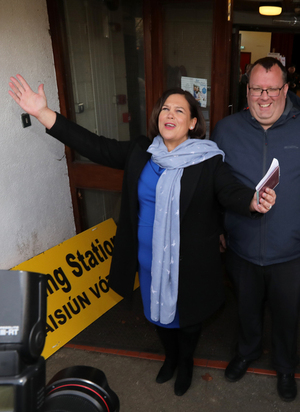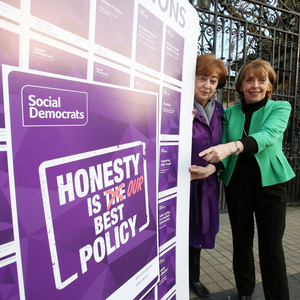
From top: Fianna Fail’s Jack Chambers and Claire Byrne debate climate change on RTE One’s Claire Byrne Live last Monday; Eamonn Kelly
They say you can’t put an old head on young shoulders, but with Jack Chambers someone has succeeded.
The only problem is, it’s not a wise old head, it’s just an old Fianna Fáil head, probably found abandoned in a storeroom after some 1980s cabinet reshuffle.
Jack went to the Parochial Interrupters School of Communications where arguments are won, not by logic, but by creating noise so that nothing is heard.
In Jack’s book that’s called a win. But that tackle he’s sporting is now widely recognised as so last century. The time when shouting at people was regarded as debate is long gone.
Once Claire Byrne got Jack mildly pacified, the conversation turned to carbon tax, a brilliantly vague political football to be humping around the place like we’ve all the time in the world.
The obvious questions were artfully avoided. Like for instance, will the billionaires be paying their fair share, or will it just be retail workers and civil servants footing the bill. Will the multi-nationals be fined, or will it be just families fined for burning the bale of briquettes they were given at the fuel poverty store?
Going on prior form you’d have to suspect the latter, with maybe campaigns launched by local councils involving undercover carbon wardens empowered to impose on-the-spot fines on casual farters.
The real problem with carbon tax was nearly touched on during the Claire Byrne show, but somehow the opportunity slipped away when everyone got distracted again by Jack Chambers yelling incoherently and jabbing his index finger at someone and everyone, making some lost point in a last gasp attempt to drag Fianna Fail back to yelling supremacy.
The problem with carbon tax, especially a carbon tax levelled at ordinary people, is our old friend late-stage capitalism.
Here’s how it doesn’t work.
An extra tax means that people will have to earn more money, which will put more pressure on capitalism to deliver more growth and jobs, which will mean further damage to the climate as everyone expands their operations to increase profits to pay their carbon tax. It’s like a snake swallowing itself.
A carbon tax only makes sense if you heavily tax the hundred or so multi-national corporations who are creating the bulk of emissions. They’re eating up the natural world for private profit, so that they can amass enough wealth between them to build orbiting space stations for themselves when the great extinction comes. Personally, I’d rather go extinct than live in a space station looking at old movies about how Earth used to be.
A crazy stat came up from an audience member on the show. Our sparrow population has decreased by 80%. Sparrows. They used to be the most common bird. Did you miss them? I bet you miss them now.
No matter how you spin the climate change argument it seems to always come back to the same question: do governments have the strength to take on the multi-nationals who are causing the bulk of emissions, or do the multi-nationals own all the governments?
The Long Game
Throughout history there have always been big brains working quietly away on some long game that no one else can see.
For instance, back when it was discovered that the world was round, the big brains realised that if it was round it was finite, as were all its resources, and so the British big brains, by way of the East India Company, set out to find out where everything was, doing an inventory like the world was a larder.
When nukes came on stream some big brains realized that the winners of a nuclear war would be those who first established an infrastructure among the ruins. Maybe print a newsletter declaring victory. To this end they factored into their targeting, safe zones to land engineers after the war.
Big brains of today are likely devising long-game strategies for any old climate extinction that might come along. The key to success in this venture, as any kid who ever played Monopoly will know, is to get all the resources first. Then you’re in business.
Once the apocalypse begins you can build your space station, commandeer Hubble, peer into the void for some other possible habitable planets while your floating around eating your squishy astronaut food.
Then, when the dust settles on Earth and everything is as dead as Mars, you can maybe look at building one of those domes you see in science-fiction movies and away you go again, publishing a newsletter declaring victory. Sound like fun?
The key to escaping climate catastrophe may be in trying to convince the billionaires that letting the Earth die in the interests of private profits might not be such a great idea after all.
And that they might be better advised to use the resources they’ve been squirreling away to do something heroic for a change, like maybe save the Earth, like a bunch of latter-day Flash Gordons, instead of milking all around them until the old sow is dead.
Because when it comes right down to it, if only a hundred or so companies are responsible for the bulk of climate damage, and since these companies are generally authoritarian in nature, it follows that only a hundred or so individuals need to be sold the idea of saving the world.
The hard part, for them, since they are all capitalists, is that this proposition will involve sharing, implicating them in an unholy redistribution of wealth, the very thing they’ve been brought up to condemn with every fibre of their wallets.
But as capitalists are often fond of saying, you can’t make an omelette without breaking a few eggs. In this case, you can’t save a planet without breaking a few out-dated cherished prejudices about wealth re-distribution.
An early socialist once said, what shall it profit a man if he should gain the whole world and lose his soul? In this case, what will it profit him to gain the whole world only to watch it wither?
But who’s going to tackle the billionaires and sell them the idea of climate heroism? Not Jack Chambers.
Shouting at them probably won’t work. Who’s going to say, it’s time to really invest in the future, men, and start putting the sparrows back in the trees.
Eamonn Kelly is a freelance Writer and Playwright.
Previously: Eamonn Kelly on Broadsheet
Watch back in full here
Yesterday: Horror Of Chambers