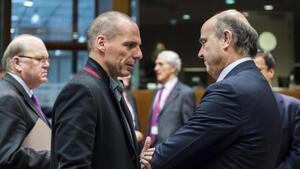

Top: Greece’s Finance Minister Yanis Varoufakis, centre, Spanish Economy Minister Luis de Guindos, right, Minister Michael Noonan, left; Above: Dr Julien Mercille
It’s 9.07am on Monday.
It’s Mercille on Monday at 9.07am
Dr Julien Mercille writes:
This week Greece will be front-page news again. Will the IMF and European authorities force Athens to implement even more austerity, or will they finally be more flexible and give Greece some breathing space?
One of the most important myths to debunk is that Greece has not done enough so far and has been slacking off in implementing austerity and reforms.
Nothing could be further from the truth. Greece has implemented austerity more deeply than any other country, and therefore provides the best example that this strategy simply doesn’t work to revive economies.
The UCD economist Karl Whelan wrote a good article a few days ago detailing how much “adjustment” Greece has already gone through:
– Public sector employment decreased by over 25%, from 907,351 in 2009 to 651,717 in 2014 (a drop of more than 255,000 people). Syriza plans to rehire as many as 15,000 employees, but this a tiny fraction of the drop in numbers.
– Greece was forced to reduce its public deficits from 15.6% of GDP in 2009 to 2.5% of GDP in 2014, “a scale of deficit reduction not seen anywhere else in the world” and which involved “massive cuts to public expenditure”, i.e. to services to the population.
– Pension reforms: this is a central aspect of the current negotiations. The perception conveyed by the media is that lazy Greeks retire early on fat pensions. But Greece has introduced long-term reforms in recent years, so that the retirement age will be increased significantly. Indeed, under those reforms, Greece will move from one of the lowest retirement age (at 62 years old) in the EU to one of the highest (at 67.5 years on average).
In addition, Yanis Varoufakis, the Greek Finance Minister, noted that since 2009, wages have been reduced by 37%, pensions by up to 48%, and consumer spending by 33%.
The result of this draconian austerity regime?
“Economic activity was choked, total income fell by 27%, unemployment skyrocketed to 27%, undeclared labour scaled 34%, public debt rose to 180% of the nation’s rapidly dwindling GDP, investment and credit evaporated and young Greeks, just as their Irish counterparts, left for distant shores, taking with them huge quantities of human capital that the Greek state had invested in them”.
Adding insult to injury is the fact that the German government, which is leading the charge against Greece, itself had its debt largely cancelled after World War II.
The London Debt Agreement of 1953 wrote down its outstanding debt by a significant amount and established a schedule that extended the repayments over 30 years, which allowed the country to recover and become Europe’s economic leader.
In the words of one analyst, the agreement was based on the premise that “Germany’s actual payments could not be so high as to endanger the short-term welfare of her people or her long-term ability to rebuild a shattered economy and society”. But the German government now is doing exactly the opposite to Greece.
In my view, the overarching point in the Greek saga is the extent to which European elites are opposed to real democracy, which goes way beyond simple elections. They are scared by the thought that people could have a say in policy and in decisions that affect their lives. The Troika imposes its will, and that’s it.
It’s the same thing in Ireland. When were you asked if you wanted to offer a blanket guarantee to the banks? When were you consulted about austerity? Did you ever agree to cut the funding of rape crisis centres throughout the country by 30%, just to make it harder for victims of rape to seek help?
Whenever people power emerges, it is opposed by the establishment. Syriza and Podemos in Spain are hated because they provide a message of hope and offer a clear progressive alternative to austerity. For the same reason, the media spends an enormous amount of time criticising the anti-water charges movement, Sinn Féin, and the smaller left parties like People Before Profit and the Anti-Austerity Alliance.
Another way to look at it is that even though the story is always presented in terms of “Germany vs. Greece”, this is misleading. The fundamental dynamic in Europe is instead that elites from all countries are acting in a loose alliance against ordinary people in all countries. That’s why Enda Kenny is siding with Angela Merkel and the troika against Syriza.
Therefore, grassroots cross-national solidarity is very important and offers one of the best hopes for both Greece and Ireland. If Syriza wins in Greece, and Podemos in Spain, they will support similar democratic movements here.
In this respect, there’s a group in Ireland called the Greek Solidarity Committee. It is composed of activists, academics and the five Right2Water trade unions (Mandate, Unite, CWU, CPSU, OPATSI).
They’ve organised various events and have brought to Ireland speakers from Greece. For example, one of them came to talk about the Greek water anti-privatization movement, making it obvious that the same issues affect people across Europe. Thus, information and experiences can be exchanged and built on.
Another simple way to increase democratic input in the Greek and Irish crises would be to proceed with so-called debt audits. You may never have heard about that because the media never talks about it, but it’s a very simple process.
Groups of citizens evaluate the whole debt of their country and examine which parts are illegitimate, illegal, or “odious”.
For example, should debts contracted by a military dictatorship be paid back by citizens? Should borrowings used to pay back bondholders that gambled on domestic banks be paid back by citizens? Or borrowings made under conditions of austerity which everybody knows worsens the economy? There’s room for debate here, but this is what real democracy is about.
For those who think this is utopian, the Greek government has just released its preliminary debt audit report last week. It was commissioned by the Syriza government and should be used as a basis to address Greece’s debt problems. Is that even imaginable in Ireland? Not under the current government, but if Syriza-Podemos waves come to our shores, it will be.
@JulienMercille is lecturer at UCD and the author of The Political Economy and Media Coverage of the European Economic Crisis: The Case of Ireland (2015, Routledge). His new book, Europe’s Treasure Ireland (Palgrave), will be out next month.