
Tag Archives: Homeless figures

Minister for Housing Eoghan Murphy and the Department of Housing’s homeless figures for March 2018

Earlier this week.

The Department of Housing released the official homeless figures for March 2018.

The March figures stated that there were 9,681 homeless people in Ireland using emergency accommodation during the week March 19 to 25 of this year.

This was a drop of 126 from the homeless figure of 9,807 in February.

Breaking down the decrease, the March figures showed there were 17 fewer adults, 109 fewer children and 19 fewer families homeless.

It should be noted that the department’s figures include the numbers of people living in Private Emergency Accommodation, which includes hotels, B&Bs and other residential facilities that are used on an emergency basis; Supported Temporary Accommodation, which includes hostels or accommodation with onsite professional support and Temporary Emergency Accommodation, which includes emergency accommodation with no or minimal support.

Earlier this week, the Minister for Housing Eoghan Murphy claimed that some local authorities had incorrectly counted some people as homeless and that, overall, the figures were overstated by between 600 and 900.

Further to this…

Sinn Féin TD Eoin Ó Bróin has released a statement, saying:

“This week, I have been talking to a large number of officials working in homeless services in Local Authorities and the voluntary sector, following Minister Murphy’s startling claim that 600 people were miscategorised by councils as homeless and wrongly included in earlier homeless figures.

“I am satisfied that the minister’s claim is false. These people, including many families with children are homeless and are in emergency accommodation arrangements funded by council’s homeless services.

“Despite this, the councils in question received an instruction to remove them from the March homeless report.

“The minister is guilty of knowingly manipulating the March homeless figures. In doing so, he has insulted the staff and management of the local authorities. Worse, he has insulted the adults and children who are homeless by trying to deny that they are living in temporary and emergency accommodation arrangements.

“Due to the dramatic rise in the number of families presenting as homeless and the lack of adequate emergency accommodation, councils across the country have had to develop ad hoc temporary emergency accommodation arrangements using a range of property types.

“None of these arrangements involve tenancy agreements. Rather, families are placed in temporary accommodation, while the council or voluntary sector organisations seek to secure the families permanent housing.

It is clear that Minister Murphy did not want the March figures to reflect the reality across the state, namely that levels of homelessness continued to rise and had finally breached the 10,000 number. Given that he claimed on Monday that most of the 600 people allegedly miscategorised have now been removed, it is clear that the true March figure is well in excess of 10,000.

“Minister Murphy must immediately clarify the situation. He must admit that he and his department officials instructed councils to remove families in emergency accommodation arrangements from the March homeless figures. He must apologise for the hurt his actions have caused. And he must republish the March homeless figures including all those people living in temporary emergency accommodation arrangements.

“Once again, Minister Murphy has shown that his priority is in the protection of his own political reputation rather than in solving the homeless crisis.”

Anyone?

Minister Murphy ‘knowingly manipulated March Homeless Figures’ – Ó Broin (Sinn Fein)

Rollingnews
Kitty Holland, in The Irish Times, reports:

“July saw the biggest monthly increase in the number of homeless children in Dublin since January 2016, and second largest rise since the homelessness crisis began, figures to be published on Friday show.”

“The data, from the Dublin Region Homeless Executive, also reveals that of the 215 families that Minister for Housing Eoghan Murphy said in May would be out of commercial hotels and in “family hubs” by the end of the summer, just 48 have made the move.”

“Despite his commitment that the majority of families would be out of hotels by the autumn, numbers have increased from 647 in May to 753 last month.”

“July was also to be the month no homeless family would be in a commercial hotel under a target set by Mr Murphy’s predecessor Simon Coveney.”

The number of homeless children in all forms of emergency accommodation in Dublin during the week July 24th-30th was 2,423 in 1,178 families.”

This compares to 2,270 children in 1,115 families in the week of June 19th to 25th, an increase of 153 children.”

Surge in number of homeless children in Dublin (The Irish Times)

Alternatively.

Pic: MIck Caul

Infographic and table from the Central Statistics Office

This morning.

The Central Statistics Office (CSO)  released its homeless figures from Census 2016.

The CSO writes…

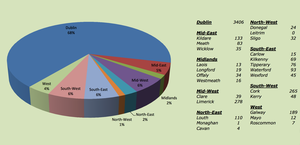
The report shows that, on the night of 24 April 2016 (Census Night), 6,906 persons were either sleeping rough or in accommodation designated for the homeless. Of these, 4,018 were male and 2,888 were female.

Specifically…

The average age of the homeless population was 31 years compared with 37 years for the general population.

Of the 6,906 homeless persons counted in Census 2016, 1,846 persons were aged 0-17 years, with 1,594 being children in family units. A further 413 persons (6%) were aged 60 and over.

On a marital status basis, 55% of homeless persons aged 15 and above were single, compared with 41% of the general population.

While almost 48% of the general population were married/remarried, only 9% of those homeless were.

The rate of separation/divorce was just above twice that of the general population, just over 12% compared to 6%.

Of those enumerated on census night, 22% did not provide information on this topic.

…There were 896 families among the homeless population, representing 2,968 persons, and accounting for 43% of all homeless persons.

There were 67 couples without children, 326 families with one child, 261 families with two children and 131 families with three children.

A further 111 families had four or more children.

There were 262 couples with children and 567 one-parent families.

Female parents accounted for 96% of all one-parent families.

Of the 5,212 homeless persons aged 15 and over, 2,915 (56%) were in the labour force, of whom 899 (31%) were employed.

A further 2,016 (69%) were either unemployed/looking for a first job.

There were 607 persons who were unable to work due to permanent sickness or disability, representing 12% of the total, compared with 4.2% of the general population.

Students accounted for 429 persons (8%), while 188 persons stated that they were retired.

Earlier: ‘No Homes Have Been Secured In Dublin’

Previously: A Good Time To Bury Bad News

A Rising Tide

Total number of people homeless in Ireland

Total number of homeless adults in Ireland

Total number of homeless children in Ireland

Total number of homeless families in Ireland

Total number of single-parent families who are homeless in Ireland

Further to the Department of Housing’s release of the homeless figures for June 2017 yesterday evening…

A few graphs (click to enlarge) which show how the number of people who are homeless has been rising steadily.

Readers will recall how June’s figures showed 7,941 people registered as homeless in June 2017, 5,046 adults and 2,895 children.

The overall figure represents an increase of 241 people since May 2017.

Previously: A Good Time To Bury Bad News


This just in.

The Department of Housing has published its official homeless figures for June 2017 – more than two weeks late.

The figures show 7,941 people registered as homeless in June 2017, 5,046 adults and 2,895 children.

The overall figure represents an increase of 241 people who have registered as being homeless since May 2017 when there were 7,699 people in total registered as homeless – 4,922 adults and 2,777 children.

The Department of Housing’s report can be read in full here