What is the legal basis for your contract with Irish Water?
Is it worth the paper it’s not written on?
We asked Legal Coffee Drinker what’s it all about?
Broadsheet: “Legal Coffee Drinker, what’s it all about?
Legal Coffee Drinker: “The authority to charge users of water for water charges comes from Part 3 of the Water Services (No. 2) Act 2013 , in particular Section 21, which says Irish Water “shall charge each customer for the provision of its water services in accordance with the approved water charge plan.”
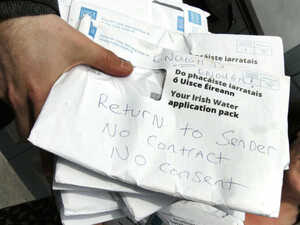
Broadsheet: “Some readers have suggested that there can be no legal charge in the absence of a contract between the user and Irish Water?”
LCD: “Not the case. The entitlement to charge derives from the Act and is not dependent on the presence of a contract. If Section 21 did not exist, a contract would of course be needed – but this is not the case.”
Broadsheet: “Doesn’t the word ‘customer’ in Section 21 imply a contract must exist?”
LCD: “No, because Section 2 of the same Act defines customer – somewhat sneakily – as “the occupier of the premises in respect of which the water supply is provided.” Occupation and provision of services, on its own, gives rise to liability for water charges.”
Broadsheet: “Even though it’s not enough to imply a contract?”
LCD: “Yes. Acts of the Oireachtas – like this one – can impose liability for charges even where no contract exists.”
Broadsheet: “Who sets the water charges?”
LCD: “Section 21 of the Act says Irish Water shall charge each customer for the provision of it by water services in accordance with a water charges plan submitted to and approved by the Commission for Energy Regulation. That’s the plan that’s recently been published (available here). There is provision for these charges to be varied by agreement between Irish water and the customer, but in the absence of such agreement it will be this plan which is applied.”
Broadsheet: “So what happens if you don’t pay these water charges?”
LCD: “You can be sued in court for a debt and judgment given against you for the sum owed. This judgment may be enforced by the Sheriff in the usual way. In addition, if you are a business, your water can be cut off or reduced for non-payment. Section 21(8) of the legislation prohibits the cutting off of water in respect of domestic principles, possibly because of constitutional concerns (there are South African cases holding the cutting off of water to dwellings for non-payment of charges unlawful).”
Broadsheet: “Can the water charges plan be challenged?”
LCD: “The Commission decision approving the plan is judicially reviewable and can be challenged if the scheme provided for in the plan breaches the principles and policies of the Water Charges (No. 2) Act 2013. Alternatively it can be challenged or on other judicial review grounds (e.g. bias, breach of legitimate expectation, taking into account irrelevant considerations, ignoring relevant considerations). In exceptional circumstances ‘unreasonableness’ may provide grounds for judicial review but it is a very difficult criteria to satisfy. Finally it can be challenged on the basis that it breaches constitutional rights (see below).”
Broadsheet: “So the Water Charges regime is subject to constitutional scrutiny?”
LCD: “Yes. Like every statutory provision in Ireland, the Water Charges (No. 2) Act 2013 and the Plan approved under Section 21 apply only to the extent that they are constitutional and, if there is a doubt about their constitutionality in some respect, the courts are obliged to interpret them to give a constitutional interpretation if at all possible [drains coffee].
We have no express constitutional right to water in Ireland. However it is at least arguable that some sort of right to water to domestic premises is implicit in the human rights guarantees in the Constitution, and the legislature has implicitly recognised this by prohibiting the cutting off of water to domestic premises.
Whether or not this is a right to an unpaid supply of water is an entirely different matter; it is unlikely that persons in good financial circumstances would be deemed to have their constitutional rights breached by being charged for water. The situation might be different, however, in cases of financial need where someone was genuinely unable to meet water charges. It will be interesting to see what happens on this in the future.”
Broadsheet: Thanks Legal Coffee Drinker. You’ll need a drop of water yourself after all that!
LCD: “No.”
Broadsheet: “Let’s hope you aren’t an Illegal Water Drinker!”
LCD: “Look, I have to go.”
Broadsheet: “Thanks very much Legal Coffee Drinker. Bye. Sorry.”
Pic: Irish Water