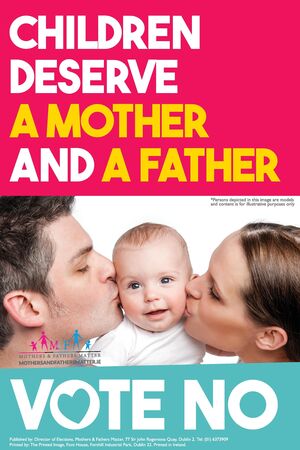
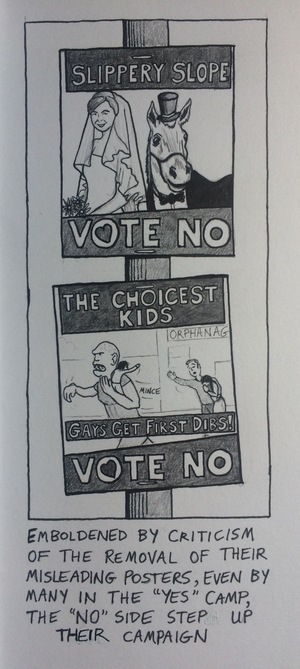
Most of you will have received a fancy brochure in your letter box telling you “7 Great Reasons to Keep Marriage as is”. The well-funded group “Mothers and Fathers Matter” are advocating a no vote in the upcoming referendum quoting evidence that two married parents, a male and a female, provide the optimal family for raising children.
Kate Bopp, of this group, announced that “studies have shown that teens who have grown up without a father are more prone to crime, they have greater presentations of emotional distress: volatile anger in young men and boys, and young women tend to gravitate towards abusive relationships”.
This is not the case. This is the classic misinterpretation of research which continues to be presented as fact; where association is interpreted as causation. Yes, family type matters, but they do not “cause” children to grow up unhappy, under-educated or prone to crime.
Growing up in Ireland, the national longitudinal study of children in Ireland provides a rich source of data on contemporary families in Ireland.
Brendan Halpin and I investigated the effects of growing up in a one parent family, examining data from over 8,000 nine year old children from this study. We concluded that marriage does not have a major direct influence on child development.
Across 14 measures collected from parents, teachers and the children themselves, differences across family types were indeed evident. In other words, growing up in a one parent family is associated with lower educational scores, lower levels of school attendance, and negative self-concept among 9 year olds.
However, these children are more likely, on average, to live with a mother who has low levels of education, to live in poverty and to attend a DEIS school – just to name a few important factors that differ across families and which should be taken in consideration.
Once you take account of the wide array of ways in which resources differ across family types, children whose parents were not married look remarkably similar to those whose parents were married on all these measures.
The reason for differences in child development is therefore not the marital status of parents, but rather child development is strongly related the background characteristics of the parents, particularly the mother’s education.
In a separate study, Prof Tony Fahey confirmed these findings and advocated a reform to the social welfare system so that income supports would be directed at families on the basis of their low incomes rather than the residential status of parents.
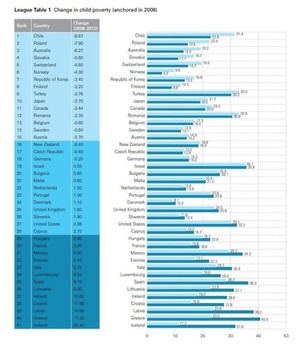
If we want to focus the debate on marriage equality on child development, the largest issue we need to address in this regard is the growing rates of child poverty.
The child poverty rate as measured by Eurostat rose from 18% to 28.6%, between 2008 and 2012, an increase of 10.6%. This corresponds to a net increase of more than 130,000 poor children in Ireland (UNICEF 2014).
The resources available to parents – be they black or white, old or young, gay or lesbian – is what really matters.
Parental access to education, access to childcare, employment opportunities that fit with the realities of every day family life are just some of the issues that need to be addressed. Irrespective of family structure, we want parents to be able to give children the best possible start to life.
Reason 7 to keep marriage as is states that “Every Child Deserves a Mother’s Love” rather every child deserves a roof over their head, food in their belly and access to a school of choice.
Dr Carmel Hannan is a Lecturer at the Department of Sociology, University of Limerick and a contributing author to a new book on “The ‘Irish’ Family” (Routledge 2014). Follow her on Twitter @CarmelHannan