Tag Archives: Mary Lou McDonald

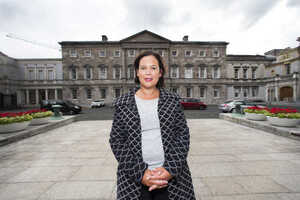
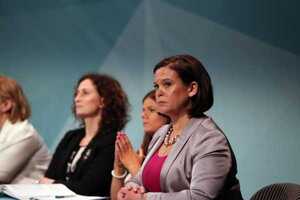
Sinn Féin president Mary Lou McDonald with Lousie O’Reilly TD this morning

The Sunday Times/B&A poll suggests Sinn Féin are the most popular opposition party, up 3 points to 24 per cent support.

They’ve overtaken Fianna Fáil who are down 2 to 23 per cent.

New Sinn Féin leader Mary Lou McDonald has a satisfaction rating of 52 per cent, one per cent behind Taoiseach Leo Varadkar.

The poll also suggests a three point drop for Fine Gael who are down to 30.

That poll was done between May 3rd and 15th among 935 people.

However…

The Sunday Business Post/Red C poll puts Fine Gael up 2 to 34 per cent, Fianna Fáil unchanged on 25 per cent support and Sinn Féin up 2 to 16 points.

Their survey of 1000 adults between May 10th and 16th suggests people are putting the blame for the CervicalCheck scandal at the feet of the HSE.

Sinn Féin see approval rating boost under new leader Mary Lou McDonald (Irish Examiner)

Rollingnews

This afternoon.

Leinster House, Dublin 2/

Eili Nic Mhathúna aged 2 (top) among Pro-Life activists urging the Health Minister “to protect women from the abortion industry while, above, Sinn Féin Party leader Mary Lou McDonald talks to the media as Dáil and Seanad colleagues mark International Women’s Day with a protest urging support for the “Votes for Repeal” march (see below) and rally this evening.

Leah Farrell/Rollingnews

Free tonight?

Votes For Repeal 2018 Rally

Earlier: A Pro-Life Pattern

Update:

This evening.

Dame Street, Dublin 2.

Pics: Mark Stedman

Last night.

Gresham Hotel, O’Connell Street, Dublin 1

Sinn Fein deputy leader Mary Lou McDonald ran unopposed as a candidate in the Dublin Central Constituency and formally announced her wish to replace Gerry Adams as President of Sinn Féin.

Touching on recent bullying allegations against the party, Ms McDonald said:

“Where relationships break down or rivalries take hold, where disciplinary issues emerge, it is important that we remember why we each joined Sinn Féin, what we are about as republicans, that we put front and centre our political ambition for a united, equal Ireland

“…It is also important that the rules of the party are respected by every member of our party and that they are applied fairly.”

Ms McDonald also signed the Sinn Féin General Election pledge…

Gulp.

Mary Lou McDonald wants to replace Adams as Sinn Fein president (Belfast Telegraph)

Rollingnews

This afternoon.

In the Dáil.

During Questions on Promised Legislation.

Sinn Féin deputy leader Mary Lou McDonald spoke about the late Dara Quigley and her question was responded to by Minister for Justice Frances Fitzgerald.

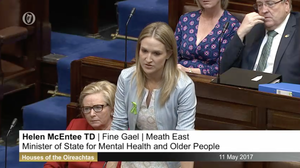
Mick Barry, of the Solidarity-People Before Profit party, also spoke about Dara and Fine Gael’s Minister of State for Mental Health Helen McEntee responded to him.

Their exchanges:

Mary Lou McDonald: “Tánaiste, yesterday, the Taoiseach indicated that you would be more than happy, in fact delighted, it seemed, to come before the House and make a statement on the matters surrounding Templemore and some of the issues that we touched on and Leaders’ Questions. You also indicated that you would be quite happy to take questions in that regard. So I want to know, when you propose to do that.

“And can I also say, Tánaiste, when you take to your feet  on that occasion, I would like you also to shed some light on the case of Dara Quigley. A young woman who died by  suicide on April 12. She had been detained by gardaí some days previously, under the Mental Health Act. She had been walking naked on a Dublin street when detained and Garda CCTV footage of this detention  was posted on Facebook. A really deplorable and revolting turn of events and something that has brought great hardship to her family and clearly brought very, very great distress to Dara. So we mark her passing and when we talk about Garda culture and reform and accountability, I suppose this the rawest end, the sharpest end of deplorable, a deplorable culture of humiliation and disregard for human beings.”

“So, Tánaiste, I hope that you will, as the Taoiseach promised, come before the House, make your statement, take questions and I hope also that you might shed some light on the accountability that will be held for the life of Dara Quigley.”

Frances Fitzgerald: “Well, in relation to the individual case that you mention, deputy. Everybody would be totally disturbed and appalled by the story that has been reported in the media and actions are following on from that. As you know, that has been reported, there is an investigation and there is a GSOC inquiry but, just to say, of course our thoughts are with, are with that young woman’s family, given the appalling and very, very sad sequence of events. No doubt, the business committee can discuss the question of ministers appearing before the Dáil and, certainly, I want to make the point that, I don’t want to cut across in any way the work that the Public Accounts Committee is doing in relation to Templemore.”

…

Mick Barry: “There has been media comment on the circumstances leading up to the death of the journalist and blogger Dara Quigley. Very serious questions have been raised about the Garda Síochána and their treatment of the most vulnerable in society. I want to leave those questions for another day.”

“Today, I want to ask you a question on dual diagnosis. Dara suffered and struggled with both addiction and mental health problems. She received help from many agencies but what was available was not sufficient. A particular problem was the lack of dual diagnosis services for psychiatric and addiction problems are treated together in a professional and properly funded manner. My question to the Tánaiste: does she see a legislative pathway to addressing this problem?”

Helen McEntee: “Just to join you in offering my condolences to her family and to her friends. This is, you know, it’s an absolutely terrible situation and it’s deplorable what has happened consequently since. The issue of dual diagnosis is something that we haven’t dealt with in the past and we know that in a significant number of suicides, there is a link between drug or alcohol use as well. We’re currently developing a clinical programme on the issue of dual diagnosis.”

“We’ve appointed a national clinical lead who will be working to develop a programme which means that if somebody is suffering from either a drug or alcohol problem that is leading on to a mental health problem, that there will be a clear clinical pathway for our doctors and nurses within our acute hospitals but also in our primary care settings so there’s work well underway and we’d be hoping to continue that into the year.”

Watch Dáil proceedings live here

Screen Shot 2016-07-21 at 12.20.51

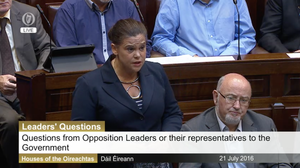
Sinn Féin TD Mary Lou McDonald during Leaders’ Questions today

“Tánaiste, I wish, this morning, to raise with you the issue of mental health and suicide prevention. Yesterday, the coroner’s court held an inquest into the death by suicide of a young man in November, 2014.

This man was Ryan Dempsey, from The Liberties.

He was in his 20s, he had his full life ahead of him and he was clearly a young man at risk.

He’d been discharged five times from accident and emergency in a six-month period before his death.”

Taking an overdose, on one occasion, he was brought to the A&E, and was discharged on the same day. Found hanging another time, brought to the A&E, discharged 12 hours later.”

“The following day, he tried to throw himself out of a window, again, brought to the A&E and discharged within hours.”

“On the final occasion, he presented himself to the A&E, he was expressing suicidal feelings. He, Tánaiste, was left in a room by himself, where he attempted to cut himself twice.”

He was then transferred to a ward, left on his own again, and Ryan hanged himself and he died.

“…Tánaiste, we failed Ryan. The health system failed Ryan and how different it all might have been if Ryan was provided with the proper follow-up care on his first presentation.

His family believe that he was not assessed properly, he was not observed properly, his care was inappropriate, inadequate, right up until the time that he took his life.”

“Ryan was failed by the mental health service, which simply does not function at the times when people need it. Accident and Emergency (A&E) is not the right place for people in acute, mental distress.”

“So we need to fund the delivery of community and early intervention services, as was promised ten years ago in Vision For Change. And yet, ten years on, we still don’t have 24/7 crisis intervention services. Not a single crisis house has been established and, at present, there are just 15 suicide crisis intervention nurses in the State.”

“People in distress present themselves to the Gardaí, to the A&E, places where over-stretched and, sometimes, inappropriately trained staff struggle and do their best but they’re not capable of proving the appropriate care.”

Sinn Féin’s Mary Lou McDonald speaking in the Dáil in the last hour.

Watch today’s Dáil proceedings – the last before the summer recess – live here

Screen Shot 2016-06-23 at 12.12.04

Sinn Féin TD Mary Lou McDonald

“I want to raise the issue of homelessness with you, Tánaiste, and I want to do so in telling you about Áine. She’s an 18-year-old young woman and on Tuesday of this week, she presented as homeless to her local council, along with her partner and their four-month infant daughter.”

“The council refused to accept that she was genuinely in need of emergency accommodation and she was turned away. At 4.30pm that afternoon she rang the freephone number but no emergency accommodation was available. At 9pm that night she again to be told that there was still no emergency accommodation.”

“Eventually, at 12.30am, standing outside Heuston Station, shivering and holding her infant child, she was collected by the Rough Sleepers Team and brought to a hostel.”

“Now Áine, Tanaiste, is just one of 10 families turned away from local authorities on that day, on Tuesday, only later to be accommodated throughout the Rough Sleepers Team. The last of the families wasn’t accommodate until 1.30am in the morning.”

“Yesterday, Áine returned to her local council only to be turned away again. She was eventually accommodated by the freephone at 8pm in the night and, as we speak Tanaiste, this young woman is yet again on her way back to her local authority not knowing where she and her family will sleep tonight.”

“And the reason why families are being turned away from the local authorities is because there isn’t enough emergency accommodation and staff in local authorities are being asked to make really an impossible choice between families – between those who will have a bed and those who are sent back out onto the street.”

“Tanaiste, I could read out the statistics and you will know homelessness is out of control, you will know that on the watch of your Government, homelessness has increased by 86% in one single year…”

Sinn Féin TD Mary Lou McDonald speaking during Leaders’ Questions, recieved by Tánaiste Frances Fitzgerald this afternoon.

Meanwhile….

12278983_1072764386069318_8354732594761274221_n

Brú Aimsir Hostel

You may recall how Brú Aimsir Hostel opened at the Digital Hub on Thomas Street, Dublin 8 last year – as part of Dublin City Council’s Cold Weather Initiative.

Last month, the 100-bed facility was to close down – prompting residents of Brú to hold protests against the closure.

Further to this…

Dublin City Council writes:

[Brú] was due to close at the end of March but its closure was deferred until May 31, due to cold weather in March and April. In anticipation of a closure by May 31, an orderly wind down of the facility was commenced and the number using the facility on a nightly basis was reduced to around 40.

However, in light of the continuing increase in the numbers sleeping rough in the Dublin region and following the intervention of the Lord Mayor Críona Ní Dhálaigh, agreement has now been reached to extend the use of Brú Aimsir and to operate it at full capacity.

Previously: Meanwhile, At Brú

Nama Wine Lake Writes

90391572

Sinn Féin deputy president Mary Lou McDonald

The ‘Ra ‘under the bed’.

Recent poll setbacks.

Jeremy Corbyn.

Sinn Féin’s Mary Lou McDonald talked to Miriam Cotton last night for the ‘sheet about all that and why few understand the troubles she didn’t see.

Miriam Cotton: “[Garda Commissioner] Noirin O’Sullivan and [Minister for Justice] Frances Fitzgerald have clarified the situation with regard to the IRA and have confirmed that it has been disbanded. But concerns remain, they say. Isn’t it true that Sinn Féin hasn’t done enough to distance itself from former paramilitary associates? Surely the party has intelligence about suspected or known criminal and vigilante activity among these former associates that it could share with the PSNI, for example?”

Mary Lou McDonald: “The position as regards the IRA has been clarified in the way that you describe but I have to say that, for anybody like me who grew up in Dublin at a distance but with the troubles, as they were called, as background noise – and certainly for people living in the North of Ireland – it is manifestly the case that the IRA has gone away. Its military structures have been disbanded, its weapons have been decommissioned and there is a process of peace – an imperfect one, albeit. We are on an incomplete journey as of yet, it is true to say, but nonetheless a very robust process has been put in place.
As regards what Sinn Féin can do, the record of the party and the party leaders stands on its own merit over the last 20 years or so. Certainly, in the here and now, I think it is most unreasonable and really a bit of a try-on for other political parties and other entities to demand that Sinn Féin be answerable for the criminal actions and misdemeanours of those who may have had an association with the IRA at some stage in the past. That is not a reasonable ask if you consider that thousands – or tens of thousands – went through the prison system in the course of the conflict. Are we therefore saying that Sinn Féin is to be answerable for any misdemeanour or criminal act that any one of these individuals might have been involved in? That’s absolutely crazy. The job of keeping the peace and enforcing law and order and of upholding the law in general rests in the hands of the PSNI, An Gárda Síochána, the Revenue Commissioners where appropriate. And we, like any other citizens, expect those agencies to carry out their tasks and their functions.”

Cotton: “Why do you think [northern Sinn Féin boss] Bobby Storey was arrested?”

McDonald: “Bobby Storey has set out in no uncertain terms his deep, deep concern and indeed anger at his arrest. He has said categorically that there was no evidence produced, not a shred, no intelligence produced – again not a shred either to him or to his legal representatives as to why he was arrested and detained. As you are probably aware, that will now be the subject of a legal action by Bobby Storey who has instructed his legal representative. Obviously this will also be raised within the accountability mechanisms that oversee policing arrangements in the North. As a political leadership we are seeking a meeting with [PSNI chief] George Hamilton to put our very deep concerns to him and equally will be raising them with the Taoiseach and the Prime Minister. I can’t answer as to why this arrest happened. What I can say is that the persons arrested were released after the 48 hours unconditionally and certainly in the case of Bobby Storey – I can’t speak for anybody else – but in his case his arrest appears to have had absolutely no foundation in fact.”

Cotton: “Is there anything Sinn Féin could have done differently to avoid the latest collapse in the Stormont government?”

McDonald: “Well, bear in mind that long before the atrocious, cold-blooded murder of two men on the streets of Belfast – in the Markets and in East Belfast – before they were seized on by those who wished to posture for their own political advantage, there were problems within the system and within the Assembly and the Executive and they largely centred on and remain centred on issues of a budgetary nature. There has been a very substantial cut to what is called the Block Grant. Further cuts are envisaged – swingeing Tory austerity and a part of that are proposals to introduce what are euphemistically referred to as welfare reforms but in fact amount to welfare cuts. Certainly the British government was very keen to strong-arm the Assembly and its parties, including ourselves, to administer and introduce these cuts and we have refused to do so.”

“Sinn Féin led the charge in that regard as had the SDLP. Unionism had to an extent joined our efforts to face down the British administration. We did arrive at an accommodation in Stormont House last Christmas if you recall, but unfortunately when it came to implementing that particular agreement, what we understood to have been agreed in respect of protecting current recipients, Unionism was not prepared to honour. Therein lies the immediate, if you like, wrangle in respect of budgetary matters. But there is also a longer term issue and it relates to the fact that the Assembly and the Executive don’t enjoy fiscal powers and this is something that we have been raising consistently. We have been saying that where the Executive and the Assembly are to run public services, ensure their smooth and efficient operation, engender a climate of enterprise, create job opportunities and so on, it’s illogical to make that ask of an Executive with both hands tied behind its back. So our view is that every sensible person who wishes to see a dynamic economic environment, who wishes to see fully resourced and quality public services must surely understand that the sensible, pragmatic thing is for fiscal powers to be vested in the Assembly. We have made progress in respect of the issue of corporation tax although that discussion is not fully complete but we believe very strongly that the full range of tax-raising powers must be vested in the Assembly. I know that is a long answer but there are certainly short-term, immediate budgetary issues in respect of so-called welfare reform and in respect of getting a workable budget for the North as a community coming out of conflict and in a very particular, special case confronting very specific issues. There is also then the much longer term trajectory of creating a scenario in which economic dynamism and growth and quality employment and job opportunities are made and created. You have to be given the toolkit to make those things happen.”

Cotton: “What efforts have Fine Gael and Labour made to work with Sinn Féin to resolve the present situation? They have spoken with other parties in the North – have they approached you with any constructive suggestions?”

McDonald: “No, not so far and over the last four and a half years we have been raising, particularly our leader Gerry Adams has been raising, with the Taoiseach the fact that the Taoiseach has been very disengaged from developments in the North. The government as a whole have not demonstrated any appetite or any understanding for developing the peace process and moving it forward. They seem to forget that they are guarantors of internationally binding agreements. In respect of the most recent turn of events, I think they made a number of very clumsy and ill-conceived interventions. I attended a meeting alongside Gerry [Adams] with [Minister for Foreign Affairs] Charlie Flanagan where he tried to sell the idea of an adjournment of the institutions. We absolutely rejected that and subsequently the Assembly Business Committee very sensibly rejected that proposal.”

“We had to explain in some detail that you cannot allow events in the criminal justice system and criminal acts on the streets of Belfast to be used and manipulated in such a manner – to destabilise, to undermine or to adjourn and suspend democratic institutions and democratically mandated representatives. We are not going backwards to that place, it’s not going to happen. I very much hope that in the time ahead the Taoiseach and the entire government will be constructive and will understand now the seriousness of where things are at – and the depth of their own responsibilities in respect of things in the North.”

“Needless to say some of the comments over the last number of weeks from the likes of Joan Burton, from Enda Kenny – and from Micheál Martin perhaps most notably, demonstrated a really craven level of political opportunism. They seem to misunderstand entirely the implication of their posturing. It seems to me that there is almost an irresistible temptation in the mind of Micheál Martin and Joan Burton – and sadly it seems Enda Kenny to play fast and loose with the institutions for the sake of a couple of percentage points in the opinion polls. That to me is no way to govern.”

Cotton: “What is your response to Arlene Foster in her role as First Minister in particular to her comments about the trustworthiness of nationalists?”

McDonald: “Well, I think they are very, very obnoxious on one level and they represent very unacceptable commentary. When I heard what Arlene had to say I was reminded of that old phrase ‘not a Fenian about the place’. That seems to be the place where they are coming from. I suppose Arlene needs not just to understand but to start articulating very clearly that the days of single party rule, of unionist domination and so on are gone. They are not coming back ever and those with democratic mandates, including Arlene by the way and her party, and those in unionism, nationalism and republicanism – are there absolutely, correctly on a democratic basis and really to start that kind of nonsense and that kind of lowest common denominator politics is certainly not helpful. I would have to say I don’t think her comments do her any credit as the acting First Minister.”

Cotton: “What do you think will happen to the investigation into NAMA-related activities and the issues that have been causing concern there.”

McDonald: “Because the institutions have remained live and have remained up and running – certainly our ministers are at their desks and will be working in the days ahead – as is the finance committee which as you know is chaired by my party colleague Daithi McKay. Evidence has been heard by that committee. And of course here in the South, NAMA are due to appear in front of the Public Accounts Committee on the 1st of October so we will be following all of these matters with great interest and what is an unfolding scandal, we believe. I think we have only seen the tip of the iceberg. It’s on one level a very complex story that’s emerging but the concerns that arise around the governance of NAMA, I suppose close political circles, concerns about corrupt or corrupted process, suggestions of corrupt payments. All of these are of the utmost concern and it’s very important that those of us living in the southern jurisdiction understand that, although much of the intrigue has played out or centred on the North, this is a national story because of course NAMA is in the final analysis a creature of the Oireachtas. It is the Minister for Finance, Michael Noonan and indeed An Taoiseach who ultimately are answerable for any flaws, for any malpractice or for anything more serious which might emerge in the coming period . It is still a matter of astonishment to me that although Michael Noonan knew that the initial bid for Project Eagle’s Northern loan book had been compromised and corrupted in a most serious manner where backhanders were sought essentially from a bidding entity but he still went ahead and didn’t suspend the process. He allowed the process to continue albeit with different bidders. That to me is an astonishing way to carry out your business – and also that Michael Noonan didn’t deem it necessary, or the southern government didn’t deem it necessary to inform the Office of First and Deputy First Minister as to what had happened. Astonishing, astonishing stuff.”

Cotton: “You were born in 1969 and were saying earlier that you had no immediate or direct involvement in the war that went on in the North and that the peace process is moving on for people like you and for everyone involved. By the same token isn’t it true that while Sinn Féin is led by people so closely identified with its paramilitary past that the party is unlikely to lead a government? Given the sensitivity of the situation for people who were personally affected and the political capital that your opponents in Fine Gael, Labour and Fianna Fáil in particular are able to make of the situation while Gerry Adams, Martin McGuinness and others are still in charge, wouldn’t it be better for everyone if they moved on too?”

McDonald: “Well, the prerequisite for Sinn Féin being in government is enough votes and a sufficient mandate for that to happen. So, actually, in real terms that decision is in the hands of the people not in the hands of Enda Kenny, Joan Burton, Micheál Martin or anyone else. It’s a democratic decision that the electorate has to take. I do take your point that there are those in politics and I would also have to say that in politics and in the media and in particular in Independent News and Media there are people who view the past and the conflict and all the rest of it as fertile ground to have a go at Sinn Féin and to have a go at republicans. You know they absolutely forget or omit to give all of the other dimensions of what happened in the course of the conflict in respect of the British state, the RUC, Loyalist paramilitaries who as we know colluded with the British state and were their proxies in many cases. None of that gets any airing.”

“You’d imagine that the conflict was entirely one-sided and of course they will seek very cynically, I believe, to make hay with that. But what they cannot do though is to deny what is self-evident on the streets particularly in the North and that is that the situation has been utterly, utterly transformed. Nor that the process although very challenging initially and challenging to this day is now embedded and that Sinn Fein and Irish republicans right across the country and indeed beyond are absolutely wedded to this process and determined to make it a success. The propaganda attacks from the outside will not deter us from this course. If someone was to leave Sinn Féin it’s not the case that the negative elements would simply give up the ghost and go away. There are certain people who have a particular view which is hostile to us and to the politics that we represent, to the challenge that we represent to the status quo and to the project that we have for a United Ireland, a democratic Ireland, an equal Ireland. They will come at us with whatever they can reach for to try and stop us in our tracks. That’s the reality of it. Would that change irrespective of who was leading the party? I don’t think so. I would also say that as you cited specifically Gerry Adams and Martin McGuinness I’m very proud that they are our leaders and I think they are two outstanding leaders and I think that when the history books are written that will be well recorded.”

Cotton: “Fine Gael has seen an increase in popularity according to the latest Red C poll. Would you be concerned that this is the beginning of a slide in Sinn Féin’s popularity and what do you think accounts for the poll?”

McDonald: “Well I suppose with opinion polls you have to read them on trends and I still believe the trend for us is extremely strong and that we’re in a good place. Obviously I don’t underestimate that we need to get out there and get our message across and win every vote that we can and convince every voter that we can. I take no vote bar my own ever for granted and I’m reluctant to read a single opinion poll in isolation but I do note that when the Dáil isn’t sitting that you tend to see a recovery in the polling performance of government parties because obviously the Dáil isn’t in session and they are not being held to account for whatever the goings-on whether it’s Fennelly, or whether it’s the manner in which they have bungled and mishandled the crisis in the North. I think that’s an element of it. But look, without wishing to sound clichéd the only poll that will actually matter is the poll on the day whenever the Taoiseach calls the election and people finally make up their minds. There is of course a danger that people lapse into the traditional patterns of voting but given everything that has happened over the last number of years I think a huge number of people have become politicised. I think a huge number of people now look at Irish politics differently than they would two or three or four or five years ago. I think there is a real appetite for change but I think that people want to know that this change is real and concrete and that it’s not simply pie in the sky or rhetoric and that is the challenge for the likes of us in the election, to demonstrate that change is possible, that change can be real.”

Cotton: “There’s definitely a concern abroad that whatever politicians may say in opposition if the opportunity presents itself to get into government with Fianna Fail or Fine Gael, despite all the promises they are prepared to abandon all their principles to get there.”

McDonald: “That’s a huge problem and it’s at the root of an awful lot of people’s cynicism. I understand that, I completely get that. When you heard, for instance Pat Rabbitte saying as regards the Labour Party’s broken promise ‘oh sure that’s what you do in an election’ – when senior figures from the Labour Party are saying that out loud sure little wonder that people are cynical so I understand that. I would see it as our job during the course of the campaign – and after the campaign whatever the outcome is to demonstrate that in fact there are those of us in political life who put a premium on not just making promises but on holding to them – and being held to them after the fact. I think that’s absolutely essential.”

Cotton: “What do you think is the significance for people in Northern Ireland of the election of Jeremy Corbyn as leader of the UK Labour Party and could he help to resolve the present crisis?”

McDonald: “Well, Jeremy is a longstanding friend of Ireland as you know. He is certainly a person who has never been afraid to take a principled stand on issues that he believes to be right and to face down, even when it wasn’t popular to do so, things that he believed to be wrong. So I believe that Jeremy is an extremely honourable man and I’m very pleased and indeed delighted for him that he has come through and that he has won this great victory.
He will now in the first instance I suppose have to sit down with his colleagues and take stock and then set out their priorities and their stall. I would of course hope that the British Labour Party would be extremely supportive of our efforts starting [today] to straighten matters out, to ensure that we achieve a workable budget for the institutions and then moving forward to look specifically at the issue of the transfer or devolution of powers.”

“I would hope that the Labour Party would be a helpful, proactive and positive influence in that regard. Bear in mind also that whatever the differences, and they are quite considerable between Jeremy and his predecessor Tony Blair, it would have to be said in a spirit of fairness that the contribution of the Labour Party under Tony Blair’s leadership to developing the peace process was very, very considerable. So I suppose the Labour Party has more skin in the game than the Tories in respect of building peace in Ireland.”

FIGHT!

Miriam Cotton is a freelance journalist and founding editor of MediaBite

 Pic: RollingNews.ie

90361464

_81535096_paudie1

90372989

From top: Mairia Cahill, Paudie McGahon on BBC Spotlight and Mary Lou McDonald

Sinn Féin deputy leader Mary Lou McDonald went on Today with Sean O’Rourke on RTÉ Radio One this morning to defend Sinn Fein’s record on reporting of sex abuse within its organisation  and answer allegations made by Paudie McGahon that he was sexually abused by a member of the IRA and then subjected to an internal IRA kangaroo court.

Sean O’Rourke: “Now I gather you heard what Mairia Cahill had to say at the top of the programme. Are you, as she suggested you should be, raising merry hell in Sinn Féin about all of this?”

Mary Lou McDonald: “Well, I’m as disturbed and upset for Paudie, and indeed Maria, as anybody else, listening to their stories, and I’m as anxious as the next person that they achieve justice and I’m, em listened to what Maria had to say and I also got a chance to listen to Paudie, he was on your rival radio station, and, to my way of thinking Paudie has said something very important and he has said it far more eloquently than I can, and I want to reiterate it, and that is that nobody should be afraid to come forward and I’m very anxious that that message would go out that any one who has experienced any kind of sexual violation, the trauma of a rape, however long ago, at the hands of whomsoever but in this instance we’re talking about those that would have called themselves republicans, perhaps IRA volunteers or anybody else, Paudie has said it and he has it in one, no body should be fearful, nobody should be afraid, the only way that we deal with the insidious and awful crime of child sex abuse and sexual violence more generally is when people feel comfortable and empowered to speak out.”

O’Rourke: “But I suppose people are…”

McDonald: “And I want to commend Paudie and indeed Mairia Cahill, both of them, for doing that.”

O’Rourke: ““Now you are saying this and people may or may not take it at face value. i suppose the problem is, when they look at the Republican movement, they hear not just you but they read, albeit something that’s been withdrawn and apologised for, people like [Sinn Fein councillor] Francie Molloy saying another load of rubbish on Spotlight, joint Indo-Blueshirt Production or whatever and they see as well that while you may accept he is telling the truth about being abused, immediately the details are seized on of his story and they are denied about for instance how the IRA dealt with him in the aftermath and they look as well at situations like what happened int he aftermath of the murder of Robert McCartney but all these calls of that type ‘oh come forward tell all you know’ and nobody comes forward.”

McDonald: “Well I hope that people will hear my words and more importantly Paudie’s words and take them beyond face value, I say that, and I mean it, Sinn Fein representatives have said it and it’s been re-echoed and we mean that, and we mean that most sincerely, I would have to say to you that in circumstances where abuse occurred, in any scenario it’s never easy for people to come forward and I understand the difficulties very very, very very clearly m self in regard to that but I just want to repeat that in order for justice to be served and there is an ongoing garda investigation in respect of Paudie’s case, albeit very belatedly, I know all of us wish that investigation to be speedy and to be successful and anybody else out there who has had a similar experience needs to come forward, and then it is a job for an Garda Siochana to investigate matters.
To, just to take the point of you saying that people are picking over details, here’s the position and let me specify it to Paudie since his story, he has come so recently and told his story, the position is this, Paudie tells the story of his abuse he alleges a particular individual who allegedly was a member of the IRA who allegedly was in his home in a spirit of good trust and good faith, just to say to your listeners I’m using those terms very carefully because I’m conscious there is an investigation under way.
Paudie has named a particular individual in respect of what he says was an IRA investigation the person that he has named has refuted through their legal representatives that it was them at all and has said that they’re happy to co-operate with the Garda Siochana to clarify that matter and then you come to somebody like me and you ask me questions about it and the only thing that I can say and I think in all fairness the only thing you could say if you were called on to make any kind of definitive statement about this is that the Gardai are best placed to actually adjudicate what precisely happened and I want to emphasise…”

O’Rourke: “Well I’m not sure that they are, actually. If they don’t get the full co-operation they’ll find out nothing.”

McDonald: “Oh, well they need to get full cooperation.“

O’Rourke: “Well do you think the Gardai are in a better position to find out who ran that kangaroo court than for instance you or Gerry Adams?”

McDonald: “I think absolutely, I think the Gardai…”

O’Rourke: “Well who’s going to tell them?”

McDonald: “Sean, I think the Gardai are best equipped to investigate any and all of these matters. That’s not my job, I’m not equipped to do it.”

O’Rourke: “We don’t have to go into the whole history of all this, of nationalism, Sinn Fein and the Republican movement, who held what position or who was and who wasn’t a member of the IRA. The fact is, there was an internal IRA investigation into the allegations made by Paudie McGahon, an individual he named has said, nothing to do with me, I was never there and I never met this man. Surely there are people you know and who Gerry Adams knows… if it wasn’t the individual named by Paudie McGahon, who was it?”

McDonald: “Well listen, let me say this Sean there is a Garda investigation underway in respect of Paudie’s experiences, his abuse and all that flowed from it and everybody needs to co-operate fully with that.”

O’Rourke: “And part of that co-operation might be finding out, Gerry Adams, the local TD in Co Louth, finding out who did run the kangaroo court and giving those names to the Gardai?”

McDonald: “Now Gerry has made it very, very clear that he will bring forward as is absolutely correct any information, any names, anything that he comes across he’s furthermore called on people to come forward…”

O’Rourke: “Now hang on, isn’t that being far too passive, is he not in a position to go and find out?”

McDonald: “I don’t accept, I don’t accept that that’s passive, in fact I would say to you Sean this is the only method by which you actually get to the truth and get information, that’s to call on people to come forward, to emphasise the absolute necessity of it, and then to create the atmosphere in which people actually come forward.”

O’Rourke: “But the track record, the track record is such that nobody believes that will happen.”

McDonald: “Well, I don’t accept that that’s the case, em, and I believe that it will happen, I believe that people will come forward, I believe that people must come forward and I believe…”

O’Rourke: “So do you believe that the people who…”

McDonald: “And i believe Sean that if for instance and I hope that this will happen if for instance the Taoiseach were to respond positively to what has been proposed by Martin McGuinness by way of a joint effort and initiative between the Dail and the government here in Dublin and the selective in the north I think that many many people will come forward and I think that it could create exactly the atmosphere in which people who have been reluctant or afraid to speak would in fact come forward.”

O’Rourke: “But you see, the people who come forward, if they are to come forward, won’t be people who run internal IRA investigations they will be people perhaps who pick up the courage to do as Mairia Cahill and Paudie McGahon have done and say this happened to me too this was how it was dealt with and then what we can expect is that senior Sinn Fein people will say, well we accept that that person was abused, of course they’re telling the truth and if there was an IRA inquiry they should never have dealt with this, this should have been dealt with by the authorities and by the way further the person who is said to have chaired or presided over that internal inquiry well they say well you know nothing to do with me I wan’t there you got the wrong guy here and I’m prepared to go and tell the guards I had nothing to do with it and again another brick wall…”

McDonald: “There’s no brick wall here but I think I think the difficulty is Sean you’re asking me to do something that in fact I can’t do…no hear me out, heer me out and I want to emphasise that this isn’t me gainsaying Paudie, Paudie is Paudie, he tells his story and I respect the integrity of that but you are asking me in circumstances where not Sinn Fein or me but the person who is named asserts it is not them through their solicitor, you are asking me, a person who was not there who isn’t possession of all of the information, who isn’t in possession of any witnesses or any individuals to make a judgment call on things.”

O’Rourke: “No, I’m not suggesting that for a minute…”

McDonald: “Sorry, that is, that is what you’ve asked me to do and because, Sean, I’m not prepared to do that because it’s not my function or my appropriate role to do it it’s appropriate for the Gardai to do it, because I say that, you accuse me of brick walling, can I just say I’m not interested in brick walls on this I’m not interested in the standing or the sensitivities of Sinn Fein or anybody else, I’m interested that a young man Paudie says he was raped and brutalised at the age of 17 and the person who did that needs to face the full rigours of the law, the full consequences and the full penalties for his actions. That’s my only concern.”

O’Rourke: “Well now…”

McDonald: “And my further concern if there are other people who have had that experience listen to what Paudie is saying listen to why I am saying and take that in good faith, don’t be afraid, step forward step forward now don’t delay.”

O’Rourke: “Yeah that’s grand and that’s very welcome and I don’t for a minute question your sincerity in saying that, by the way, and also I’m not suggesting for a minute either is that you stand in judgment on anyone or to make a judgment what I’m suggesting to you is that if it is the Sinn Féin position that the individuals named by Paudie or an individual as having presided over the internal disciplinary process is not the one who did that you and others at senior level in the republican movement are in a position to find out who did so preside and to persuade and direct those people to they themselves come forward and assist the Gardai in bringing about a conclusion with justice for people like Paudie.”

McDonald: “And let me reiterate over the airwaves, if I might, anybody with any information on this, anybody who is approached by an Gardai Siochana the appropriate investigating authority should co-operate fully…”

O’Rourke: “But what I’m saying is that people like Gerry Adams are in a position to find out information that others in the Republican movement have no intention of giving to the Gardai…”

McDonald: “Well look, and what I’m saying by way of response that its for the Gardai to investigate all of those matters and I’ve also said that I fully expect any person who has information on this, Gerry Adams or any other to bring that forward and to it without delay and then I expect and I have confidence in the capacity of the Gardai in this instance to investigate to examine evidence to speak to witnesses, to cross examine them and go back again and again to build a case,
I have no doubt about their capacity to do this and I am urging people in the strongest possible terms,  to co-operate and I believe that they will, and more so saying to people who may have been victimised and traumatised in this way and who are listening to all this playing out again on the airwaves to please come forward in the manner that is best for them, and to bear in mind also that there are support networks and services for people for whom a story like this isn’t just a story, it’s a very personal thing because they have been through something very similar themselves.”

O’Rourke: “Mary Lou McDonald, Deputy Leader of SinnF thank you very much for joining us.”

Listen here

Meanwhile…

A message is being advanced that what happened, and how it was handled, in both rape cases has to be viewed in context: either the Troubles, or the swirling aftermath. Just as we’re told that all the killing and maiming through those lost decades has to be seen against the background of an unjust society.

Listening to the way Sinn Féin people speak about victims sexually abused by their members, and abused in a different way by those operating kangaroo courts, I hear echoes of an earlier form of rigidly rehearsed language. I hear the unconvincing apologies offered for the ‘collateral damage’ caused when civilians were killed in explosions. That was supposedly all about context, too.

Has nothing been learned? Nothing at all about humility or fellow feeling? I understand that war strips people of some or all of their humanity, and that a number of those in the upper echelons of the party have come through a war. I accept it is a brutalising process. These men and women look whole, but they aren’t. They left part of themselves behind.

But there is a generation behind the Troubles leaders in Sinn Féin. Where is their compassion for rape victims? Why are they unable to step outside the formulaic phraseology about victims, and communicate directly? Why do all of them toe the party line so obediently on every issue, even this one?

No amount of Sinn Féin spin can undermine these victims’ stories (Martina Devlin, Independent.ie)


Screen-Shot-2013-04-09-at-17.20.25

Colaiste na bhFiann founder Domhnall O Lubhlaí, top, and a clip from yesterday’s Leaders’ Questions

Yesterday, during Leaders’ Questions, Sinn Féin’s Mary Lou McDonald and Tánaiste Joan Burton once again came to blows – after McDonald questioned Burton about an internal Garda review that was carried out into allegations of abuse against Irish college teacher, Colaiste na bhFiann founder Domhnall Ó Lubhlaí.

Ms McDonald said the report was completed under the watch of the newly appointed Garda Commissioner Noirín O’Sullivan and that Justice Minister Frances Fitzgerald has had it since July.

McDonald alleged that Ó Lubhlaí’s alleged victims have been told they will not recieve a copy of the report.

And she claimed Tusla has told the same victims that its inquiry into the allegations is being hampered by the fact the gardaí and the department of justice have failed to pass on vital information.

After heated debate, the Dáil was suspended. It was suspended on two further occasions after that.

Mary Lou McDonald: “As the Tánaiste may be aware, very serious long-standing allegations of sexual abuse by the late Domhnall Ó Lubhlaí, teacher and founder of Coláiste na bhFiann, became the subject of an internal Garda review in April 2013. The review was initiated under the watch of former Garda Commissioner, Mr Martin Callinan. The review was deemed necessary because of very serious concerns relating to investigations into these complaints of abuse by An Garda Síochána. Victims feel very let down by the Garda and the criminal justice system, although it should also be said that other agencies of the State, including the Department of Education and Skills, the HSE and the Department of Arts, Heritage and the Gaeltacht, similarly failed victims in their quest for justice. Their experience of botched investigations and institutional prevarication amount to what they believe to be a cover up. The scale of abuse perpetrated by Domhnall Ó Lubhlaí is truly shocking. Some estimate that as many as 100 victims may have suffered at his hands. One of his victims was 13 years old when he was abused. His name is Gearóid Ó Conchubhair. I raise his case today at his request and with his consent.

I now understand that the Garda internal review has concluded on the watch of Ms Noirín O’Sullivan, formerly acting and now confirmed Garda Commissioner. I understand that the review report has been with the Minister for Justice and Equality, Deputy Fitzgerald, since July. I have with me a copy of the letter sent to Gearóid Ó Conchubhair, refusing him access to that review report. The letter very coldly informed the victim that the review has concluded, but that he will not receive a copy of that review detailing findings and conclusions. Other victims have received the same letter.

 I am sure the Tánaiste will agree that this is mind-boggling. However, equally concerning is that Tusla has informed victims that its inquiry into these abuse complaints is being held up because the Garda Síochána and the Department of Justice and Equality have failed to pass on necessary information. What is going on? Will the Tánaiste join me in calling on the Garda Commissioner to make the review report available to victims immediately? Will she join me in calling on the Garda Commissioner and the Minister for Justice and Equality to instruct that all information required by Tusla be passed on without delay?”

Joan Burton: “As I am sure the Deputy will agree with me, all sexual abuse, whether of adults or children, is reprehensible. The Deputy might possibly join others in the House in condemning all sexual abuse. We recently had a discussion on that issue regarding the Maíria Cahill case. If I recall, her response regarding that case left much to be desired. On the case the Deputy has referred to, as she is aware I do not have access to the kind of detailed information that she has just brought to the floor of the House. Down the years I have heard suggestions and reports of what might have happened in that case and with the person who has been identified as the accuser. Given that this case is one that has been talked about over a long number of years, I am sure that those people have suffered grievously. I extend my sympathies to anyone who may have suffered at the hands of this individual whom the Deputy has identified. In order to deal with this in a responsible way the Deputy should raise the issues, which presumably she has obtained on a confidential basis from some of the people affected by the abuse, directly with the Ministers for Justice and Equality, and Children and Youth Affairs, particularly in the context of the very detailed statements and allegations she has made. I am sure everybody in the House would be deeply concerned over any suggestion of a cover up. We heard in detail Sinn Féin describe the cover up of sexual abuse that happened on its watch in communities in the North of Ireland and with supporters in the Republic. We heard about that in detail. We have had that confirmed in detail. Sinn Féin Members said that such cases had to be examined in great detail. I suggest the Deputy takes this up first with the Minister for Justice and Equality and the Minister for Children and Youth Affairs because in terms of the detailed allegations she has now made on the floor of the House I am not in a position to respond on the detail of those allegations. I think she is very aware of that. If she is seeking to assist with the victims, it might be more appropriate to go through the Ministers who have responsibility directly in relation to this in the first instance and then we can deal with it when we or they are in a position to determine, in relation to the inquiries and the allegations she has made, as to how then to proceed and respond.”

McDonald: “In case the Tánaiste did not hear me clearly, in the years that I am in this House in so far as I am concerned and the women and men of Sinn Féin are concerned, anybody culpable of crimes such as this faces the full rigours of the law—–

Paudie Coffey: “What about your actions? You say one thing and do another.”

McDonald: ” —–but I understand that the Tánaiste raised this by way of diversion and perhaps we will leave that discussion to another day. I am raising this issue on the floor of the House because I have been asked to do so. It has been requested of me as a parliamentarian.”

Paul Kehoe: “Many things are requested of the Deputy.”

McDonald: “One might ask why this request has been made. The simple reason is because these victims have faced a brick wall, institutionally, through the various Departments that I mentioned to the Tánaiste – Education, the Gaeltacht, the HSE, the Department of Justice and Equality and, indeed, An Garda Síochána. That is the reality. There is little point in the Tánaiste saying to me to say back to those victims to go to those various agencies again. They have tried that and that has failed. We know that there has been an internal review within An Garda Síochána. We know the review is complete. We know it has been with the Minister, Deputy Frances Fitzgerald, for four months. We also know, through the victims who have asked me to raise it here today, that Tusla is being held up because of a refusal of the Garda and the Department of Justice and Equality to forward on information.

Seán Barrett: “Thank you.”

McDonald: “Without getting into the specifics of the case, because clearly the Tánaiste does not have the specifics even though this has been a matter of public concern for a number of years and has been well publicised, could she not simply agree with me on behalf of those victims but most particularly on behalf of Gearóid Ó Conchubhair—–”

Barrett: “Sorry, Deputy, you are way over time.”

McDonald: “—–who wants that review report, that it be given to him? Could she not also agree that the Minister for Justice and Equality and the Garda Commissioner must hand on whatever information Tusla requires without delay?”

Burton: “As the Deputy has raised this without any notification, I have to say to her in regard to this particular case, which has been spoken of over a long number of years, that she and people in Sinn Féin would be very well aware of the fact that Mr. Domhnall Ó Lubhlaí was identified for a long period of time very closely as a very significant and important republican figure. Whether or not he was associated with Sinn Féin or at what stage—–”

Sandra McLellan: “What has that got to do with it?”

Jonathan O’Brien: “This is ridiculous, disgraceful.”

A Deputy: “A family is listening to this.”

Burton: “…he was associated with Sinn Féin…”

Aengus Ó Snodaigh: “He was a lot closer to people in the Minister’s party than anything to do with our party.”

Coffey: “That is the wrong track.”

Ó Snodaigh: “Ask some of your Ministers and they will tell you about it.”

Barrett: “Sorry, please.”

Burton: “Certainly in any reference that I ever heard to Mr. Ó Lubhlaí his connections to the republican movement were always very strongly identified. Deputy McDonald might not like to hear that…”

Brian Stanley: “That is false.”

Burton: “…but that is the reality.”

McDonald: “And how is that relevant?”

Stanley: “That is false information.”

Burton: “Deputy McDonald knows the history of the republican movement better than anybody else in this House.”

Stanley: “That is false information and the Tánaiste knows that.”

McLellan: “It has nothing to do with this.”

Burton: “Mr. Ó Lubhlaí has been characterised in previous media reports, as Deputy McDonald well knows, as being a paedophile rapist on a very significant scale in relation to children who came under his care and attention. I do not have the results of the Garda investigations to hand but he was a very prominent republican during his life. He died before the investigation was completed…”

Peadar Tóibín: “The Government has that.”

Burton: “…and in numerous media comments in relation to the investigation…”

Tóibín: “It is sitting on the review.”

Burton: “…it was always pointed out that his links into the republican movement were of deep significance. We know…”

Barrett: “Tánaiste, we are way over time.”

Burton: “…from the discussion previously and the acknowledgements by the Deputy’s party that in fact there has been a problem of paedophilia and sex abuse particularly of children in the republican movement…”

Coffey: “A cover up.”

Burton: “…and cover ups.”

Previously: Irish College Darkness

Dáil Suspended

Dáil suspended three times after angry exchanges (RTE)

Transcript via Oireachtas.ie

Trinity College Dublin this evening.