
Tag Archives: Mary Lou McDonald

This evening.

“RTÉ is very mindful it has a duty to the public to reflect events as they unfold.

During the course of the campaign and over recent days RTÉ has taken into consideration the notable change in the dynamic of the campaign on the ground, and representation and statements by political parties.

The dynamic has also been consistently reflected in all opinion polls since the campaign commenced.

We now consider it necessary to amend our original approach, respond to the changes in the campaign, and continue to put the audience first in the making of Tuesday night’s programme.”

RTÉ statement this evening.

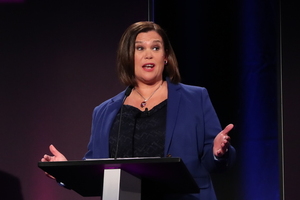
Mary Lou McDonald to take part in leaders’ debate (RTÉ)

Earlier…

David McCullagh and Miriam O’Callaghan of RTÉ’s Prime Time; Sinn Fein leader Mary Lou McDonald, during the seven way RTE leaders debate

On January 14 last, Taoiseach Leo Varadkar announced that the election would take place on Saturday, February 8, 2020.

The following day, January 15, RTÉ released a press statement announcing details of its TV election debates. It noted:

“In the final days of the campaign The Prime Time Leaders Debate will see the party leaders from the two largest political parties invited to take part in a live head-to-head studio debate.”

“In approaching election coverage the RTÉ Election Steering Group has regard to objective and impartial criteria, such as the results of the last comparable election (in this instance, the General Election 2016) and the results of intervening elections, such as the 2019 Local and European elections. Other factors are also considered in RTÉ coverage of the campaign.”

This morning.

RTÉ’s Political Correspondent Paul Cunningham reports:

“RTÉ’s General Election steering committee will meet at 11am to consider representations from Sinn Féin for Mary Lou McDonald to participate in the Prime Time leaders’ debate tomorrow night.

“Under the existing plan, the debate will be between the Fine Gael leader Leo Varadkar and the Fianna Fáil leader Micheál Martin.

“Sinn Féin’s Pearse Doherty, who made the request to RTÉ in person yesterday, has argued that recent opinion polls prove that the criteria used to exclude Ms McDonald are redundant.”

More as we get it.

Meanwhile…

Prime Time presenter Miriam O Callaghan with, from left: Micheál Martin of Fianna Fáil, Enda Kenny of Fine Gael and Eamon Gilmore of The Labour Party before a three-way leaders’ debate during the 2011 General Election

From the book Electoral Management: Institutions and Practices in an Established Democracy: The Case of Ireland by Fiona Buckley and Theresa Reidy…

In a chapter by Kevin Rafter:

Televised leaders’ debates have been a feature of Dáil elections since February 1982 with the sole exception of the 1989 election when agreement was not reached to organise a debate.

The seven debates between February 1982 and May 2007 shared several common features. In the first instance, participation was confined to the leaders of Fianna Fáil and Fine Gael, the two largest parties, which in effect turned the encounters into ‘Prime Ministerial debates’ as holder of the office of Taoiseach (Prime Minister) have been drawn from these two parties.

In addition, there was always only one televised debate per campaign, and all these debates were hosted by RTÉ.

The nature of the leaders’s debate changed in the 2011 general election. The number of debates increased to four while the number of host broadcasters increased to three with the involvement of TV3 and the publicly owned Irish language service, TG4.

The debate on TG4 took place in the Irish language (all earlier debates were in the English language).

Finally, and undoubtedly the most important change in 2011 was an increase in the number of participating party leaders.

The leader of the Labour Party, traditionally the third largest party participated in all four debates while one of the debates was a five-way encounter involving all parties with a minimum representation in the outgoing Dáil.

Since 1988, the organisation of presidential debates in the USA has been overseen by an independent commission although they are still defined by ‘behind-the-scenes arguments about everything from the format of the questioners to the length of the response time, the placement of cameras, the height of podiums, and the location of water glasses’.

In an Irish context, these ‘debates about the debates’ involves private interaction between the main political parties and broadcasters. At the 2011 general election, each of the three broadcasters ultimately involved in broadcasting debates (RTÉ, TV3 and TG4) negotiated separately with the five main political parties. This was a different approach to the UK experience where the broadcasters ‘communicated and agree a concerted approach’.

RTÉ’s hosting of two leader debates in 2011 was preceded by eight months of informal conversations, email communication and formal face-to-face meetings.

In a post-election review, one RTÉ executive offered advice for colleagues involved in future debate negotiations:

“…avoid getting drawn into lengthy discussions on formats or rules and regulations – we make the TV, they provide the candidates – and at no stage did we get drawn into the sorts of intricate rules which were a feature of the UK debates.”

...The importance of being impartial and fair, and being seen to be so, was a central feature of RTÉ’s approach to election coverage in 2011.

Indeed, at the final internal SC [steering committee] meeting before polling day it was noted ‘with satisfaction that RTÉ’s coverage hadn’t featured as an election story and this was very welcome as an indication that we were providing extensive, accurate and fair coverage’.

There you go now.

RTÉ committee to meet over Sinn Féin participation in election debate (RTÉ)

This afternoon.

Temple Bar Gallery, Dublin 2.

Sinn Féin President Mary Lou McDonald launching her party’s General Election 2020 Manifesto.

Including:

Doubling of the length of maternity leave and abolishing third level fees…

Pledges to build 100,000 council homes over five years, at a cost of €6.5 billion.

AND a refundable tax credit will reduce rent by 1,500 a year along with a freeze on rents for three years.

The party’s election manifesto also says that Sinn Féin can deliver all its promises ‘while also returning a surplus‘.

FIGHT!

USC, health & housing at centre of Sinn Féin manifesto (RTÉ)

Leah Farrell/RollingNews

Ah here.

What on earth is going on up there?

Edward Carson?

Their day.

It’s coming.

Outcome of vote shows ‘disregard for people of Ireland’ – McDonald (RTÉ)

Zero tariffs on EU goods coming into NI in no-deal Brexit (RTÉ)

Earlier: Derek Mooney: Leaderless Top the End

 Former Senator Mairia Cahill speaking to media outside Government Buildings last night after meeting with Sinn Féin party leader Mary Lou McDonald

Saying the meeting started with a handshake, but didn’t end with one, Ms Cahill told the Belfast Telegraph: “As far I’m concerned Mary Lou McDonald has abdicated her responsibility over this.”

In a statement following the meeting, Mrs McDonald described her conversation with Mairia Cahill as “lengthy and candid”.

‘It was distressing to listen to the nonsense’: Mairia Cahill speaks out after meeting with Sinn Fein president (Belfast Telegraph)


Meanwhile…

Meanwhile…

Yesterday: ‘I Have No Feeling In The Left-Hand Side Of My Face’

Rollingnews

Máiría Cahill and Sinn Féin leader Mary Lou McDonald

This afternoon.

At 4pm.

Former Labour Senator Máiría Cahill is scheduled to meet Sinn Féin leader Mary Lou McDonald.

Ms Cahill is the granddaughter of Frank Cahill, brother of leading Sinn Fein member and subsequent IRA Chief of Staff Joe Cahill.

In 2010, Ms Cahill alleged that she was repeatedly raped by prominent IRA member Martin Morris when she was 16 and that her allegations were dismissed by a Sinn Fein ‘kangaroo’ court while the alleged abuser was subsequently moved to Donegal.

Ms Cahill also alleged former Sinn Féin president Gerry Adams was aware of the allegations and failed to take action.

In 2014,  Mr Morris, who denied the allegation, was acquitted after his trial collapsed.

The trial collapsed after Ms Cahill, and two other women who alleged Mr Morris abused them, withdrew their evidence citing a loss of confidence in how the case was being handled.

Last month, the Ombudsman, in Northern Ireland, found that the women were failed by the PSNI and recommended that four officers be disciplined.

Ahead of her meeting with Ms McDonald, Ms Cahill spoke to Áine Lawlor on RTÉ’s News At One.

During the interview, they had the following exchange:

Aine Lawlor: “It’s been four years, as you say, since you first went public on [BBC] Spotlight. What personal price have you paid?”

Máiría Cahill: “Horrendous. My health has suffered, Áine, on a number of fronts. Mentally, I’m kind of, quite OK, I suppose I’m a but stubborn. But I have, at the minute, no feeling in the left-hand side of my face, for example. Or in my mouth, because I woke up, in the aftermath of the Ombudsman report, unable to feel that.

“We’re still trying to find the root cause of that. I’ve had to take a lot of time off work. My family relationships, the wider family relationships have suffered because some of those people still claim allegiance to the Republican movement for example.

“I think I was treated despicably by Sinn Féin and their members, graffiti went up on the walls of West Belfast, in the area which I was raped for example. You know, quite a public shaming of someone who came forward essentially looking for an admission and that was all I wanted, for people to admit that it was wrong. And it shouldn’t have happened.

“To date, that hasn’t happened. And I’d like to think that someone from Sinn Féin would have a modicum of decency around them to finally admit that.”

Previously: Falls Memory Syndrome

Rollingnews.ie


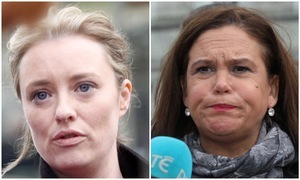
From top Máiría Cahill; Sinn Féin President Mary Louy McDonald

Further to the publication this morning of a Police Ombudsman for Northern Ireland report that found Máiría Cahill was failed by a “disjointed police investigation”.

Ms Cahill, a former Labour Party Senator and now SDLP councillor in Lisburn and Castlereagh County Council, said she was raped by an IRA member between 1997-98 and subjected to an IRA investigation into her claims including a face to face meeting with her alleged rapist in 2000.

A subsequent trial later collapsed and MS Cahill had criticised the handling of her case.

This afternoon, Sinn Féin President Mary Lou McDonald said:

“I welcome the publication of the Ombudsman’s report and the fact that the PSNI have accepted and will implement the recommendations of that report.

Abuse has scarred too many lives across Ireland. We all have a responsibility to keep children safe. I have no doubt that the three women at the heart of this report have been through an ordeal.

I want to commend their bravery, in particular the bravery of Mairia Cahill for waiving her anonymity.

Sinn Féin has robust procedures in place for mandatory reporting of abuse. I deeply regret that these procedures were not in place at the time of Máiría Cahill’s disclosure. For this I unreservedly apologise.”

Mary Lou McDonald responds to Police Ombudsman’s report (Sinn Féin)

Update:

Ms Cahill said on Twitter that she is not satisfied with Ms McDonald’s apology.

McDonald apologises to alleged abuse victim Cahill for ordeal (RTÉ)

Rollingnews

This morning.

Sinn Féin leader Mary Lou McDonald (centre) met with Britian’s Prime Minister Theresa May (top ) ahead of Ms May giving a speech in Belfast this morning about Brexit.

Ms McDonald spoke to Philip Boucher Hayes on RTÉ Radio One after they met.

From the interview…

Mary Lou McDonald: “It seems to me that she has come to Ireland to deliver a speech that really represents picking a fight with Ireland and picking a fight with the EU. I have put it to her that the rhetoric around protecting the Good Friday Agreement, in all of its parts, the rhetoric around preventing any hardening of the border is just that – it’s rhetoric. And it superseded entirely by her instinct, her desire to play to the Brexiteer gallery back in Britain and within he DUP. So it was a firm meeting a very challenging meeting. I said to her, umpteen times and I reiterated it again – a) that Ireland cannot and will not be the collateral damage of the Tory/Brexit. I have to tell you Philip I came away from that meeting with no sense of reassurance…

Philip Boucher Hayes: “Let’s break it down bit by bit Mary Lou. What was her reaction to your suggestion that Britain was picking a fight with Ireland?”

Mary Lou McDonald: “Of course she rejects that. I think you will see and you will hear when the, when her speech is delivered shortly that it is very much posited as a Unionist speech. I mean, there’s no great surprise in that. Theresa May is a Unionist and that’s fair enough.

“But she is particularly tone deaf to politics here in this part of Ireland. She doesn’t seem to have any deep appreciation of the fact that some 50% of the population would not ascribe to themselves the definition or the identity of Unionist. She seems to have only a very superficial understanding that the north of Ireland is a place apart…this place isn’t as British essentially, things are different here. And Ireland, the island, the North, in particular, but the island as a whole, because of the particularities here, requires a bespoke solution and absolutely needs a worst case scenario contingency plan – the backstop as it’s called…”

Listen back in full here

Pic: Paul Reilly

UPDATE:

UPDATE:

David Blevins (Sky News): “Prime Minister, you said the EU backstop would be a breach of the Good Friday Agreement because the majority of people here wish to remain in the UK. But the majority of people here have also voted to remain in the EU. So are you not now in breach of the Good Friday Agreement?”

Theresa May: “I think, if we look at what happened in the referendum. A decision was taken that, across the United Kingdom, people would be asked their view on whether or not to leave the European Union. And parliament said and Government said that it would accept that collective view that was taken across the United Kingdom and that is exactly what we are doing. And within the UK there were different votes in different parts of the UK but, overall, the result was that people wanted to leave the EU and we’re delivering on that and I believe that it’s an important part of our, of people’s trust in politics, given that parliament said it was the overall choice of the people of the UK, that we respect that overall choice that they took.”

This morning.

Leader’s Questions.

Ain’t that the truth.

FIGHT!

Earlier: A Limerick A Day

Meanwhile…

YOU decide.