
Tag Archives: Morning Ireland

0223varoufakis

Yanis Varoufakis

This morning.

Yanis Varoufakis, who has said he will resign as Greek Finance Minister if Greece votes Yes in Sunday’s EU bailout referendum, spoke with Audrey Carville on RTÉ Radio One’s Morning Ireland.

Audrey Carville: “Greece will vote on Sunday, on a bailout plan which is no longer on the table from its creditors. The banks have been closed for a week and we heard earlier that the country is quickly running out of money. Last night the IMF said that Greece needed debt relief, that it should have a 20-year grace period before making any debt repayment and no final payment until 2055. It also said that it would not put a request for a third bailout package to its board, unless it included debt relief. Yanis Varoufakis is the Greek finance minister. I asked him was that the language he had been waiting to hear.”

Yanis Varoufakis: “Yes indeed, it is music to our ears because what we have been saying right from the beginning is that the great, big reason why we have a huge crisis here in Greece is that our debt is unsustainable, has been since 2010, investors know that. They’ll not invest in a country whose debt cannot be sustained because they fear that the tax burden… that they wouldn’t profit from their investment. Interestingly, last week the IMF was part of a Troika delegation in Brussels that put to us a very comprehensive proposal for an agreement which, actually, did not involve debt relief. And it’s the reason why the negotiations stalled.”

Carville: “So it wasn’t mentioned? It wasn’t mentioned in their original proposal? Has it come too late almost? If it had had been there, a few weeks ago, might there have been a deal?”

Varoufakis: “There’s no such thing as too late. We have a duty to the people of Europe to grab whatever opportunities there are, for sensible agreements, that are beneficial for the whole of Europe, including the IMF. So I don’t believe it’s too late. We could do a deal tomorrow morning.”

Carville: “What do you understand their comments to mean though? Do you understand them to mean a debt write-off or would Greece have to pay eventually?”

Varoufakis: “Well Greece wants to pay. We are very keen, as a proud people, just like the Irish, to meet our obligations with our creditors. The problem is that the combination of [inaudible]and the austerity policies which are being imposed, so as supposedly to be repaid conspire to ensure that out national income shrinks, which makes it impossible to repay. So, a sensible fiscal policy, coupled with debt relief, you don’t even need to talk about haircuts. So we can have a sensible public financial engineering exercise that renders our debts payable and sustainable, this could be [inaudible]. Together we could reform this country by needs, it would end the crisis and help us repay our debts.”

Carville: “But of course the IMF is just one of your creditors. The ECB and the European Union are two more and they may be much harder to convince. They’ve certainly not mentioned debt relief. Enda Kenny said last week he would not support debt relief for Greece.”

Varoufakis: “But isn’t this a conundrum. Here we are negotiating, as a Greek government, with three institutions that disagree with one another – each one of them as a different set of red lines. So wherever we tread, we tread on red lines. And this is where you have it, you have it. This is the reason we have not reached agreement. This is a very inefficient and ineffective way of going about the business of European economic policy.
As for the Irish position in this, I don’t believe that the Irish Government has any reason to oppose our proposal because, let’s face it, Greece and Ireland took a major hit right after the Greek financial collapse in 2008 on behalf of the rest of the Eurozone. The Irish people have been saddled with a preposterous debt, for reasons that you know better than I, that happened immediately after our debt exploded and we had the inaudible of the bailout in 2010. It’s about time the Irish and the Greeks, possibly the Portugeuse and other peoples of Europe request a very sensible debt relief exercise for the whole of Europe, without haircuts, we can do it. Technically, the way forward, all we need is the political will to get together as opposed to staying apart.”

Carville: “So Enda Kenny should be, should ally himself with you in looking for debt relief?”

Varoufakis:Not just with us, with the whole of Europe. I think the whole of Europe should be sensible about that. We have a major public debt problem in Europe and it’s about time we sat down around the tables, rationally, and we discussed it. Instead of that we have taboos, we’re prohibited from discussion about debt, that debt supposedly is a moral duty and it should not be discussed as a matter that requires any kind of rationalisation, re-profiling or restructuring. This kind of denial, of very simple economic facts, is contributing mightily to the deflation of the forces that are making it very hard for Europe as a whole to escape a crisis of other investment and the crisis of inflation..”

Listen back in full here

Earlier: Free Tomorrow?

Pic: Matt Dunham/Bloomberg

Screen Shot 2015-06-26 at 10.04.32

Minister of State at the Department of the Environment, Paidí Coffey

Further to the amendments story  yesterday in relation to the Environment (Miscellaneous Provisions) Bill 2014, the junior environment minister Paidí Coffey spoke to Gavin Jennings on RTÉ’s Morning Ireland this morning.

Mr Jennings repeatedly asked the junior minister if a tenant, who didn’t pay their Irish Water bill, would be evicted…Coffey said that will be up to the landlord.

He also asked him about the Eurostat test… Coffey said it hasn’t been carried out yet.

And he asked him if he knew how many people have paid their Irish Water bills yet…Coffey said he doesn’t know the figure.

This is what was said.

Gavin Jennings: “If you don’t pay your water bill, the penalties – and more – are among six amendments to a bill on air pollution and waste collection to be put to the Dáil next week. Homeowners won’t be able to sell their home unless water bills are paid. Tenants will have an obligation to pay, included in their tenancy agreements and landlords will be required to give Irish Water details of their tenants and there’ll be another database from getting the water grant next year. Paidí Coffey is minister of state at the department of the environment. Paidí Coffey, good morning.”

Paidí Coffey: “Good morning to you, Gavin.”

Jennings: “Richard Boyd Barrett was here earlier. He says you’re ramming this measure through the Dáil. Fianna Fáil says you’re trying to get these changes in under the radar. Are you?”

Coffey: “Couldn’t be further from the truth, Gavin. There are no surprises here, despite what the opposition are saying. The substance of these amendments were flagged by Minister [for the Environment Alan] Kelly as far back as November and again indeed in May. And indeed I accompanied Minister Kelly in oral questions on a number of occasions in the Dáil, on the floor of the Dáil when people, like the opposition, were questioning him on the obligations of landlords in relation to water charges. And he stated, quite clearly, that he would deal with this in legislation by the end of the current term. So there’s no surprises here, what we’re bringing is clarity and certainty for landlords and tenants and I think, to be fair to be people who are compliant, we need to have a system where there is some sanction or enforcement, to ensure that those that are not compliant and are refusing to pay, that they do pay and that’s what this Miscellaneous Bill is about. It’s often used  in legislation to tidy up pieces of legislation. There’s over 15 pages of waste-related amendments in this and the Opposition are not mentioning that at all.”

Jennings: “If an tenant doesn’t pay their bill will they be evicted?”

Coffey: “No again, this is scaremongering, I believe, on behalf of the Opposition. Irish Water are going to every length to tell people that they will work with people that are under pressure financially. They will, like other utilities in place, payment plans to assist them and something that I would remind people about is the importance of registering with Irish Water by next Tuesday, the 30th of June. Because, if they’re not registered by then, they won’t qualify for the €100 grant.”

Jennings: “We’ll talk about the grant in a minute but if tenancy agreements are going to include an obligation to pay a water bill, does that give the landlord the power to evict a tenant if they don’t pay their water bill?”

Coffey: “Often is the case anyway, Gavin, where tenancy contracts are drawn up that, you know, landlords are insured that tenants are compliant with utilities..”

Jennings: “But the difference is: in other utilities, you can be cut off if you don’t pay. Water is different. Can I ask you again: if a tenant doesn’t pay their water bill, will they be evicted?”

Coffey: “Gavin, the Government has gone to great lengths to, you know, reassure people and we don’t want to see water cut off so we’ve legislated to ensure that doesn’t happen. That’s what the Opposition were stating initially, that we’d cut people’s water off. We don’t also want to see people ending up in court with fines and all the rest of it. So we are after drafting new legislation which will be introduced as well…”

Jennings: “So if a tenant doesn’t pay their water bill, will they be evicted?”

Coffey: “That’s a matter for the landlord and the tenant, as is the case in any contract.”

Jennings: “It’s a matter for the landlord, OK.”

Coffey: “So we’re bringing certainty for landlords here, we’re ensuring that they do ensure that tenants are registered with Irish Water…”

Jennings: “And if they’re in, if a tenant doesn’t pay the bill, will the landlord have to instead?”

Coffey: “There will be a case where any outstanding bills are not discharged, well then the owner of that property would have to discharge it before it would be sold on or in any conveyancing transaction and I think that’s the case already with property tax. And, you know, I just want to say Gavin, the Opposition, and especially Richard Boyd Barrett and other TDs have advised the public, in the past, not to be compliant in relation to property tax and I believe it was bad advice then and this is bad advice now because, you know, we want to see people, you know, compliant with the law and we don’t want to see people ending up in trouble and that’s where we’re making measures that we feel are fair and bring a certainty to the whole area.”

Jennings: “People are facing paying their second water bill soon, how are they going to get the grant to reduce their bill?”

Coffey: “Well, first of all, the most important point is by next Tuesday, the 30th of June, they must register with Irish Water to ensure that they are eligible for the grant. The Department of Social Protection are going to administer the grant on behalf of the State and they will over the coming months, be writing to people that have registered to ensure that they will qualify and indeed be paid this €100 grant…”

Jennings: “And when will they get the money?”

Coffey: “They’ll get it by the end of this year. You know there is a substantial amount of work in the administration and establishment of the administration of the grant so that’s underway in the Department of Social Protection and, you know, this legislation also allows for information to be shared by Irish Water and landlords so that the Department of Social Protection can pay this grant out to people. So Government are working to assist people with this and lessen the burden…”

Jennings: “..by the end of the year, that’s as much as you know at this stage, yes?”

Coffey: “Yes, indeed.”

Jennings: “Ok, if you don’t register by next Tuesday will you be given another opportunity to register in order to get the grant?”

Coffey: “No there won’t be further opportunities. This is the opportunity and I think, you know, in fairness, you know, I’m speaking about it hear this morning, Irish Water have advertised to people and I would encourage people to register and take advantage of the grant. It’s there to assist people to bring in measures, conservation measures in their own homes and some quite simple interventions will help people, lessen their bill and I think the vast majority of people will be compliant. Those, as you say, who are under struggling, under financial pressure, Irish Water have assured us that they will work with those people in payment plans to assist them…”

Jennings: “Have the EU approved this model yet?”

Coffey: “The EU have, as you know Gavin, it has to go for an independent Eurostat test and that’s imminent I would suggest. They’re independent, they’re not directly related to the Department of the Environment or…”

Jennings: “But they haven’t done so yet no?”

Coffey: “They haven’t done so yet but I would expect that to happen over the coming period.”

Jennings: “When?”

Coffey: “I’d say in the next few weeks or possibly months at the latest. It’s an independent organisation that will analyse the whole structure and model of Irish Water and we’re quite confident that we will pass that test when it does happen.”

Jennings: “Last question for you before we let you go: do you know how many people have paid so far?”

Coffey: “Well, we do know how many people have registered…”

Talk over each other.

Jennings: “That’s not what I asked you: do you know how many people have paid so far.”

Coffey: “Yeah and that’s a matter for Irish Water to respond to and my understanding on that is Gavin that when Irish Water have their figures, when they present them to their board, I understand that the board meeting is due to happen next week and it is very likely, and I would encourage them to publish the payment figures then.”

Jennings: “If you’re not going to tell me, do you know how many people have paid..”

Coffey: “I personally don’t know now, at this minute because the report hasn’t been made to the board of Irish Water which is the responsible body that would get the report..”

Jennings: “Would you like to know?”

Coffey: “That information will be shared out, I expect, in the next couple of weeks as well.”

Jennings: “Would you like to know?”

Coffey: “But sure I will know in the next couple of weeks and we can have a full debate about it at that stage.”

Listen back in full here 

Previously: About That Irish Water ‘Database’

‘We Don’t Know What We’re Supposed To Be Amending’


Cora

Cora Sherlock, deputy chair of the Pro-Life campaign

You’ll recall how the UN Committee on Economic, Social and Cultural Rights has called for Ireland to hold a referendum on abortion.

Further to this, Claire Byrne spoke with Cora Sherlock, of the Pro-Life campaign on Morning Ireland this morning.

Here’s what was said…

Claire Byrne: “We heard earlier today that the UN Committee on Economic, Social and Cultural Rights has recommended that Ireland hold a referendum on abortion and that the Government should clarify what constitutes a real and substantial risk to the life of a woman – that’s under the 2013 Protection of Life During Pregnancy Act. Cora Sherlock is the deputy chair of the Pro-Life campaign. You’re very welcome Cora, thank you for joining us in the studio. You heard what the member of the UN Committee Olivier De Schutter had to say earlier this hour. He says that he wants Ireland to have a debate essentially. What do you think?”

Cora Sherlock: “Well I think we’re all in favour of debate, once it is an honest and open debate, once it takes into account all of the facts and all of the true facts. One thing that I would say about what Professor Olivier said there, I noticed that he didn’t fully answer the questions, as far as I could see, about whether or not abortion is a human right because, as we all know, there is no right to abortion in international human rights law – what there is is a right to life and that’s enshrined in the Universal Declaration of Human Rights.”

Byrne: “He did talk though about the right of women to make choices, about their pregnancy which he said was very restrictive in Ireland, as far as the UN committee is concerned.”

Sherlock: “Yeah I mean I heard that but I’m not sure how he could consider the law in Ireland, the 2013 Act, to be restricted because that is an act, let’s remember, allows abortion for the full nine months of pregnancy where there is a threat of suicide and that is not based on any medical evidence. So if these recommendations from the UN are coming from the point of view that that is restrictive, then I think that the [UN] committee needs to go back and look at exactly what the 2013 act says because it’s not restrictive in any way and that is a fundamental error.”

Byrne: “But what about discrimination? Discrimination on the grounds that if you have the cash, you can travel to the UK and you can have an abortion. If you don’t you can’t.”

Sherlock: “I think abortion is the ultimate discrimination, it discriminates against the most vulnerable members of our society, the unborn, because what we’re talking about is ending the lives of human beings who haven’t had a chance to speak for themselves yet.”

Byrne: “But it’s a choice for women who have money to go to the UK and do it.”

Sherlock: “Well, you know, I mean I don’t know that we should support a choice to end lives. I mean we all have choices that are limited by society because they impact on other people’s rights and that’s what we’re talking about here. The ultimate way you can impact on someone else’s life is to end it and that’s what we’re talking about with abortion – actually ending a human life that has already begun. One way that I would agree with Professor Olivier, I noticed that he said, at the end of his interview, that he would like a debate to happen in Ireland, where we look at the experience of other countries and I would very much like to see that happen because when you do look to other countries, like the UK, for example, you see that abortion is fully legal, right up to birth where there is a disability diagnosed and that disability can be something like Down syndrome. 92% of all babies diagnosed with Down syndrome are aborted in the UK. We’ve got the horrific human rights abuse in the UK and in other countries where babies are born alive and left to die after so-called botched abortions.”

Byrne: “I know.”

Sherlock: “These are babies who survive the abortion..”

Byrne: “But you can’t reference malpractice, I mean we could talk about that in every element of  maternity care and we..”

Sherlock: “This is not malpractice this..”

Byrne: “You wouldn’t be saying, if an operation wasn’t done properly, then nobody should have access to it.”

Sherlock: “No but this is not the same as an operation to try and save a person’s life. These are botched abortions where the intention to end the baby’s life has not been successful and the baby is left, without medical care, to die on their own. That happened 66 times in one year alone in the UK and, I have to say, I take issue with the fact that the UN Committee and various UN Committees have now told Ireland how they think Ireland should, how the people of Ireland should proceed in the area of abortion while they ignore those kind of human rights abuses. So, talk to us about a debate but look at all of the facts.”

Byrne: “Do you think then that the UN is just a liberal organisation who wants to interfere, is that what you’re saying?”

Sherlock: “What I’m saying is that the people of Ireland inserted the right to life of the unborn in 1983 and I don’t think it’s appropriate for the UN to talk about taking an opportunity to revisit the abortion debate.”

Byrne: “1983 is a long time ago, I mean the women of child-bearing age, in Ireland now, I think it’s about one and half million of them, haven’t had a say on that issue because it happened so long ago.”

Sherlock: “Well, you know, that’s an interesting point that’s put to me by  a lot of people but there’s a couple of things about it. Firstly, the Universal Declaration that I talked about there was inserted in 1948 so it’s that long ago and that talks about the preamble, about protecting the inherent dignity and the equal and inalienable rights of all members of the human family..”

Byrne: “Do you not think thought the women of today should have  say over their rights when it comes to pregnancy..”

Sherlock: “The point I’d make Claire is that we have to acknowledge the fact that there are many people, tens of thousands of people, probably listening to this programme, some of them who are alive today because of the 8th amendment. We’re contacted in the Pro-Life campaign all the time by people who will contact us after debates like this and say, ‘I had an abortion appointment made in the UK and because it took me two days extra to get there, I changed my mind and my daughter is now alive today.”

Byrne: “Cora we’ll have to leave it there but thank you very much for joining us.

Listen back in full here

Read the UN report in full here

UN committee seeks Irish abortion vote (Kitty Holland, Irish Times)

 - RTR3DGJQ

Margaret Sullivan, public editor of The New York Times


This morning, on RTÉ  Radio One’s Morning Ireland, reporter Laura Whelan spoke with the New York Times Public Editor, Margaret Sullivan regarding the paper’s coverage of the Berkeley tragedy.

The interview was conducted before former President Mary McAleese sent a letter to the newspaper, saying it “should be hanging its head in shame” over the article.

Margaret Sullivan: “Well I think the first thing that happened was the New York Times ran a short of brief and sort of to-the-point news story online, on Tuesday about this tragic and really terrible event that happened in Berkeley, California. After that, as I understand it, editors and reporters felt that they should develop the story in some way and looked for a different kind of angle and the angle that they ended up deciding on was this idea of looking more deeply at the J1 programme and that’s what ended up being this very controversial and very much criticised article and I think the criticism is completely valid.”

Laura Whelan: “A lot of people, Margaret, in Ireland, have been badly offended by this article. Can you understand these feelings?”

Sullivan: “Yes, absolutely, I completely understand where the criticism is coming from. I wrote a post today [yesterday] in something called the Public Editors Journal that said you know I understand the criticism, I called the article insensitive and, even though I can’t apologise on behalf of the Times because, as Public Editor, I only actually express my own, independent opinion, I did say that I personally was very sorry that so much pain was caused by this.”

Whelan: “Margaret, a Government minister here in Ireland [Aodhan Ó Riordain] has accused the New York Times of victim blaming. Would you agree with that stance?”

Sullivan: “There is an element of victim blaming in this article but I believe it was inadvertent. I know, for example, the lead reporter on the article – whose name is Adam Nagourney – he’s a very good reporter, he’s a very solid fellow and I’ve had a lot of correspondence with him today [yesterday]. He feels terrible about this. I think he feels that he essentially made a mistake.”

Whelan: “What changes will be made to the article now? It’s  still available, up online.”

Sullivan: “Yes. The article is pretty much as it was to begin with. Mr Nagourney said that he made some, small changes before it went to print. But the Times’s policy is not to unpublish something once it’s been published and to keep the archive version of it pretty much as is. So I’m not expecting it to be taken down or, as we say, unpublished.”

Whelan: “I understand what you’re saying about the New York Times’ policy on that but I suppose given the level of feeling here in Ireland and the fact that the New York Times has now received a letter actually from Ambassador Anne Anderson, do you think this would maybe be an incident where perhaps the New York Times should go against its own policy and withdraw this article, take it down offline?”

Sullivan: “I don’t, again I want to sort of say, that I can’t speak for the paper, about that, all I can tell you is that, in my experience, that just never happens. I mean there can be criticism and there can be apology, there can be an acknowledgement but the story pretty much stays as is.”

Whelan: “In terms of the level of complaints received Margaret and, you know, the involvement of an ambassador, and also a Government minister here in Ireland, can you remember any other article, you know, going back a couple of years in the New York Times, that caused this much upset?”

Sullivan: “There certainly has been a great deal  of complaint and many, many emails and, as you say, official ones. I’ve had, I’ve been in the role of Public Editor for coming up on three years and I would say it’s among the ones that I’ve had the most complaint and response about. But, you know, perhaps not at the very top of the list.”

Listen back here in full

Previously: Anything Good In The New York Times?

9021886190274561-1Screen Shot 2015-06-01 at 11.04.21

From top: Denis O’Brien, Independent TD Catherine Murphy Former Attorney General, Justice Minister and Tánaiste Michael McDowell,

Further to the ‘thing‘.

Tomorrow RTÉ and several newspapers, including the Irish Times and the Sunday Business Post, are expected go before the High Court seeking clarification on whether or not they can publish what Independent TD Catherine Murphy said in the Dáil last Thursday, in light of a interlocutory injunction awarded to Denis O’Brien – against RTÉ – on May 21.

Ahead of this, Cathal MacCoille spoke to former Attorney General Michael McDowell on Morning Ireland this morning.

Cathal MacCoille: “Good morning.”

Michael McDowell: “Good morning, Cathal.”

MacCoille: “This question that, this statement made that the Oireachtas has, to use a word not in the Constitution, has absolute privilege. Two obvious questions for every lay person listening to you, does it have absolute privilege? And should it have?”

McDowell: “Well it’s not very, very clear from the wording of the Constitution to the extent of which that privilege applies to repetition in different circumstances. Yes, the words of parliamentarians are privileged wherever their published but that doesn’t absolutely mean, and I think you have to be clear about this, that a parliamentarian can say anything they like and anybody else, in any circumstance, repeat what they said with absolute impunity. I don’t think that that extreme view is a tenable one.

But I think we’re dealing here with a very different situation. Firstly, can I just go back to what was said before the ad break there. I mean [Labour Party TD] Pat Rabbitte is correct, in one sense, when he said that no court has ruled that the newspapers cannot carry Catherine Murphy’s speech of what she said in the Dáil about Denis O’Brien and his borrowings.

No court has even attempted to deal with that issue, thus far. But a court order made between in proceedings between RTÉ and Denis O’Brien,seemed to have the potential to prevent RTE from revealing the same information that they were concerned to keep confidential, from whatever source RTÉ found it, including Catherine Murphy.

That’s the argument that Denis O’Brien’s lawyers made and it seems to me that where Pat Rabbitte says we are collectively leaping ahead of ourselves  on this issue; there’s a different point to be made. Denis O’Brien’s lawyers have contacted all the media to impress upon them that it would be unlawful to publish material, including Catherine Murphy’s speech. And, I mean, Denis O’Brien’s lawyers went, for instance, to Broadsheet.ie, which is an independent news online service and threatened them and requested them to take down their coverage of her speech by seven o’clock last Friday.

So it’s Denis O’Brien who believes that this order has this effect. It’s his lawyers who are effectively issuing threats to media organisations not to cover speeches, her speech, and that is the crux of the issue at the moment. I wrote on Saturday, in the Irish Times,  that media organisations had a choice. They could either take their own advice and publish what she said, or else go to the high court, which RTÉ and the Irish Times are doing and get clarification as to whether the threat that is made by Denis O’Brien’s lawyers is a valid threat, or not. And I noted that the Sunday Times yesterday published Catherine Murphy’s speech or a large portion of it and they took their own advice.

And the issue now is, was that publication by the Sunday Times, or the publication on Broadsheet, or whatever, was that a contempt of court? And the only person who can decide that, obviously a judge is the only person who can decide that, but it can only be done on a complaint made by Denis O’Brien in essence, that it amounts to a contempt of court and what RTE and the Irish Times are doing is they’re going in to seek clarification of the scope of the order that was made by the High Court in favour of Denis O’Brien against RTÉ..”

MacCoille: “Yes, essentially the position we are in now is one where most of the Irish media have acted on the basis of editorial caution, on legal advice, so therefore the position will become serious, surely, only when a court decides that, yes, Oireachtas privilege is restricted to include, for example, Catherine Murphy’s statements last week which we cannot report, again on legal advice and only on legal advice now.”

McDowell: “The reason that RTÉ and the Irish Times are taking that position, that cautious position, is because of a direct threat to them by Denis O’Brien’s lawyers, of the kind that was made to Broadsheet, saying, ‘you may not do this, it would be a contempt of court if you do it’. And I mean, let’s remember that at the heart of this is the, I believe, overweening ambition of Denis O’Brien to use the courts in this way to silence the media in covering affairs relating to himself. That’s the thing. I mean this…”

MacCoille: “His lawyers are entitled to point out what they wish about a court injunction…”

McDowell: “Oh they can and RTÉ…”

MacCoille: “…of an interlocutory injunction which they have obtained. Are you saying…”

McDowell: “They are entitled to do that, yes, Cathal, but on the other hand, it’s up to media organisations, RTÉ has taken one cautious view, the Sunday Times has taken a less cautious view. Is the Sunday Times in contempt of court? I very much doubt it.”

MacCoille: “In your view, should Oireachtas privilege overrule considerations which, for example, in Denis O’Brien’s case, of the privacy of its financial affairs?”

McDowell: “In virtually every case I believe that is the case. That is the starting point that Oireachtas, the privilege which is attached to utterances in the Oireachtas wherever published should trump the private interests of someone like Denis O’Brien in relation to business borrowings from a bank, yes I do believe that.”

MacCoille: “In terms of the likelihood and it’s obviously a very experienced and learned view in your case but it is only  a view, when you say we’re in dangerous territory, do you believe it’s likely that we’ll be out of that dangerous territory and that Oireachtas privilege will be asserted and accepted by the courts when they, either in the High Court or the Supreme Court, issue rulings.”

McDowell: “Well I think there’s two things quite possible to happen. Firstly, I think the High Court might say, the High Court judge to whom this is brought before, [inaudible], ‘neither I nor the High Court has ever made an order in relation to Catherine Murphy’s speech and, therefore, the threats made by Mr O’Brien’s lawyers…’ ”

MacCoille: “Can I just interrupt you there? Because we’ve had this clarified, as you’ve been speaking. RTE did not get any letter from Denis O’Brien’s lawyers, it was simply acting on the basis of what it understood the injunction to mean.”

McDowell: “Well then that’s fine but I know that Broadsheet.ie, which went ahead and published her speech, did get such threats so RTÉ obviously are operating on the basis of their own internal legal advice and that’s fine. But the Sunday Times took a different view so…”

MacCoille: “But back to what you think, given our Constitution, do you think…

Talk over each other

MacCoille: “Do you think that the likelihood is that the freedom of a TD to speak will be accepted by the courts?”

McDowell: “I think the first thing is that the courts will probably say that the order they already made did not extend, and had no application to the situation of whether or not to cover Catherine Murphy’s speech. I’d say that will be the first position that the courts are likely to make. They haven’t ruled on that issue and their order did not deal with that particular scenario. The second thing I think a court will do is to look, and probably somebody will draw this to the attention of the court, to the reality that the speech is now in the public domain. Her speech is in the public domain and that it would be absurd and futile to order some media in Ireland not to report it or to lay down for them a rubric that would amount to contempt of court – when others are free to do it with impunity. So, I think that, on both counts, it’s quite likely that the media will not be under any court-ordered silence in relation to Catherine Murphy’s speech whenever this matter does come before the courts.”

MacCoille: “Right and just the final point, the obvious point that’s been raised by a number of people in relation to the Mary Lou McDonald case, where her colleagues on the Committee of Procedure and Privileges found that she had abused Dáil privilege but there was no effective sanction, isn’t that a fair point?”

McDowell: “Well, the first thing is that, in relation to sanctions, the Oireachtas has been fairly lax in putting serious sanctions on its members and it has never actually evolved a code of sanctions which are effective, that’s true. But, on the other hand, let’s remember, this is an important point of principle and an important point of public interest. If Denis O’Brien is correct in saying that his financial affairs are, and we can see from the Sunday Times, it’s a kind of order that those financial affairs, the size of his borrowings, etc. If he is correct in saying that this is an entirely private matter, and could not legitimately concern parliamentarians, then we have a very strange situation indeed. I believe that there was a clear public interest in what Catherine Murphy said in the sense, not of public curiosity but of public interest because it is an issue which is important in the context of the various other dealings of IBRC and it’s liquidator. And the last point Cathal, I’d like to make is, if Denis O’Brien believes he’s bringing these proceedings, and making these threats to independent news channels and the like, as a matter of principle, is this a principle that all news organisations – of which he has a commercial interest – are going to abide by in the future. Is it really the case that if INM – the Irish Independent, the Evening Herald, or whatever – find themselves with confidential information about me, you or anybody else, that he’s going to say, ‘oh no, we don’t publish those things’, or is this a case of the rich and the powerful using their legal muscle to attempt to do something which is completely incompatible with a functioning democracy. That’s my view.”

Listen back in full here

Previously: [REDACTED]’s 1.25 Interest Rate

Mark Stedman/Photocall Ireland

Meanwhile…
Screen Shot 2015-06-01 at 11.06.32

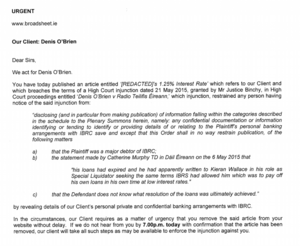
A Letter received via email from Owen O’Sullivan, head of litigation at William Fry Solicitors at 6.27pm on Thursday, May 28.

This led to the following email exchange.


6.52pm,
Broadsheet:  “Apologies for the delay. I am John from broadsheet. I am trying to locate our legal person but I think it may be for the High and Supreme Court to decide. Article 15.12 allows all Dáil statements “wherever published” to be privileged.”

7.28pm, Fry: “Thanks for responding. All I’ll say in reply is that there is an injunction in place of which you are on notice, the terms of which are very wide and cover what could be reported about what was said in the Dail by Catherine Murphy. I await a response to the request for a confirmation regarding the article.”

7.40pm, Broadsheet:  “Thank you. Just two more things. Does the High Court ruling supersede Dáil privilege? Also Catherine Murphy has stated (this evening) that the information came from sources other than the court proceedings which you mentioned.”

7.55pm, Fry: “That is for your own legal advisors.”

8pm, Broadsheet: “Fair enough. Do you have a copy of the terms of the injunction?”

8.25pm Fry: “No – but RTÉ reported on it extensively and within its terms so their reports are probably a good source for it…”

Friday 11.05am: Hosting Ireland (broadsheet’s web providers): “We have received a letter from Denis O’Brien’s solicitor William Fry regarding content on your site breaching a high court injunction. ‘As you are hosted on our network we can become responsible if we do not act on this.  We request you please remove this content as soon as possible and confirm.”

11.20: Broadsheet to Hosting Ireland: “Apologies for all this. The speech is protected “wherever published”  by Dail privilege in the constitution.  Mr O’Brien’s solicitors say the High Court ruling supersedes the constitution but the judge never revealed the terms of the injunction.”

All correspondence concluded.

Large tay.

(Photocall Ireland)

90368110Senator Lorraine Higgins at Labour’s 2013 think-in

This morning.

Fear-rattling Labour Senator Lorraine Higgins spoke to Gavin Jennings on RTÉ R1’s Morning Ireland about tonight’s midnight deadline for people to register with Irish Water.

Deadline?

Schmeadline.

Lorraine Higgins: “Everybody will receive a bill, notwithstanding whether they’ register or not, in April. And I do believe…”

Gavin Jennings: “Sorry, I’m confused. What allowances will you not get if you don’t register by today.”

Higgins: “Well there are certain allowances for children that have to be taken into account and if you don’t register by today, by midnight tonight…”

Jennings: “What allowances?”

Higgins: “Well there are certain allowances Gavin, right across the board, for children, in terms of capacity, the number of litres that you get on an annual basis and I would urge your listeners…”

Jennings: “I thought you were being billed irrespective of how much you use, isn’t that right? I thought it was dependent how many people were in the house.”

Higgins: “That’s correct.”

Jennings: “We’ve constantly been told that it’s a simple matter of, you can reiterate if you want, of how much you pay for one person, how much you pay for more than one person. So, what don’t you get if you don’t register by today?”

Higgins: “That’s correct. It’s costing €3 per week and it’s very important to ensure the quality of our water in the future and I know from dealing with people in clinics, Gavin, that you know they don’t have the same degree of difficulty as they had prior to this new range of measures that was brought in by the Government..”

Jennings: “Sorry, just to be clear, sorry, today’s deadline, again. If people don’t register, and plenty haven’t, what don’t they get if don’t register by today?”

Higgins: “Well, you know the department of the environment has come out very clearly and said that there may be a situation where there’d be added cost on to the price of paying for water for this year.”

Jennings: “What added cost?”

Higgins: “That hasn’t been clarified yet and I await to find out what that will be. There will probably be a lot of discussion over the course of the coming week in relation to it.”

Jennings: “So, just to be clear, if you don’t register by today, what happens?”

Higgins: “If you don’t register by today, there will be, there will be a situation where you’ll be given optimal time to actually register, right up…”

Jennings: “So you’ll be given more time, yes?”

Higgins: “It seems to but to be clear, the minister has always stated from the outset and indeed even last week, that the second of February [today] was not a dropdead deadline.”

Jennings: “So, if I’m not sure if I want to register to pay for Irish Water, you’re going to give me more, I’m going to be given more time, I don’t have to do it today, is that right?”

Higgins: “Well it’s very important for people to register today…”

Jennings: “But I don’t have to do it today. I’m not really going to face any problems if I don’t do it today, is that right?”

Higgins: “Well the situation is, and as I said, a release from the department with regard to possible penalties and that needs to be borne in mind.”

Jennings: “What possible penalties?”

Higgins: “There’s no clarity on that, right at this moment, Gavin.”

Jennings: “OK.”

Higgins: “But I wouldn’t be advocating that people break the law like Mary Lou (McDonald, Sinn Féin TD who earlier declared her intention to not pay) seems to be doing. I think it’s interesting, her position, given…:

Jennings: “She’s talking about not paying, we were talking there about not registering. If I don’t pay and I know this is a hypothetical matter because the bills won’t arrive until April. If I don’t pay, what will happen to me?”

Higgins: “Well there’s a situation where there’ll be an exchange of information from the Revenue. We expect that there’ll be legislation brought in over the course of this month where it’ll be possible to put a charge on property. It’ll also be possible for landlords to bill their tenants and take it out of their deposits.

Jennings: “Not yet though, no?”

Higgins: “Well this is something that’s going to be looked out over the course of this month and we hope to have legislation in place before the end of February.”

Jennings: “So, at the moment, if I decide I’m not going to pay, you don’t know what’s going to happen to me yet, is that right?”

Higgins: “Well that’s the position right now but as soon as the legislation is prepared and brought before the Houses of the Oireachtas, it will be expected that there will be a charge put on people’s properties and landlords will be permitted to take the cost of water out of a tenant’s deposit.”

Jennings: “How much of a charge do you think should be put on people’s property if they don’t pay?”

Higgins: “I can’t say that, Gavin and I’m not going to speculate on that.”

Jennings: “But you’re one of the…you’re a member of a party who’ll be legislating for it, what’s your opinion?”

Higgins: “Well I haven’t given it significant thought but I would urge people that’s important not to break the law, I wouldn’t be throwing it around, the populist line that Sinn Féin currently are, you can see how Mary Lou stuttered and stammered over the issue about how she was going to pay for water and how the Government would pay for water in terms of taxation.”

Jennings: “You can’t tell me what would happen if I don’t pay for water.”

Higgins: “Well these are decisions that’ll be made by the Government, Gavin.”

Jennings: “But they haven’t been made yet. There’s a deadline in place for today to register. The bills are going to arrive in April and we still don’t know what’s going to happen if people don’t pay.”

Higgins: “Well I’ve made it very, very clear that there will be a charge put on property and landlords will be permitted to take the price of Irish Water out of deposits.”

Jennings: “Senator Higgins, a large number of people haven’t registered today, thousands of people have protested on the streets and are continuing to do so, there’s no grant in place yet, the amount of income that Irish Water is going to get as a result of people paying bills has already been lowered. There’s no guarantee of passing the Eurostat test, no clarity on what landlords are expected to do, if their tenants don’t pay. What part of this plan has been a success so far?”

Higgins: “First and foremost, I don’t share your view Gavin when it comes to the numbers that have registered. There’s almost 1.1million that have responded – that’s 60% of where it needs to be. And there’s quite a large number…”

Jennings: “There’s a million people who haven’t.”

Higgins: “But look I mean, as I said, the second of February, isn’t a dropdead deadline, you know..”

Jennings: “The first deadline was last year, a million people still haven’t registered.”

Higgins: “Mistakes were made last year, there’s no question of that, we’ve held our hands up to that but all you’ve to do is look at the protests over the weekend, you know, the numbers were significantly down.”

Jennings: “What part of the policy, so far, has been a success?”

Higgins: “Look we’ve had difficulties, any time you’re trying to set up a new utility, it’s going to present some degree of difficulty. And I think you will acknowledge that.”

Jennings: “But has there been any success yet?”

Higgins: “Of course there’s been success. You can see the silent majority that have paid, or have registered rather, to pay the water charge, at 1.1million as it stands.”

Listen back in full here

Previously: Taking The PPS

Mark Stedman/Photocall Ireland

Screen Shot 2014-12-08 at 12.03.35

Last night, on RTÉ’s The Week In Politics,  Tánaiste Joan Burton, above, was asked about the possibility of junior bondholders in the former Anglo Irish Bank being repaid from the liquidation of IBRC.

She said:

“It is completely unlikely to happen because in the queue before the junior bondholders are the Irish people.”

Her comments came after Finance Minister Michael Noonan made comments about repaying junior bondholders in the Dáil last week.

Following Ms Burton’s comments last night, Brian Lucey, professor of finance at Trinity College Dublin, spoke on Morning Ireland this morning about the situation.

Gavin Jennings: “Brian Lucey, good morning, who are junior bondholders? Why would they be paid? And how much could they expect to be paid?”

Brian Lucey: “They can expect to be paid around €280 million. These are people who would have put capital into Anglo Irish Bank in return for a high yield. And because of that high yield, the accepting risk and that risk would be that the bank might fail. And, guess what, the bank failed. The reason they might think they might get paid now is because the economy is picking up and particularly property prices are picking up and they do have a claim under liquidation law, under the companies and bankruptcy laws, as they stand at the moment, they have a claim if, after everybody else is paid off, there’s money left in the pot, then they will get it. Joan Burton is a little bit loose with her language there. The implication people here is, ‘oh, once again, €35billion back, we’ll get it, they might get something’. The reality is the State can only recoup a maximum of €1.1billion which is fees outstanding as part of the guarantee system, that Anglo Irish Bank didn’t pay. So there’s an issue here. The reality is most of the people involved here are not the credit unions, the pension funds, etc, that had money with Anglo Irish Bank in this junior debt, they’re people, they were sold because they couldn’t hold on to it, they were junk bonds. They were bought up by vulture capitalists who are now expecting, having paid 2c, 3c, 5c, 10c on the Euro to get 100c back.”

Jennings: “So these are people who wouldn’t initially have been bondholders in Anglo?”

Lucey: “No.”

Jennings: “They would only have become so in the last couple of years, yes?”

Lucey: “Yes.”

Jennings: “Now when Joan Burton says that the people of Ireland come ahead of junior bondholders, is that true in terms of..”

Speak over each other

Lucey: “…except of €1billion that Anglo owes us. The €35billion is not going to be recouped. In fact we’re continuing to burn €25billion for Anglo over the next 20 years and that’s a greater immorality  than this €280million. €280million is two thirds of the total stand planned for next year for capital in the health system – in other words building hospitals. [Finance Minister] Michael Noonan should have stood up, in my opinion, and said, ‘Under absolutely no circumstances, whatsoever,  will a penny ever be paid out to these people’.

Jennings: “But what he did explain in the Dáil last week was, and you might be able to parse this for us, that the sale of loans assets so far has gone – I’m paraphrasing here – better than expected. So that all the people who were owed money would be written to, there would be ads put out, a deadline put and anybody, essentially, who was entitled to their money back, who wanted their money back would get their money back.”

Lucey: “That is what he said but I think that it’s economically unwise, politically foolish and morally reprehensible for these people.”

Jennings: “But there’s no precedent of us having done otherwise, so far?”

Lucey: “Well of course there isn’t – this government has been buckling all along under the mildest pressure from Anglo or people related to Anglo and, you know, it flabbergasts me and I think others that they would even contemplate this as opposed to saying, ‘get up the yard’.”

Jennings: “But without a precedent so far, why would they change their minds now?”

Lucey: “Well they won’t, so they’ll do this if they have to, if they think they have to. They could walk into the Dáil tomorrow and they could change the bankruptcy and liquidation laws. It might be that people would then, in the fullness of time, take a legal case against the State. The State should defend that to the hilt. They should run this clock out as long as is necessary. The State’s resources are ultimately, infinitely greater than anybody who bought these bonds at 7c on the Euro and who are now trying to get 100c back. And they should not ever pay these people. It is, fundamentally, it’s not an economic issue for me, it’s a moral issue.”

Jennings: “There’s also a legal issue though isn’t there…”

Talk over each other

Jennings: “But Michael Noonan pointed out in the Dáil last week, a high court case taken in Britain over two years ago which I think involved a similar case of essentially bondholders looking for their money back when they were entitled to..he pointed this out in the Dáil last week, right?”

Lucey: “He’s technically correct, which is the best kind of correct when you want to do something unpopular. Look, we are a sovereign nation and we can make a decision to do pretty much anything we like. People can then take legal action, if they wish, and in the fullness of time, the Irish and the  European courts say you must pay this, if that’s 20, 30, 40, 50 years down the line then that’s fine. But it would be incomprehensible that in the time, when last night, when people were sleeping in sub-zero temperatures on the cities and towns of this country, that we would think of doing anything like this. It’s not an economic issue, it’s not a legal issue for me, as a citizen of this state, it’s a moral issue and we should, as citizens, take a moral perspective. Economics and finance got us into trouble and got the rest of the world into trouble because we lost sight of the fact that it’s a moral issue. Adam Smith, the founder of modern economics, was not just an economist, he was a moral philosopher.”

Listen back in full here

The Week In Politics (RTE)


90359493

Mairia Cahill with Taoiseach Enda Kenny at Government Buildings last week

Solicitor Peter Madden, who represents the four people Maíria Cahill said interrogated her after  she was raped by an IRA member when she was 16, spoke to Gavin Jennings on RTÉ’s Morning Ireland this morning.

Gavin Jennings: “Peter Madden, of Madden and Finucane Solicitors, who represents Padraic Wilson, Seamus Finucane, Briege Wright and Maura McCrory, yesterday published a letter he wrote to the Taoiseach last week, saying he’d advised his clients against any meeting. Peter Madden is on the phone now, good morning to you.”

Peter Madden: “Good morning, Gavin.”

Jennings: “Why won’t your clients meet the Taoiseach?”

Madden: “Well it seems to me, having looked at the transcript of the Dáil meeting on the 22nd of October, last Wednesday, that the Taoiseach has already made his mind up about this. And he has already stated very clearly that, and stated as fact, that my clients were members of the IRA and he doesn’t even state that as an allegation. What he said is, and I’m reading from the transcript, he said that the central issue here, a young woman who was raped and sexually abused being required by powerful people, within the IRA, to attend at a meeting and having to face her abuser. So he’s taken that as a fact when in fact this is not a fact at the moment. It is a fact but it’s a disputed fact and it’s an allegation. So, it seems to me that the Taoiseach attempting to meet people in which allegations, unproved allegations actually, to meet with him is some sort of political stunt, I would say, because the fact is that they, these people, my clients, four of my clients have been acquitted by a court on these same allegations.”

Gavin Jennings: “Maíria Cahill has been consistent in her claims for many months now. Some people, many people indeed, would argue that her consistency over a long period of time gives her great credibility. What would you say? ”

Madden: “Well I would say that her credibility could only be tested properly in a court of law. And that was, that was arranged. A trial was due to take place, in which she would make the allegations in court and she would be challenged on those allegations. Now my clients have waited four years to challenge the allegations that she’s made and she has made with great detail and, in fact, two of my clients, Maura McCrory and Briege Wright, have worked tirelessly for years on the Falls Women Centre, helping abused women and children and she has made these allegations about the, all four, including Briege Wright and Maura McCrory – they are untested and, it seems to me that, the Taoiseach can not conduct any sort of inquiry into this affair at all. It’s a matter for the courts. The courts in the North here has the same system, in the North, it’s practically the same system in the North as it is in the South, I practice in both jurisdictions in criminal law and it’s very, very similar.”Continue reading →

11/12/2013. CRC at PAC. Former CEO Paul Kiely foll90327021

[Top: Former CEO of Central Remedial Clinic, Paul Kiely and former director Jim Nugent and, above the charity’s headquarters in Clonskeagh, Dublin]

A mother whose son is dependent on the services of the Central Remedial Clinic went on Morning Ireland earlier.

Maria Nolan – who is mother to 17-month-old  Oisín – spoke to Gavin Jennings and made an appeal to the public to continue to support the charity.

Maria Nolan: “Oisín really needs the CRC, he uses it every week, he goes approximately four times a week. He needs it for physiotherapy, occupational therapy, eat, drinking and swallowing clinic. And I also go the parent-toddler group myself, which is so vital for me. As, with Oisín’s condition, I felt somewhat of an outsider within my own community. So the CRC, for me, is a lifeline and a second home for me and Oisín”

Gavin Jennings: “When Oisín was discharged from hospital last August, last September…”

Maria: “Yeah, yes, the end of August he was discharged from Temple Street.”

Jennings: “And he was quite sick? You used the Central Remedial Clinic pretty soon after that. Tell me about your experience with them.”

Nolan: “My experience has been amazing. Oisín was discharged the end of the August and, literally, while, in his dischargment process, I received my letters from the CRC, welcoming me into their family more or less and all his appointments were set up immediately – his physiotherapy, occupational, everything was arranged. I didn’t have to ring, I didn’t have to follow up, I didn’t have to do anything. His appointments were laid out immediately. And we literally started the week after he was discharged.”

Jennings: “Have you experienced any cuts? Like the caller we heard to Liveline and other callers yesterday?”

Maria: “Personally, no, I haven’t myself, thank god, I haven’t. His physiotherapy has started back and he will be doing his eating, drinking, swallowing clinic very shortly. So, personally, no, thank god, I haven’t.”

Jennings: “What’s your reaction to the news that the bosses at the clinic were paying themselves such huge salaries from money donated to help people like your son?”

Maria: “You just, you feel disgusted and saddened but not just for yourself and for your child. You feel for the staff of the CRC – they’re so amazing, they all work so hard. You go in everyday and there’s always a smile on their faces. They’re amazing, amazing people who are so talented and gifted to work with children like Oisín and adults like Oisín and you can just feel that they’re so ashamed themselves and hoping that they’re not implicated, or feeling that we’re looking at them and judging them. For such…CRC, if you ever go in the front door of the CRC, the receptionist is just smiling at you, everyone is so nice, it’s just a second home from home.”

Maria: “…And for him [Paul Kiely] to do that…”

Jennings: “Maria there will be people listening this morning, many of whom who will have given money to the Central Remedial Clinic over the years, and many who want to, to continue to help children like your son. But they’re torn now, thinking that ‘well,last year for example, half that money didn’t got to services, it went to pay off a former boss’. What would you say to people who are passing a bucket or donation and are thinking ‘well, I want to help but I don’t want my money to go to pay salaries or pensions like that’.

Maria: “I understand completely. Before I had Oisín I knew of the CRC, but I didn’t know of really what it did. I just beg people, I know money is scarce and people don’t have money to give sometimes to charities but please don’t pass the bucket on the street. Do give. Just think of my son. Children like Oisín and adults like Oisín will be like this for the rest of their lives. They’ll always need the CRC and please don’t pass it, I beg of you, don’t pass it. You never know when you might need it yourself. I didn’t think that when I had my baby that I would need the CRC and I highly, highly need it and I will always need it, so please don’t pass it.”

Listen here

Previously: They Just Keep On Giving

All De Berties Men

(Sam Boal/Photocall ireland)

Ashoka

Screen Shot 2013-04-11 at 10.50.37Former IMF chief of mission to Ireland, Ashoka Mody, above left with Ajai Chopra in 2010.

Melancholy of eye and large of loafer, Ashoka was involved in negotiating Ireland’s EU/IMF bailout.

He could often be seen around Merrion Row, Dublin, during the bailout. Once Ewok spotted him in Centra observing the magazine rack forlornly with a 1990s-style bum bag about his person.

Anyway. This morning Ashok gave an interview to Gavin Jennings on Morning Ireland, in which he admitted Ireland’s bailout was riddled with mistakes, namely the non-burning of the senior bondholders and the program of austerity.

Ashoka Mody: “There were three choices. Choice one was to bring in the bondholders and they would bare some of the cost of the sovereign distress, either the bank bondholders or the sovereign bondholders. A second choice was to offer extremely concessional official financing. And a third choice was to impost austerity. And the decision then was that the entire reliance would be on austerity. And clearly the experience, if experience was needed, has demonstrated that reliance on austerity is counterproductive. And since there is no view currently on how much burden of this crisis should be borne by the private bondholders, we are left with only one choice and that choice is to increasingly make the official financing easier and more concessional. And that’s basically what we’re seeing. We’re seeing a belated recognition of the fact that the constrains imposed by only austerity was untenable.”

Gavin Jennings: “From what you’re saying to me, you make it sound like the construct for our rescue was wrong.”

Mody: “Yes, indeed, it was. It was wrong in the sense that there was never a real possibility, or let me put it a little bit more mildly, the risks of the program succeeding were such that the complete reliance on austerity was not a reasonable way to go.”

Jennings: “You were writing recently, and this was following the promissory note deal, that it was a good idea, albeit a belated idea, that some of the bondholders, some of the people who had lent Ireland money should take a haircut or a restructuring of what they had lent us. Why was that not done at the time?”

Mody: “I think at the time, and now, the view continues to be that honouring sovereign debt and indeed most of the debts owed by the banks which, de facto, have also become quasi sovereign debts, that those debts need to be repaid cause if those debts are not repaid, that will create financial instability. And so, that was the decision made at the time that continues to be the case today. Clearly what has happened is that some margin has to give. In Greece, that was the presumption that sovereign bondholders will remain whole but, over a period of time, that assumption proved untenable and so had to be, there had to be a compromise on that. And even with that, in the Greece case, the official debt was too burdensome and so easing of those terms began. And for Ireland, and for Portugal, what we are now seeing is that while the private creditors are remaining whole, the official terms are being relaxed because the debt burdens, especially if you view the likely prospects of growth in these countries, the debt burdens are still very large. We are in the range of 120% of GDP which, historically, is a large number. And the only real prospect, other than the official, concessional financing, is that growth begins to emerge in a very dynamic way. And I’m concerned that some of the growth projections have proven to be overly optimistic. And given that Europe is dragging itself down through this austerity process, some of the growth projections are likely to not be met and in that case, these debt burdens will remain higher than currently projected for longer than we currently think so something has to give.”

Jennings: “I’ll talk to you more about growth in just a moment. But, going back to what you said, if austerity was wrong, judging from your comments on both burning private and sovereign bondholders, and not following that policy, was that too a mistake in your view?

Mody: “I would say yes. The answer is yes. When everyone says ‘yes, it was a mistake’, there is an immediate reaction that doing so would have had catastrophic implications. And my reading of history on sovereign defaults is that such defaults can be well managed in a way that accommodates the interests of various parties and that the notion that a sovereign default, or a default especially on creditors to banks who have become quasi sovereign bondholders is very…the notion that those defaults are extremely costly, is historically just not true. We know from the evidence that we have that in a way bondholders treat that as almost welcome because it reduces the uncertainty and normally there is a very quick return to market, the output losses are relatively minor. And so the history is very clear on the cost of doing so.”

Jennings: “So, if imposing austerity on Ireland was wrong, or a mistake; if not allowing any burning of bondholders, whether official, sovereign or private was a mistake; you were centrally involved in that program. I know Ajai Chopra was very much the public face of the IMF mission to Ireland. But you were centrally involved in constructing this bailout. How much responsibility do you take for those errors.”

Mody: “Yes, so, obviously, I have to take the responsibility in…but I’m in very good company in taking responsibility in this. There were many parties involved. And my role really was to bring such matters to the attention of people who finally made these decisions.”

He then removed his shoes and cried softly .

Listen to whole interview here.

Previously: Remember Ajai Chopra’s Sad Eyed Large Loafered Friend?