

Good times.
Anyone?



Peter Sutherland on RTÉ’s Six One yesterday evening
Last night.
On RTÉ’s Six One, presenter Bryan Dobson spoke to Peter Sutherland.
Mr Sutherland is a lizard former EU Commissioner for Competition Policy (1985- 1989), former Attorney General (1981-1984), former chairman of Goldman Sachs (1995-2015) , and currently the United Nations Special Representative for International Migration (since 2006).
They started off speaking about the makeshift refugee camp in Calais, following a news item about a protest having taken place there yesterday – with some locals and truck drivers calling for it to be closed down.
Mr Sutherland talked about how he had been there, how it is appalling and how 70 additional people arrive in Calais every day.
He then talked about the EU response, as a whole, to those seeking refuge in Europe and highlighted the problems a fragmented approach with different countries doing different things.
He called on EU countries to act with more solidarity in mind.
Then, Mr Dobson asked Mr Sutherland about the EU Apple tax ruling.
Grab a tay
Peter Sutherland: “Basically, the British are saying ‘yes, all of those who are in Calais want to get into the United Kingdom but they’re the responsibility of the French because they’re in France and we won’t allow them into Britain, so the French are going to have to deal with this. This creates obviously some tension but it also creates an enormous problem in Calais where people are constantly trying to get on lorries or on trains and it’s very dangerous and many of them are children.”
Bryan Dobson: “Does that, in a sense if you like, encapsulate the way this has been responded to by Europe, that individual states have been passing the buck?”
Sutherland: “Absolutely, and the greatest evidence of that is in the Mediterranean frontline states – Greece and Italy are taking all of the refugees. Everybody leaving Libya, virtually, is delivered, including by our Navy and the British Navy and the Germans to Italy and they are left with this huge number, growing number of refugees and I think this is grossly unfair. The same can be said for Greece.”
Dobson: “But, of course, what happened, the German chancellor Angela Merkel opened up the border, the German borders to invite people in, in this extraordinary gesture last year is that, politically, she’s facing a backlash now, isn’t she? And her political future is in question because the hostility of very many German people just to that policy.”
Sutherland: “It is, absolutely, but in my view she’s a heroine. She’s done something that others have not been prepared to do and virtually all the central and European countries are saying ‘absolutely no’ to refugees. Surely, if we are a community, a European Union, based with a concept of solidarity, we should share and we should share on a logical basis all the refugees.”
Mr Sutherland then went on to say Ireland should ‘do more’ and invite ‘thousands’ to Ireland.
And was asked about the Apple tax ruling.
Dobson: “The Government, you believe, have made the right decision when it decided to appeal?”
Sutherland: “Unquestionably, there was no decision that could be taken, other than to appeal. Otherwise it would be accepting an adjudication which, as I understand it, the Government absolutely contests. I mean the Government’s case appears to be that the Revenue Commissioners, not the Government made the decision on the application of the law in regard to taxation which would be applicable to everybody. It wasn’t a special deal. Now, if that is correct, it seems to me that that is not a state aid.”
Later
Dobson: “Do you think Apple have paid their fair share of tax to whomever it’s due – Ireland, United States, other European countries?”
Sutherland: “I can’t comment on that, I mean what is a fair amount of tax? It seems a ridiculously large sum to have avoided, I don’t know. I’ve no idea, I’ve seen no papers.”
Watch back in full here
Previously: Peter’s Friends
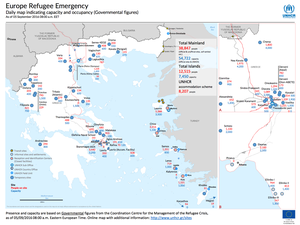
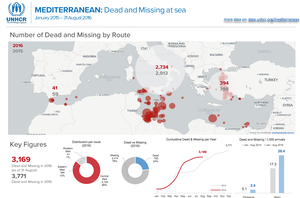
Graphics from the UNHCR showing the capacity and occupancy rates at sites for refugees across Greece (top) and the number of people known to have died or gone missing this year, as of August 31, in comparison to 2015
According to the latest figures from the UNHCR, there are now 59,569 refugees and migrants on Greek territory.
The figures also show the following numbers of people on the islands versus the capacity of the facilities available.
Lesbos: 5,388 people versus facilities with a capacity for 3,500.
Chios: 3,316 people versus facilities with a capacity for 1,100.
Samos: 1,351 people versus facilities with a capacity for 850.
Ekathimerini, a daily Greek newspaper which is sold with the International Herald Tribune, in Greece reports:
A year after the European Union launched its refugee sharing plan so member countries could help overwhelmed Greece and Italy less than five percent of the migrants have been relocated.
European Commission figures show that only 4,473 asylum seekers were relocated as of September 1.
The plan is a cornerstone of the EU’s strategy to deal with more than one million people who entered Europe last year in search of sanctuary or jobs. It commits countries to relocate 160,000 refugees from Greece, Italy or any other member state deemed unable to cope by September 2017.
EU Commission spokeswoman Natasha Bertaud said Monday that, despite the slow pace, “what we are doing is not insignificant.”
Small percentage of Europe’s migrants relocated (Ekathimerini)

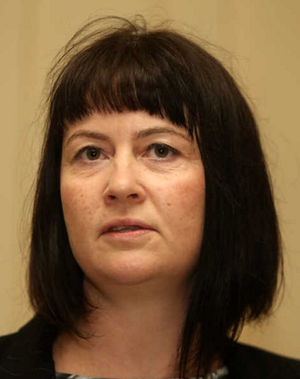
From top: Turkish soldiers patrolling in Hatay province along Turkey’s border wall with Syria in Feburary; and Edel McGinley, director of the Migrant Rights Centre Ireland
The development of EU border security is not only costing lives, it’s also serving to deepen the demographic dilemma facing Europe.
Edel McGinley writes:
Last Saturday, at the start of World Refugee Week, Turkey’s border guards shot dead 8 Syrian refugees – four women, one man, and three children – fleeing a war-torn country. This is truly appalling, but it received very little media attention. Is this our new normal?
There is no good reason to deny people seeking protection access to a country, though people with vested political and economic interests will try to say otherwise.
Let’s take a step back and look at what is often missing from the debate surrounding such terrible tragedies.
Border security creates violence, dehumanises and increasingly facilitates the indiscriminate killing of innocent people. This is not just on the Turkey-Syria border, but at borders across the world and at our EU borders, in our name and paid for with public funds.
The EU Turkey deal – an external border agreement to readmit refugees and migrants from Greece to Turkey – reinforces the EU policy approach of externalising our borders. This was the case with Libya, whose agreement with the EU blocked the movement of people from Africa to the EU until the fall of Gadhafi.
A lucrative industry has grown up around border security. The excellent Migrants’ Files follows funds that flow through public and private hands to expose corporate interests and arms dealers at the heart of EU border security and policy development.
But the shoring up of EU borders is not a new phenomenon and has been in progress for a long time. Between 2007 and 2013, EU funds favoured border investment over investment in people seeking protection. In Spain, the EU gave 30 times more to border controls than it spent on refugee supports. In the same period, Greece was allocated 10 times its refugee budget to ‘control’ its borders.
So no veiled approach there – clearly, EU policy favours exclusion and coercion over rights integration and inclusion. This is not surprising, given the EU’s response to people seeking protection at our borders. However, the crisis facing the EU’s migration system is not limited to its borders and the large-scale movement of people.
Missing from political debate are the facts that the EU needs labour; there are limited channels to allow that labour to come; and our policies deny rights and protections to those who do come.
Europe faces demographic challenges: there is a declining population of working age and the number of dependent older people is increasing. The fact is that the EU’s workforce will decline by approximately 50 million by 2060.
In tandem, long-term care is the fastest-growing area in the health and social care sector within the OECD. The number of people aged 65 and over is projected to almost double over the next 50 years to reach approximately 152 million in 2060. People living with long-term illness and disability are also projected to increase.
In Ireland, someone turns 80 every 30 minutes.
The lack of joined-up thinking in response to the humanitarian crisis of our times is astonishing. Connecting the large-scale movement of people and the need for up to 50 million workers would seem like a no-brainer. A small child could join these dots better than the EU Commission and our political leaders.
As of May 30th 2016 (last available stats) out of the 4,000 people Ireland has agreed to accept under relocation and resettlement fewer than 300 people have been resettled and only one family of 10 relocated from Greece.
I am not saying that everyone who comes to Ireland will have the qualities, skills and desire to provide care services, but that we are in a pivotal moment: a moment where we have to pay attention to demographic change and how to address it.
Unemployment is falling and our economy is growing. We need more people to support our aging populations, through tax revenue and to bolster our social welfare system. As a society we have a duty to care for those who are vulnerable, including older people, children and people seeking refuge. Unfortunately we have never been great at forward planning, despite repeated warnings issued to the Government.
It seems like we want it every way. We need a strong social welfare system to provide a social safety net for our aging population but don’t want to open up channels for migration outside of the EU which will alleviate this. We want cheap flexible labour with limited rights so people find it so unbearable that they don’t put down roots, and we think this is how to extract the best labour from them.
The irony is we could have it all. We could have more secure pensions and a greater tax take; we could have stronger links with countries all over the world; we could have a care system that works for carers and those in need of care; and we could reach out to people fleeing war, conflict and destitution and give them a safe place to live and work. These possibilities are not mutually exclusive – in fact, they’re deeply intertwined.
If Ireland is to be attractive to people to come here, to live and work and raise families, we need a system that is responsive, that strengthens rights and protections for families and workers. Ireland and the EU must adapt to our new reality.
The inescapable fact is that we need more migration not less; that we can’t survive on our own and that we live in an inter-reliant world.
Edel McGinley is the director of the Migrant Rights Centre Ireland (MRCI) and Chair of PICUM, the Platform for International Co-operation on Undocumented Migrants.
Pic: Human Rights Watch/Anadolu Agency

Souda camp on Chios island, following a fire
Leslie Meral Schick is volunteering on the island of Chios in Greece.
On Tuesday, she wrote the following:
I’m really struggling to post about yesterday’s events and would much prefer not to, but they have to be told.
In the morning, I attended a coordination meeting of all agencies and NGOs involved on the island. The meeting was chaired by a UNHCR rep; the agenda was long.
Three huge issues – which should have been covered by multiple contingency plans a very long time ago – remained yet again unaddressed:
1. The unbelievable overcrowding in all three Chios camps and resulting inhumane living conditions in some; also plans for housing any new arrivals (which everyone believes is a matter of time; I personally think Erdoğan has his hand on the faucet and will deploy what he deems his most powerful threat against the EU whenever necessary).
2. Escape plans in case of emergencies such as a fire.
3. The fact that – as has been made clear for months now – the food situation is entirely unsustainable.
Currently meals for 1600 refugees are provided by volunteer-run and donation-funded kitchens; the funding is scheduled to run out on June 16.
The UNHCR has no plans in response to any of these three important issues. None.
Their representative pointed out that this is Europe, and that people will surely not be allowed to starve in Europe. Um.
The food has been entirely inadequate. It’s good — but insufficient. The living conditions in some areas, including much of Chios, are ungodly.
I was in Athens last week, struggling to find any housing with running water for a family with a hospitalised newborn and a one-year-old – and supplying people living in tiny tents with no running or drinking water, no electricity, no food, no services whatsoever, with food packages purchased through donations.
None of what is happening is permissible, or humane, or acceptable by any stretch of the imagination. So hearing that surely, surely Europe would not allow refugees to go without food, and waiting until the last moment for a magic wand or magic dust to be sprinkled, is not exactly satisfactory.
The UNHCR will not provide funding for food. There is no plan. Today is the 7th. The kitchens will run out of money in 9 days.
It was pointed out repeatedly that the situation is already dire, that nerves are already beyond frayed, and that serious issues were likely to ensue if food should not be provided.
I know that if any of us were living in these conditions and if our children were hungry and if we had no choices, we would be pushed to the brink too. There was unanimous agreement. Tongues were clucked. The meeting was adjourned.
About four hours later, a large fire was set in Souda Camp. Those responsible have not yet been identified, though they were obviously frustrated refugees at the end of their wits.
Several containers housing NGO offices and a large tent housing refugees were burned to the ground. Walking through the camp and talking to people later I found them not angry, but devastatingly sad.
I sat in someone’s tent as she told how they had escaped bombing in Syria only to find themselves in such horrible conditions – and now, this. She was crying.
A small contingent of local Golden Dawn members immediately took the opportunity to situate themselves at the entrance to the camp and to prevent already traumatized refugees from leaving the site; I heard that a few had been violent, and that some refugees were hit.
It’s just impossible to comprehend how this can be happening, broadcast for all to see.
There is huge need for support of all kinds. Rally your representatives, come and volunteer, donate funds to reliable volunteers and to small NGOs. Please help these desperate people in any way that you can.
Leslie is crowdfunding to support volunteers here
Previously: Order Out Of Chios

Today’s Waterford Whispers.
Fluffybiscuits writes:
Lots of commentary saying this has crossed the line. I don’t know, I thought it was pretty sharp..what say the BS commentariat?
Dead Refugees Criticised For Appalling D-Day Landing Reenactments (Waterford Whispers)
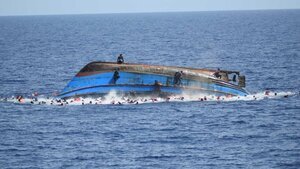
A boat carrying people seeking refuge in Europe capsizing in the Mediterranean last week
Our proud tradition as a nation that speaks up for the voiceless is being undermined by the failure to speak up and demand a humanitarian response to the continuing crisis on Europe’s shores.
Ireland was once the country that people under threat of starvation, torture and war could count on for solidarity.
When others turned away, we offered shelter during the Bosnian conflict, brought the plight of Somalia to the floor of the UN and stood firm against apartheid.
Unfortunately the same cannot be said in terms of the current crisis.
Ireland must refocus the European and global debate away from bogus arguments and back to the needs of men, women and children fleeing barrel bombs, chemical attacks and executions.
We must speak up and demand safe legal channels to Europe, with every country doing its bit and offering people a genuine chance to restart their lives.
Our silence, coupled with the continuing unacceptable delay in honouring our own promise to shelter 4,000 people, is difficult to understand – in particular in light of the widespread public calls for action just six months ago.
It is time for Ireland to rediscover its humanitarian voice and show the most vulnerable people of the world that they are not forgotten.
Brian Killoran,
Chief Executive,
Immigrant Council
of Ireland,
2 Andrew Street,
Dublin 2.
Ireland and a humanitarian crisis (Irish Times letters page)
Pic: Al Jazeera

https://vimeo.com/165599754
A short documentary, by Irish activist Caoimhe Butterly, filmed at the makeshift refugee camp in Idomeni last month – the camp which the Greek authorities began to evacuate yesterday.
The Border — الحدود is one of three short films directed and created by Ms Butterly.
Two more films, about the Piraeus port and Eko camp will be released soon.
Meanwhile, earlier today Taoiseach Enda Kenny fielded questions in the Dáil about his most recent European Council meetings.
The EU-Turkey deal and the humanitarian crisis regarding refugees were raised.
Readers may wish to note that a) there is video footage which seemingly shows the Turkish coastguard attempting to sink boats crossing the Aegean Sea; b) it’s generally understood that smugglers are not present on the vast majority of boats that arrive in Greece but would rather be found on the shores of Turkey; and c) concerns have been raised about the camps to which people who have been subsisting in Idomeni are being moved.
Mr Kenny said:
The real argument at the European Council was because of the endless flood of people coming from Turkey, in particular, due to its proximity to Greece. Be they from Afghanistan, Pakistan, Syria or elsewhere, these people have paid large amounts of money to get on inflatable rafts.
It is fine until one hears the Prime Minister saying that they are loaded onto these boats and as soon as they are out on the sea and the first ship appears, in many cases the inflatables are knifed and sunk so they end up in the water and have to be rescued. That is why there is a NATO operation under way off Turkey. It has been successful to an extent but not in the way it should be.
The reason for the European deal with Turkey in the first place was because they wanted to focus on dealing with people smugglers. One can deal with them in an effective way by patrolling offshore while being able to return people entering Europe illegally to where they came from, whereas others who have arrived in Turkey and are based in camps but who wish to be relocated to a European country have whatever the categorisation might be to say they want to be legitimately recognised as refugees or asylum seekers and they want to live and go to Europe.
Those who have paid money to people smugglers and are sent across the short distance to the Greek islands do not have the same intent, whether they are in a camp in Turkey or wherever.
In addition, Fine Gael TD David Stanton also spoke about the humanitarian crisis – after he was asked about the evacuation of the camp at Idomeni by Independents 4 Change TD Mick Wallace.
He said:
The Deputy [Mick Wallace] also referred to the closing of the refugee camp in Greece. It is my understanding that no official camp exists in Idomeni. Exploitative people smugglers have encouraged desperate asylum seekers to congregate on the Greek border with Macedonia by spreading misinformation to suggest the border crossing will soon re-open and allow them continue their journey to destination countries, including Germany and Sweden.
The Deputy pointed out that the conditions where many vulnerable women and children have gathered are unsanitary and unsafe. I understand from Greek authorities that their intention is to move asylum seekers to reception centres, where their needs, including food and medical care, may be adequately met.
Right so.
Yesterday: Meanwhile In Idomeni
The Border – Idomeni (ROAR magazine)
Transcripts via Oireachtas.ie and Kildarestreet.com
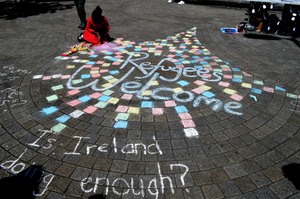

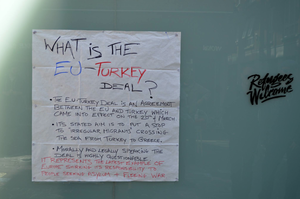

Last Saturday in Dublin.
Members and supporters of the Irish Refugee Council, End Direct Provision Dublin and the Dublin Calais Solidarity gathered at St Stephen’s Green, the Central Bank, and the Italian Quarter to raise awareness about the humanitarian crisis concerning refugees.
Thanks Caroline Reid

At it’s most fundamental, it’s not a migrant crisis, its’ not a refugee crisis – this is first and foremost a human crisis.
The terms ‘migrant’ and ‘refugee’ become weighted with connotations and they have too often have become terms that we use to almost distance ourselves from the humanity of the situation and that is desperation of men, women and children taking a risk-laden journey to try to escape the horrors of terror for survival.
I mean, at it’s very most fundamental, it’s about survival. And in our own DNA we understand that because we have a history, be it in the mid-19th century, but we are actually the survivors of that and it’s in our DNA and it’s part of the reason why I think we understand it more than most.
Social Democrat TD Catherine Murphy speaking this afternoon.
Previously: ‘A Beautiful Thing To Do’