Tag Archives: refugees

Screen Shot 2016-04-25 at 11.03.21Screen Shot 2016-04-25 at 11.02.54

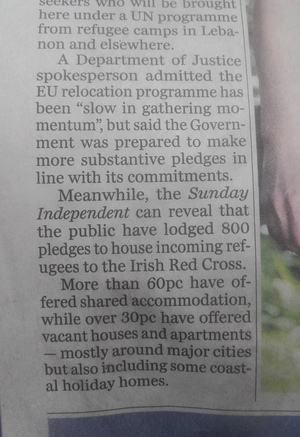
Yesterday’s Sunday Independent

Yesterday’s Sunday Independent reported how the Irish Red Cross has been contacted by 800 people in Ireland who wish to offer accommodation for refugees.

Further to this…

https://www.youtube.com/watch?v=psuUSWm21cI

Independent TD Mick Wallace speaking in the Dáil on Thursday, following a recent trip to the makeshift refugee camp in Calais, France.

During his speech, he implored Ireland to do more for the people languishing in Calais and Dunkirk.

He said:

Last weekend, Deputy Clare Daly, a solicitor called Gary Daly from Dublin, and I went to Calais for the weekend and spent three days there – two days in the Jungle camp in Calais and a day in Dunkirk. It is hard to be well after what we witnessed.

It is hard to be well thinking about the role that the EU is playing in the issue of refugees at the moment. It is bad enough that Ireland has been complicit by allowing Shannon to be used as a US military base. We seem to be very comfortable with it – 2.5 million troops have gone through Shannon since 2001.

Anyone who pretends to think that this is nothing to do with the refugee problem is living in cuckoo land. We have been complicit in the destruction of the homes of millions of people.

We saw the end result of it in Calais and Dunkirk last weekend. It is just horrific where these people are today. It is horrific that the EU has played such a poor role in it. Last year, we had the release valve of Germany doing the right thing and taking close to 1 million people. They cannot do it again this year. There will be a serious problem.

The EU can block all the borders it likes but the refugees will come.

In terms of the Greece-Turkey situation it will be a bit more difficult for them now there but it means there will be more of them on the Mediterranean this summer.

The deal the EU did with Turkey and Greece is shameful. We met Kurds in Dunkirk. The notion that Turks will actually arrive on islands off Greece and be forced back to Turkey is beyond thinking about.

We talked to a guy called Beshwar Hassan who is the head of a refugee council in Dunkirk. These people are afraid of their life of the Turks because of what the Turks have been doing to them.

Today in Turkey it is possible for ISIS to get direct access to hospitals and there are special supermarkets that it can access. How in God’s name could the EU take the position of allowing Turkey to play this role? We pay them for doing it.

This is not the answer to the migrant problem. Turkey will make things worse for these people and it will not solve the problem that is arriving in Europe. We are still saying we will not take people who have arrived in Europe and that they will have to be assessed outside of Europe.

We met kids of 11, 14 and 15 years of age, a lot of whom were Afghan. Calais is dominated by Afghans. There is a fear in Ireland that a lot of these people are terrorists and could cause trouble here. Afghanistan is in bits.

The pretence that things are sorted in Afghanistan is total nonsense. We met a lot of Afghans over the weekend and most of them were running from the Taliban and from ISIS. This time last year, they reckon that there were 100 ISIS fighters in Afghanistan.

Last week, they claimed that there are 10,000 of them. The Afghans that we met were at pains to point out that ISIS is now more powerful in Afghanistan than the Taliban and that the Government is a sideshow.

Most of the people we met in Calais who had to run had nothing to do with the Government, the UN or the US army, but some of their cousins had. They are afraid of their life of the Taliban and ISIS, both of which said that their cousins would have to stop doing this, that or the other or that they had done this, that or the other in the past and will pay a price for it.

They have had no choice but to get out of the country. They told us of an Afghan who, after spending six months in Calais, just could not take it anymore. He had mentally had enough of it and decided that he was just going to hand himself in and go home. He went home and was dead in two weeks. It is not a safe country to return anyone who has run out of the place. It is out of the question.

I think the Irish Government should look at the camps in Calais and Dunkirk. We have met many good people there – people who have a lot to add to society here. It would be such a gesture to go over there, process people, take them from these camps and bring them to Ireland to settle them. It would mean so much and it would be a beautiful thing to do.

Transcript via Oireachtas.ie

CgjiswQW0AA31oq6283-itok=iVM-iHcE

From top: A Kurdistan family of six who have been living in a tent in Piraeus port, Athens in Greece for more than 40 days; European Council president Donald Tusk

Ahead of his and German Chancellor Angela Merkel’s visit to a refugee camp in Gaziantep, Turkey tomorrow, the president of the European Council, in today’s Guardian, writes:

Only strong states are capable of supporting those in need on a large scale, without the risk of self-destruction.

Tough policies do not rule out humanitarian goals – quite the opposite: only determined policies enable their implementation. If we want Europe to remain open and tolerant, we can no longer allow ourselves to be helpless.

We need the solidarity and determination of all member states in every aspect of migration policy: relocation, humanitarian aid, external actions, and most crucially protecting our external borders.

What is at stake is not only the future of Schengen, but the future of our community.

Recent experience with Turkey shows that Europe must set clear limits to its concessions. We can negotiate money but never our values.

We cannot impose our standards on the rest of the world. Equally, others cannot impose their standards on us.

Our freedoms, including freedom of expression, will not be part of political bargaining with any partner. The Turkish president must heed this message.

By being tough on migration Europe can also be humane (Donald Tusk, The Guardian)

Previously: ‘We Can Bus The Refugees To Greece’

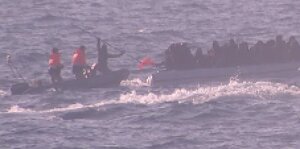
One Love

Pic: MSF Sea

CgVEk5jWcAI_-cx

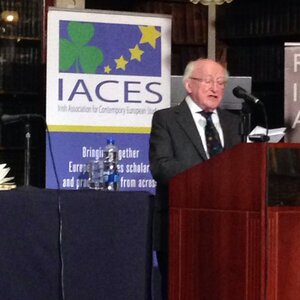
From top: A video of Dr Conor Kenny, based in Idomeni, explaining how he treated three children under the age of 10 for plastic bullet wounds to the head on April 10; and President Michael D. Higgins speaking at the Royal Irish Academy earlier today

President Michael D. Higgins, who turns 75 today, addressed the Irish Association of Contemporary European Studies at the Royal Irish Academy earlier today.

During this speech, he spoke about Europe’s collective response to the 1.5million people who’ve travelled to Europe in the pursuit of refugee protection.

From his speech…

Why did the member states of one of the globe’s richest and most powerful entities, a Union of 508 million citizens, feel so threatened by the arrival of a 1.5 million refugees and migrants last year?

This, I contend, is revelatory of a certain perception of ourselves as Europeans, one that is predicated on fear. It reflects a sense of helplessness, which of course is far from irreversible, should our elected representatives, our public intellectuals, our media, show constructive leadership and craft a discourse of confident hope for Europe.

Instead, in their coverage of the “refugee crisis”, European media have tended to conflate the image of Europe with that of the small Greek island of Lesbos; they have presented to us a vision of Europe as a frail isolated rock overwhelmed by a tsunami of uprooted people.

When one considers the prosperity and the rich diversity of so much of Europe, where so many people from all regions of the globe have settled peacefully and successfully over so many decades, confidence, not apprehension, should guide our response to the arrival of new migrants.

Yet, whereas one might have expected, in the face of the new challenge, a reviving of the old European adage – “strength through unity” – what we have witnessed instead is a ruinously and narrowly self-interested response on the part of many member states.

There were, and it is important to acknowledge them, several remarkable exceptions to such approach; but the rejection of the European Commission’s proposal for a binding quota system has left the “frontline states” of Greece, Italy and Malta to rely largely on their own, limited, resources in responding to the urgent needs of so many migrants and refugees.

This calamitous situation does not just jeopardise the future of Schengen and the principle of free circulation within the EU; it is also indicative of a severe breakdown of trust amongst the EU member states. Most alarmingly, it has the potential to undermine the values and principles at the basis of that humanistic spirit to which Europeans recommitted themselves after the devastation of World War II.

Can we leave millions of mothers and fathers, teenagers, children and babies, to wait in uncertainty, hopeless poverty and squalor at the border of Europe? Can we avert our gaze from the even larger numbers of those who are trapped in precarious camps in Turkey, Lebanon, and Jordan? Is our response to be defined by barbed wire, tear gas and rubber bullets?

We might, at this crucial juncture, recall the words of Hannah Arendt in her essay, “We Refugees”, written in the midst of World War II, when Jewish refugees from Poland, Germany, Austria, Romania, and elsewhere had found themselves trapped, in an utter state of vulnerability, in the middle of Europe:

“Refugees driven from country to country represent the vanguard of their peoples … The comity of European peoples went to pieces when, and because, it allowed its weakest members to be excluded and persecuted.”

Unfortunately, the element of fear, exacerbated by the threat of terrorism, has only increased our European leaders’ urge to find ways, to curb the influx of refugees at all costs, so as to reassure public opinions who tend to view through the same anxious lens “security crisis” and “refugee crisis”.

Many commentators have rightly noted that such hasty responses, sometimes achieved in disregard of usual European rules and procedures present serious risks for the rule of law and the principle of human dignity as cornerstones of the European project.

The agreement struck last month by Turkish Prime Minister, Ahmet Davutoglu, and EU leaders is an important effort at countering the exploitation of migrants by ruthless smugglers.

However, we must ask ourselves, does this agreement provide a lasting solution to the crisis? Will refugees not seek alternative routes for coming to Europe? And, most importantly, can such an agreement fully and effectively respect the human rights obligations which provide the foundation for the European legal order?

These are essential questions which remain to be adequately answered. I strongly believe that we should be wary of bending European and international human rights legislation to breaking point. The contravention of core principles might be politically convenient in the short term, but such breaches would only jeopardise the survival of our European Union in the long term.

Moreover, if we fail to uphold the values of human dignity and respect in our response to the plight of refugees, how could we expect to be taken seriously when we ask, quite rightly, that the newcomers also respect such fundamental European values as freedom of speech, freedom of expression and gender equality? How can we speak with authority, given such departures from what we previously acknowledged and proclaimed were universal principles?

These are the questions that were posed to us this week also by Pope Francis and Patriarch Bartholomew during their visit to Lesbos – the moral questions which are inescapable for all Europeans at this time.

They are questions, too, which are given a further poignant urgency by the reports emerging today of further tragic losses of life in the Mediterranean.

To give protection, food and shelter to those who are fleeing war, oppression or starvation is a matter of fundamental, universal human solidarity. It is also a matter of legal responsibility.

EU member states, through their being party to the Geneva Convention of 28 July 1951 on the Status of Refugees, have a duty to do their fair share to resettle people in need of international protection. There can be no cap on this fundamental responsibility, no limit set on the number of those eligible to request asylum.

The right of asylum – the notion that a person persecuted in their own country may be protected by another sovereign authority – is, as you all know, an ancient juridical concept, and one that is a corner stone of the European legal order.

Some of our most prominent European thinkers have been refugees: René Descartes, for example, who was persecuted in France by Voetius and his followers, sought refuge in the United Provinces [the Netherlands], while in the same years, French King Louis the XIII refused to extradite Dutch citizen Hugo Grotius, one of the founders of international law – the same man who wrote of asylum that it existed for those “who suffer from undeserved enmity”.

Rather than responding with regression to short-term interests, we Europeans can with so much benefit draw on our rich intellectual and philosophical tradition as we seek, in our time, to find a just compass by which to define our relation to the other, the stranger of today, the fellow-citizen of tomorrow.

In 20 years from now there will be Syrian men and women who will remember what happened to them in Europe as children, how they were kept waiting in the icy Balkan winter before being sent back to the other shore of the Mediterranean, or, on the contrary, how they were offered hospitality in a new country, and how they were able to rebuild their lives free of fear and embrace the opportunities to contribute to a new Europe of prosperity and tolerance.

As I wrote these words, I thought too, of my speeches in recent years in Boston, Chicago, New York where I spoke of the post-Famine Irish migrants arriving in the ports of Canada and the United States.

For us to have a positive, practical and human response to the current situation, for Europe to accommodate the dreams and hopes of so many families currently on the road, it is imperative, I believe, that we also focus on building up social cohesion within our states.

All of us Europeans should make it our priority to build thriving, inclusive societies, not just for our citizens, but also for all those residents of the European Union who were born elsewhere.

This involves, of course, adjusting our labour markets and crafting bold and ambitious policies in such fields as education and schooling, language training, housing, as well as political participation.

Read the speech in full here

Related: Idomeni: ‘I heard screams as people ran from the border fence’ (Irish Times)

Previously: For Your Consideration: Borderland

When People Are No Longer Considered People

10522601_995381203876658_3016546357826137401_n

Deportations from Greece to Turkey by Frontex officials under way this morning

The deportations under the EU/Turkey deal in relation to refugees began this morning with boats leaving the island of Lesbos and Chios for Turkey.

The Guardian reports:

Two boats carrying the first migrants to be deported from Greece to Turkey under an EU deal with Ankara have arrived in the Turkish port of Dikili.

Officials from the EU border agency Frontex said the boats, which departed from Lesbos, were carrying 131 deportees, mostly Pakistanis, Bangladeshis and Moroccans who were already being deported to Turkey before the deal’s creation. This means Monday’s deportations are not a true test of whether the agreement can stop the flow of mainly Syrians, Afghans and Iraqis to Greece.

…Eva Moncure, a Frontex spokeswoman, said there were no children on the first two boats. Two Syrians were onboard, including a woman who had volunteered to return.

The deportations on Lebsos were calmly carried out at dawn, several hours ahead of schedule… Disembarkation was delayed while officials erected a white tarpaulin on the boat to block the media’s view.

A Turkish catamaran was also transporting refugees from Chios, a Greek island near Lesbos, on Monday morning. Local TV reported that 60 migrants and refugees were on board. Volunteers on the island alleged that they saw police beating deportees at the quay.

…Anas al-Bakhr, a Syrian engineer from Homs who is among those stuck on Chios, said police marked his arrival date as 20 March – when the deal came into force – even though he arrived the day before.

“They said the computers were broken that day,” he said.

Meanwhile, in Dikili, Turkey…

UPDATE:

First boats returning migrants and refugees from Greece arrive in Turkey (The Guardian)

Previously: Return To Sender

Pic: AA

CeU-Du6UMAA1Y13Screen-Shot-2016-03-07-at-15.34.17-1024x555

From top: People at Moria detention centre in Lesbos; acting Taoiseach Enda Kenny in Brussels for a meeting between Turkey and the EU heads of government on March 7

Further to the EU/Turkey deal

On Tuesday, journalist Oscar Webb, from Lesbos island, reported:

Up to 190 shipping containers are on their way to Lesvos, Samos and Chios, to be used as offices by 600 EU asylum officials and 430 interpreters. According to the terms of the deal between the EU and Turkey that came into effect on 20 March, ‘all new irregular migrants crossing from Turkey to the Greek islands … will be returned to Turkey’.

Sixty judges will preside over appeals committees – also to take place in containers – for people who do not immediately accept deportation orders. And 2500 police, security and army personnel from Greece and other EU states, with eight ships and thirty coaches, will enforce the deportations. Until the material and manpower arrive, the refugees and asylum seekers are waiting in detention camps on the islands.

On Lesvos, close to a thousand refugees – the unlucky ones who arrived, in some cases only by minutes, after the 20 March deadline – have been placed in the island’s only detention centre, near the village of Moria.

They were met at sea and on the beaches by police who took their photos, gave them numbered wristbands, issued them with arrest papers (‘you have been legally arrested … currently you are being held here legally and temporarily … please be patient’) and took them to the camp. More arrive almost every day.

Conditions are bad in the Moria camp. The Greek authorities are struggling to look after the detainees without the help of charities and volunteers. Last week, the UNHCR, Médicins sans Frontières, the International Rescue Committee, Save the Children and the Norwegian Refugee Council all said they were pulling out.

Further to this…

The Department of Justice released a statement earlier this morning, saying:

Ireland will shortly be sending three international protection case work experts to the Greek Islands. The experts will come from the Office of the Refugee Applications Commissioner (ORAC) and the Irish Naturalisation and Immigration Service (INIS).

Ireland will also be offering the services of two members of the Refugee Appeals Tribunal to support the establishment of Appeals Committees. This is also being coordinated by EASO [European Asylum Support Office].

The agreement requires that the return of irregular migrants to Turkey will take place in full accordance with EU and international law. Furthermore, all migrants must be protected in accordance with the relevant international standards and in respect of the principle of non-refoulement.

This contribution will be on top of the four Irish experts sent earlier this year from the Irish Naturalisation and Immigration Service and the Office of the Refugee Applications Commissioner to Greece and Italy to support the relocation of asylum seekers under the EU Relocation Programme.

Ireland is also considering a request from Frontex to EU Member States for the deployment of border Guards to assist in the return of people from Greece to Turkey in compliance with international law. There are some limitations on what Ireland can do, given it is not a member of Frontex, but it would like to help where it can.

Meanwhile, Hannah Lucinda Smith, in The Times reports:

Turkish border forces are shooting refugees dead as they flee the civil war in Syria, The Times has learnt.

Sixteen migrants, including three children, were killed by guards as they crossed into Turkey over the past four months, according to the Syrian Observatory for Human Rights, a monitoring organisation.

An officer in the British-backed Free Syrian Police and a Syrian smuggler living in Turkey said that the true number was higher.

The deaths cast further doubt on an EU migrant deal struck 11 days ago. It classes Turkey as a “safe third country”, meaning refugees can be returned there without fear of persecution.

Update on implementation of the EU – Turkey migration agreement (Department of Justice)

Waiting for the containers (LRB blog, Oscar Webb)

Turks shoot to kill as refugees cross border (The Times)

Previously: ‘Can Ireland Not Do Any More?’

Ireland And The Turkey Refugee Facility

Turkey Basting

Top pic: Oscar Webb

H/T: Subpri.me

CdcwwJDWoAERzP4

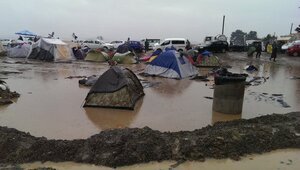
The makeshift refugee camp at Idomeni, at the border of Greece and FYROM

Emma Spence, from Glasgow, Scotland, has been volunteering with the refugees in Greece for the past few months.

She’s currently in Idomeni, at the border between Greece and former Yugoslav Republic of Macedonia (FYROM), where an estimated 12,000 to 15,000 refugees and migrants have been living in squalor for a number of weeks.

Last Tuesday, in defiance of the border being closed, approximately 2,000 refugees walked several kilometres from the makeshift camp in Idomeni in search of a gap in the border.

They did manage to enter FYROM, by crossing a river, only to be rounded up and returned to the camp.

Further to this, and following the EU/Turkey agreement reached on Friday, Emma writes:

The images cannot capture it: the desperation, the push, the fear, the unstoppable movement. Nor can they show the extent, the sheer number of people forming the swollen trail, marching themselves and dragging themselves for 10-15 kilometres over hills and through rivers toward the glimmer of hope that they could pass through an opening in the border fencing, and finally, after weeks of waiting, waiting, in the mud and the cold, move onwards.

The exodus from Idomeni camp, Greece, by the border to the Former Yugoslavian Republic of Macedonia, on Tuesday, March 14, is estimated to have involved around 2,000-plus people.

No words can capture it.

I was present, witnessing helplessly the people whose tents I have been trudging between for the recent past, now out in the open with their energy vibrating more powerful than anything I had ever seen, overwhelmed by both their strength and by fear at the knowledge of their vulnerability.

Nature can be rough but does not discriminate; border police can be rough, and they do.

Most people had little idea where they were going. They were following the others, traipsing after a tenuous dream. The group was not formed of the young and the able. It comprised everyone. From the fittest who strode on with a sense of elation – finally, movement! – to those leading children, carrying children, the pregnant women, the elderly, the disabled, everyone, they pushed on through mud trails in rain ruined shoes.

Their mission was, in the end, futile.

All who made it through were returned to Greece. Their departure was no surprise to the Greek police, whose buses I saw upon several instances driving past the groups walking, walking, and, on the other side, awaited the Macedonian military.

This group of people did not arrive in Europe to hike through hills to find gaps in fences. They arrived, in pursuit of safety for their lives and those of their families, to follow a route which has become recognised and concretised through the installation of reception and registration centres, which with no warning and no dissemination of information was halted.

Idomeni has therefore now become the interminable waiting place for well around 12,000 people. The camp was designed for a tiny proportion of this number. Last week, estimates peaked at between 14,000 to 15,000; following trickling departures of buses to Athens, the spreading of people to surrounding areas, both to official military-run camps or to unofficial sites at gas stations or hotel car parks, alongside the chaos of the Macedonian flight, the numbers appear to have fallen, but it is almost impossible to call.

The ‘camp’ is a mud-filled, trash-filled, over-filled spread eagle of families crammed into summer-intended tents. The day time is a bustle of queues, of splashing through mud-lakes, of children falling out of tents and playing in ditches, of over-crowded distributions, of acrid camp-fires of firewood, broken pallets, branches, paper, dirty clothes, discarded packaging, plastic, and rubble; people walking, talking, running, shouting, over one another: there is nothing to do, other than stand outside, sit in a tent, build a fire, or wait. Wait for a sandwich, wait for a blanket, wait exhaustedly for a future.

The night time is a retreat to huddle inside under grey blankets, the billowing smoke of remaining fires hanging languidly over tent-tops, the constant coughs, splutters, cries of infants.

There is no information. Nobody knows. Everyone asks: when can we go? When can we go? We can’t live here. We can’t stay here.

Over one week ago, after the first heavy rains, I stood in Idomeni amongst the fabric sprawl that tumbles across fields, skirts the edges of rubb halls, skirts the wire fences which form distribution queues, backs into portable toilets, halves roadways, lines the railtracks, rolls back and back a ten-minute walk to the disused train station where abandoned trash-filled houses sit families in their corners and further back again as the tracks curve into the woods and tree branches are the props for impromptu shelters, swathes of rainbow splashes across bog-like grass divided by newly formed mud-lakes, and the thought came to me: these people have fled here across the sea in rubber dinghies, before which they fled war and fear, and now, here, under our noses, arriving to ‘safety’, they are faced with conditions worth fleeing – except, they have nowhere to go, no way to get there.

Two days ago, after a full week of heavy rain, their tents swimming in water and swimming in trash, it no longer mattered whether they had nowhere to go or no way to go there. They were going to walk there anyway.

I am only an individual. My view is small, biased, skewed, subjective. Words tend to lean towards a form of melodrama. However, at Idomeni, these categories are being surpassed, destroyed.

When thousands of exhausted people attempt to cross a churning, fast-flowing river, the current pushing against their tired legs as their tired arms hold their children above their heads, and they do this because they have been weeping for days for their children’s safety in damp, cold, dirty tents, straightforward ‘reality’ has mutated into something other.

The point is: this is not cinematic, this is not novelistic, this is not melodrama. This is the actual circumstance of each person’s life. And I would defy anyone to find me an individual who could stand before this mess, and with their own small, biased, skewed, subjective view, fail to find these living conditions anything other than horrendous.

One’s small, biased, skewed, subjective view could go further, and get mired in the politics of borders.

The last days have witnessed many extremely questionable decisions being taken as to the future of the apparently defunct Balkan route, and the extent of return agreements between the EU and Turkey.

These decisions form the entirety of people’s lives, and the dignity and security therein. Each person is a person, not a piece of currency, not the leverage of deal-makers. Or, as we are now being forced to consider: each person should be a person.

This move to the conditional indicates the dire level to which the politics of this situation have sunk. Aside from this political ‘bigger picture’, in the very concrete here and now, Idomeni is beyond questionable, unquestionable, there is no question. It is a disaster-site. It is squalor. The people have been abandoned as non-people, as inanimate bit-parts of a system that is now to be dismantled and disposed.

The destruction of this system is so essential that well beyond 10,000 people can be left to rot in the mud, not to mention the tens of thousands stranded across the rest of Greece.

Some aspects of this crisis are immersed in complications. Some aspects are so utterly simple, are the very basics of human safety and respect. A canvas roof to cover a child’s head should not be a preferential situation, it is the absolute minimum.

If Europe can throw billions at ‘protecting its borders’ but cannot hand over a few thousand to erect some liveable tents, this is a Europe in which actual human lives have ceased to matter.

There is no way to emphasise it enough to make it real. There are no words. A generalised description ignores the particularity of each individual, specific anecdotes exclude the masses.

Today I met, homeless, bedless, floorless: an eight-month pregnant woman with fever; seven adults sharing a three-person tent; a family of five with three infants, the mother, four-months pregnant, whose tent no longer has a door; a boy of ten or eleven I met two weeks ago who described to me being carted back from Macedonia in the back of a green truck packed with ‘hundreds’ of people; three different women whose husbands are in Germany, who had gone ahead to make homes for their families, from whom they are now stranded.

There follows a semi-constant stream of “hello-hello, how are you” and children who parrot “I love you, I love you, how are you, I am fine”; and everywhere is another story, everyone is another real individual, whose life has been reduced to the damp interior of a stale smelling tent and sliding and sticking through the mud to reach a rank smelling portaloo.

What people are being subjected to is not natural. It is not the natural ‘way of things’ that people have to put on fake lifejackets to travel petrified across the sea in the dark for thousands of euros.

I crossed the same route safely for twenty five. And it’s not the natural ‘way of things’ that people wait cramped for three or four weeks in a thin tent in a field with no information.

That only becomes the way of things when people are no longer considered as people. This backlog of tens of thousands in Greece created by the border closures imposed further down the line has created a crisis situation, but I cannot for a second believe that Europe does not have the resources or capacity to act.

So, every decision is political; permanent infrastructure is resisted because the creation of a permanent camp is not to be encouraged. Thus, once again, the decision-making process as to how people are to be treated and the value of their safety is relocated once again from the human level to a logistical level of keeping people out, whatever it takes, so that we can look the other way calmly, decide that the problem is now elsewhere, the pain is now elsewhere, the pain no longer exists.

Except: there are thousands of children sleeping in the cold, the damp, in their dirty clothes, in a thin tent in stagnant mud tonight, and it’s nowhere else but right here.

MSF Sea

Cd0ukCIW8AAK78xCd0rArGWwAUQ0boCd0sPYNWwAAra42

Photographs tweeted by Channel 4 journalist and cameraman Stuart Webb this morning allegedly showing members of the Turkish coastguard trying to damage the engine of an inflatable dinghy carrying refugees trying to reach Greece

Further to the talks continuing today in Brussels between the heads of the EU’s 28 member states and the Turkish Prime Minister Ahmet Davutoğlu – as they attempt to finalise a plan to stop migrants and refugees from reaching Europe…

Sue Conlon, of the Irish Refugee Council writes:

We are calling on the acting Irish government to refuse to sign up to a proposal of the European Council, discussed on 7th March 2016, forcing refugees who have entered the EU back to Turkey.

The proposed deal, in exchange for a further €3bn, resettlement of Syrians from Turkey as well as increased rights of entry to the EU for Turkish nationals, would breach international obligations not to return refugees to a country where they may face persecution or serious harm.”

“To date, Ireland has agreed to make a contribution of €22m to an initial EU payment to Turkey of €3bn. No indication has yet been given as to whether Ireland will contribute any further payments to Turkey or accept any more refugees other than those agreed to in September 2015.

However, the danger is that, notwithstanding that Ireland only has a caretaker government at present, decisions may be made which will see Ireland, with other EU states, sign up to an agreement that sees Syrians and other nationals in need of international protection, returned forcibly to Turkey in contravention of obligations under the Refugee Convention.”

“The essential commitment of signatories to the Refugee Convention is that of non-refoulement, the agreement not to return someone to the borders of a state where they may be at risk of persecution.”

Meanwhile, Amnesty Ireland has created a petition calling on Taoiseach Enda Kenny to refuse to accept the deal.

Those who wish can sign it here

Previously: Cannon Fodder

‘Can Ireland Not Do Any More?’

Ireland And The Turkey Refugee Facility

Pics: Stuart Webb

CdgVeZLW4AA8rqL Cdgc1K_UMAAaS_n CdgYdiwXIAAaHal

After days, and in some cases weeks, of up to 14,000 refugees and migrants waiting in deplorable conditions in Idomeni, journalists and volunteers working on the ground are reporting that thousands have started to march towards the border.

The Greek/FYROM border was closed off completely last week.

TIME reporter Simon Shuster tweetz:

“I’m with mass of refugees from Idomeni trying to walk through hills to Macedonia…Idomeni break-out today well-organised. Fliers printed out by refugees tell 1000s to walk to Germany. So far, so good. Police staying back.”

“Few dozen Greek police just tried and failed to block 100s of refugees breaking out of Idomeni. March continues. Local police chief on refugees breaking through: “Our orders are, No violence. That’s what Athens says. So what can we do?”.”

“March of refugees looks to be in 1000s now, more joining. Police drones monitoring progress toward Macedonia. Flier calling for refugees to march said: Germany wants to take you, Balkans only want money. If 1000s march, borders will open (paraphrase).”

Pics: Simon Shuster, Jim KroftDimitri Tosidis

Video: Fotomovimiento

Screen Shot 2016-03-07 at 15.34.17

Taoiseach Enda Kenny in Brussels this morning

In Brussels.

Several Irish journalists asked Taoiseach Enda Kenny questions as he arrived for a meeting between Turkey and the EU’s heads of states or government – to discuss the numbers of refugees reaching Europe.

It’s being reported that Turkey is now seeking €20billion in return for Turkey taking back all non-Syrian refugees from Europe.

In addition, Turkey wants faster accession talks and quicker visa-free travel for its citizens within Europe.

Readers may wish to note that Ireland’s naval service rescued more than 8,000 people from Italy-bound boats off the coast of Libya and haven’t been present in the Aegean Sea to date, where boats of refugees, leaving Turkey, are bound for the Greek islands.

Ann Cahill (Irish Examiner):Can Ireland not do any more? In terms of helping the situation. I mean we have very few of the EU’s first-time asylum-seekers last year and I know we’re taking some but could we not do more?

Enda Kenny: “The problem is not only on the Irish side, we’re actually not, as you know, part of the protocol, Ann, but the thing is that we’ve taken some from resettlement and relocation. We’re committed to taking 4,000 and we’re working towards that with the personnel that we have, from Ireland, coming to both Greece and to Italy and with the hotspots and the personnel working there.”

Cahill: “Can we not take more from Turkey?”

Kenny: “Well I think we should first of all be able to deal with what we’ve got with the commitment that we’ve entered into. I might say, I spoke this morning as well to the Minister for Defence [Simon Coveney], I expect that it’s our intention to send one of our vessels down to the Mediterranean again, in order to help with the situation there, in so far as humanitarian assistance is concerned whether that be as part of the formally, of the European response or on a bi-lateral basis will be worked out. But it’s our intention to send a further vessel down.”

Cahill: “And will they take people back to Turkey if…”

Kenny: “Well that has to be worked out in respect of sending them down first of all and in what role they’ll play there either as part of a formal European, humanitarian response or as a bi-lateral arrangement as we had before.”

Cahill: “And would you favour that, would you..”

Kenny: “I’m fully in support of the call and the intention of sending a further vessel down, they did rescue 8,000 people on the last occasion.”

Watch in full here

Previously: Cannon Fodder

Ireland And The Turkey Refugee Facility

‘We Can Bus The Refugees To Greece’

Choice Would Be A Fine Thing

Related: EU migration summit stalls as Turkey ups demands – live (The Guardian)

Screen Shot 2016-03-02 at 13.38.48

Are you an Irish emigrant?

Do you know any Irish emigrants?

Jason Deans writes:

Dear Broadsheet readers,

I am a visual artist from Dublin, currently on residency with Draiocht Arts Centre in Blanchardstown. I am working towards several solo exhibitions in the second half of 2016 and, as part of this, I will have a piece that will comment on both Irish emigration and the refugee crisis in Europe.

To expand upon this conversation I wish to include actual boarding passes and plane tickets from Irish emigrants, these can be either from the original trip to leave Ireland or from a return journey. The main focus is that the ticket be from an Irish person who has emigrated.

These boarding passes will form the bed for a sculptural rendering of the Irish Navy ship LE Samuel Beckett, which has helped save over 8,500 refugees in the Mediterranean during three Irish Missions in the last year.

If you would like your boarding pass to be part of the sculptural piece, please send your digital copies to jasondeans1@gmail.com. If you would like to post printed copies you can do, addressed to Jason Deans, Draiocht, The Blanchardstown Centre, Dublin 15.

Any delicate information such as passport numbers will be removed.

‘Any Observer’ Solo exhibition will run from June 8 to September 10 at Draiocht, Blanchardstown; in Platform Arts, Belfast, in October and The Linenhalls in Mayo, in November.

Jason Deans