Tag Archives: Symphysiotomy

Screen-Shot-2014-12-05-at-17.42.26

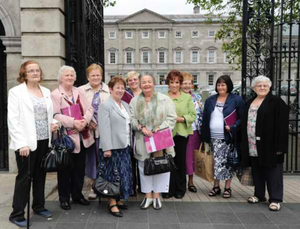
Marie O’Connor, chair of the Survivors of Symphysiotomy, with members of her group and supporters outside the Department of the Taoiseach in September 2014

Paul Cullen, in the Irish Times, is reporting that 53 women, who sought €150,000 compensation under the State redress scheme for women who had a symphysiotomy, have been told they won’t receive the money as it “was established they did not undergo the procedure”.

Mr Cullen also reports that retired judge Maureen Harding Clark, who has been assessing the claims, has warned that she might set a deadline for the furnishing of records “as ‘the scheme does not have an unlimited life’”.

Meanwhile, Mr Cullen reports:

[Ms Clark] said she understood some women have been unable to establish their belief they had a symphysiotomy because their records are not readily available.”

“Survivors of Symphysiotomy, a group representing women who had the procedure, said the scheme sets an “impossible” level of proof.”

“One woman was asked for receipts for incontinence pads she bought in the 1950s, [Marie] O’Connor claimed.”

Hmmm.

Symphysiotomy compensation refused to 53 women (Paul Cullen, Irish Times)

Government’s so-called “non-adversarial” scheme places impossible and unjust burden of proof on survivors of symphysiotomy (Survivors of Symphysiotomy)

Screen Shot 2015-01-05 at 12.28.40

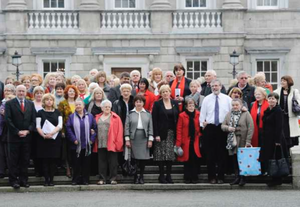
Members and supporters of the group Survivors of Symphysiotomy at an EGM in September 2014 with Rita Doyle, in the front row dressed in purple

Marie O’Connor, Chairperson of Survivors of Symphysiotomy, writes:

“We are appealing to the Master of the Rotunda Hospital to authorise the immediate release of obstetric records belonging to one of our members. The National Archives confirmed to a national newspaper in mid-December that they hold these records. They will release these records as soon as the Rotunda Hospital consents.”

“It is inexcusable that, three weeks after their identification, the hospital’s consent is still not forthcoming. While the hospital has cited staff shortages as a reason for not dealing with this in a timely manner, this is not a reason that can be applied here. The National Archives have been most helpful. All the usual demands, including a written request to be accompanied by photo identification, were met three weeks ago by our member.”

Ms [Rita] Doyle is one of a number of women deeply affected by the belated ‘discovery’ of thousands of maternity care records, some of which detail the performance of symphysiotomies and puybiotomies in three different hospitals. Documents relating to the Rotunda Hospital, such as theatre and birth registers, are held in the National Archives.’

“The Department of Health has failed to explain why these records were not disclosed in response to queries from our members. All the evidence points to a systemic cover-up. We must now ask whether the authorities intend to hold onto these vital records until after the final closing date for the Government’s scheme for survivors of symphysiotomy has passed.”

“Dáil questions asked by TDs at our request forced the disclosure of these records. There seems to have been an overarching intention on the part of the authorities to withhold them, even at the cost of breaching Freedom of Information and Data Protection legislation.’

“We appeal to Dr Coulter-Smith to consent to the release these records. Ms Doyle has waited for 53 years for the certain knowledge these records will bring: while it may not be be unlawful to force her to wait for another month, such an action would be inhumane as well as needless.”

Survivors of symphysiotomy appeal to the Rotunda Hospital for the release of key birth records (Survivors of Symphysiotomy)

Related: ‘They butchered me… now I will find the proof’ (Irish Independent)

Previously: ‘Many Women Had This Operation Wide Awake’

Thanks Marie

Pic: SOS (Facebook)

Screen Shot 2014-12-05 at 17.42.26

Marie O’Connor, chair of the Survivors of Symphysiotomy, with members of her group and supporters outside the Department of the Taoiseach in September

Symphysiotomies – which involved the sawing through of a pregnant woman’s pelvic bone to allow her to deliver her child – were carried out on around 1,500 women in Ireland, some of those women as young as 15.

In October, Al Jazeera reported that a symphysiotomy took place in Ireland in 2005, while it’s believed another took place just last year.

Most of the women did not know what was happening, nor did they give their consent.

The controversial closing date for applications to the symphysiotomy redress scheme was today – much to the dismay of the Survivors of Symphysiotomy group.

BBC Radio Four’s Women’s Hour show did a piece on the issue this morning. During the show, a symphysiotomy survivor, Margaret, told presenter Jenni Murray of her own experience fifty years ago, while Marie O’Connor, chair of the group, Survivors of Symphysiotomy also spoke to Ms Murray.

From the show:

Margaret: “In the afternoon, I had started labour and when I hadn’t the baby by, I can’t tell you exactly the time but shall we say three or four o’clock, he [doctor] came along and he said, ‘we will have that baby in a few moments’. I then had an anaesthetic and, when I woke up, I was totally incontinent, the baby had been delivered but I didn’t see him. And he was taken away. The bed was soaking wet underneath me. And this incontinence has remained with me even to this day. Though I have had several operations to have had it repaired, nothing has really worked.”

Jenni Murray: “Margaret, what had been said to you about what was going to happen to you?”

Margaret: “Nothing. And it was as simple as that, nothing.”

Murray: “And what explanation were you given when you came around?”

Margaret: “When I came around, I was in extreme pain. I asked the doctor, he was standing over me, ‘have I had a caesarean section?’. And he answered me, by saying, ‘It was an entirely different procedure’. And I don’t think, at that particular time, as we are talking about Ireland of 50 years ago, you didn’t really ask questions, you just did as you were told.”

Murray: “When did you find out what had been done?”

Margaret: “I had no idea for years, no idea for years.”

Murray: “And what were you told when you did make enquiries about it and found out what the procedure was?”

Margaret: “I didn’t make enquiries about the procedure because I thought it was something normal. This is one of the problems.”

Murray: “So, just explain to me what they have actually done.”

Margaret: “They had cut right through my pelvis and straight down, through my bladder and I’ve had my bowel damaged aswell. I went back of course, for my six weeks check-up. Now, to get into the car, and to go home was the first effort. I couldn’t walk, the doctor told me nothing was wrong with me but my nerves. Then my feet had to be cut together, and I had to be turned around to get my legs in and the same procedure for getting out. The same procedure took place for going to bed and the same procedure took place to get up.”

Murray: “What other operations have you had to have subsequently?”

Margaret: “So then I went in to our local hospital and the surgeon there said, I think I will refrain from saying what he said to me. I don’t think I will tell you what he said it was so awful. Anyway he decided he would do a sling, this would help. The sling is an incision from one hip to the other and they proceeded to pull your bladder up to try to tip it backwards to stop it leaking but of course he cut away the top of my bladder. It wasn’t there, so he couldn’t do that. I don’t know what he thought he was doing but anywyay, that is what happened. But then that particular sling went wrong very badly whether it was done wrong, of course needless to say, I wasn’t told but I swelled and my insides swelled and so I was taken to the theatre in the middle of the night and they undone it and then I went to that obstetrician who did the sling and that sling was correct and I was 40% continent after it. So when I went back to him, after six weeks, he said, ‘if you’d like to go for a baby again, if you’re not happy about having only the one child, perhaps you would then consider, you’re going to have to have a Caesarean section, because all the damage you now have.’ And I said, ‘yes, I will’. And I had three Caesarean sections without any problem.”

Murray: “What’s your reaction, Margaret, now to the amount of compensation that’s being offered?”

Margaret: “Well now the amount of compensation, actually, first of all my main thing is, I need to hear them say what they did to us was dreadful. Now I have had two ankle suspension done as well, I have had a decompression in my spine because I cannot walk properly and I can’t manage stairs which is in evidence here today. But I would like first for them to tell us that this was the wrong procedure and surely they can say that the damage they did to us was wrong and that we’ve had a lifetime of suffering. And he [Taoiseach Enda Kenny] thinks €50,000 is an offer? Forget it.”Continue reading →

Screen Shot 2014-12-04 at 12.53.30

MaireadSymphysiotomy survivors and supporters outside the Department of An Taoiseach last September (top) and Kent Law School lecturer Mairéad Enright (above)

Law lecturer Mairéad Enright has written about the symphysiotomy redress scheme on the Human Rights in Ireland blog.

From her piece:

The closing date for applications to the symphysiotomy redress scheme is this Friday. Assessment has already begun, some redress offers – a very small fraction of the total projected value of the scheme – have already been made and a very small number of those have been accepted.

I have written before about the core problem which has dogged this scheme since it was first proposed – it is simply incompatible, in principle, with the requirements of international human rights law. In particular, these women have not been offered any adequate remedy for breaches of their European Convention rights by the Irish state. O’Keeffe v. Ireland confirms that ex gratia redress without an acknowledgement of state liability cannot be considered an adequate remedy.

Since the scheme was announced, less than a month ago, it has been roundly criticised by expert commentators including, most recently, Sir Nigel Rodley of the UNHRC.

The devil is in the detail of the implementation. The time limit for application is unconscionable. The women had 20 working days to apply. This is the shortest time limit in the history of any State redress scheme: for example, the Residential Institutions Redress Board time limit was 3 years. The rudimentary progress reports published on the scheme website indicate that 70 women only received their application forms in the first week, because they requested them by telephone. The forms are, of course, available to download from the website, but the survivors of symphysiotomy are often very elderly and may not be computer literate.

Applications made after the deadline may be considered in ‘exceptional circumstances’, but in any case will not be considered if they are made after January 15 2015. ‘Exceptional circumstances’ is not defined within the terms of the scheme. It is worth noting that the same phrase affected the RIRB, and was interpreted in a very conservative fashion, to the particular detriment of applicants who took longer to apply because they were socially isolated, had intellectual or psychiatric difficulties, or lived abroad.1 It is beyond doubt that some women who deserve, in principle, to have access to state redress will go without it because the government refuses to give them more time. 70 women have joined Survivors of Symphysiotomy since the UNHRC hearings in July and there may be others. Two women recently brought a High Court challenge to the scheme because it was not clear that women with dementia could have a representative apply on their behalf.

The Department of Health said yesterday that 257 applications have already been made to the scheme. The progress reports give some indication of what is going on. It is not clear that the scheme can be considered a success. Certainly it is working very quickly. For example, in Week 1, 10 applications were made and 7 of these were assessed and offers made.

Everything is moving so quickly, not only because the volume of applications was very low in the beginning, but because assessment is done entirely on paper and payments are not individualised. The sole question for the assessor is whether to put an applicant in one payment band or another, or none at all. There is no hearing, and no finding of liability. Some applications have been rejected, and there is no appeal from the assessor’s decision.

The fact that so many women have made an initial application does not demonstrate that they are happy with this scheme or that they accept that it offers a better compensation package than they might obtain in court. On November 16, the majority of members of Survivors of Symphysiotomy (S.O.S.) voted overwhelmingly – not for the first time – to reject it. They have no obligation to accept any offer made under the scheme – they may yet withdraw.

The progress reports indicate that ‘a large number’ of the applications already received are awaiting medical records from hospitals or the preparation of specialist medical reports. This sort of problem was to be expected. Some women, for example, do not have their records because hospitals had levied unaffordable charges to provide them. Better consultation with Survivors of Symphysiotomy would have made this clear and the scheme could have been designed accordingly.

There are about 400 survivors of symphysiotomy known to S.O.S. The women who have not yet made an application may be experiencing related difficulties. How many have the necessary support to travel for medical and legal appointments, gather hospital documentation and so on? It will be very interesting to hear about women’s experiences of compiling and submitting their applications.

For now, the scheme trundles on. But this is not what proper redress looks like.

What’s (Still) Wrong with the Symphysiotomy Redress Scheme (Mairéad Enright)

Previously: What The Man From The UN Said

Nightmares

Sam Boal/Photocall Ireland

BxP2ZgfIgAAs3R7

BxPwKaoIIAAN_S1

Symphysiotomy survivors hold a protest over the State’s proposed redress scheme.

On RTÉ One’s Morning Ireland this morning, chair of Survivors of Symphysiotomy, Marie O’Connor, said:

“First of all there’s no admission of wrongdoing, secondly there’s the issue of legal rights – survivors will be required to sign away their legal and Constitutional rights as a condition of entry to the scheme, before they know the outcome of a process controlled by the State, in other words before they know what money they will be offered.”

Symphysiotomy redress scheme criticised as ‘fundamentally flawed’ (RTE)

Pics via Siobhan Bastible (top) and Sam Griffin (above)

Screen Shot 2014-07-29 at 00.51.34

Screen Shot 2014-07-29 at 00.52.04

Screen Shot 2014-07-28 at 23.35.14

From top: Members of the Survivors of Symphysiotomy outside the Dáil in 2012 (with Sinn Féin’s Caoimhghín Ó Caoláin and Gerry Adams) and (above) Sunday Times journalist, Justine McCarthy, investigative journalist Darragh McIntyre and Marie O’Connor, from Survivors of Symphysiotomy on TV3’s Tonight With Vincent Browne last night

Sunday Times journalist Justine McCarthy presented the Tonight With Vincent Browne Show last night and her guests included investigative journalist Darragh McIntyre and Marie O’Connor, from Survivors of Symphysiotomy.

During their discussion, Ms McCarthy spoke to Ms O’Connor about how the United Nations Human Rights Committee recommended that those who carried out symphysiotomies in Irish hospitals be prosecuted.

She then specifically talked about Noreen Burns, originally from Cobh, Co. Cork, who died very recently on July 19, 2014. In the Sunday Times at the weekend it was reported that Ms Burns had had a symphysiotomy, after she had her first child by caesarean section in 1959. The paper reported: “The child, Catherine, died. An ‘on the way out symphysiotomy’ (post-caesarean section) was performed to avert the need for future sections, thus allowing her to have many more babies. She went on to have six children, all delivered by either emergency or elective caesarean sections.”

Justine McCarthy: “At a press conference last week, responding to the UN committee’s report, you told the story of a 92-year-old woman who is suing over a symphysiotomy and she received a solicitor’s letter, I think it was on behalf of the National Maternity Hospital saying that she should accept the State redress offer and discontinue the proceedings against the hospital and, if she didn’t do that, they would seek legal costs against her.”

Marie O’Connor: “That’s correct, I actually have the letter here. The National Maternity Hospital threatened this 92-year-old applicant with legal costs should she decline a so-called redress scheme from the State, which has clearly been found defective by the UN human rights committee. And should she have the temerity to continue her legal action against the hospital, and of course, in a sense this had echoes of a previous outrage I suppose one can only call it, and that was a threat again of legal costs – which of course, as we know, is one of the most intimidating threats that can be levelled at a citizen – and this was made to Reena [Noreen] Burns. And, it’s a long story, I can’t go into it all but, suffice to be said, that the hospital only consented to having Reena examined after she had been placed on a ventilator, after her health had disimproved so significantly. And this, after two earlier requests, by the solicitors acting for Reena. Those requests were ignored. On the 4th of July, following receipt of a GP report, which said that Reena was ‘imminently grave’ was the term used. A fourth notification, from the solicitor again, the hospital said that the application for an early hearing was totally premature. And that they would be seeking costs for having to appear in court in order to block that application for an early hearing. And it was only after Reena had been placed on a ventilator, on the 8th of July, that the hospital consented to having her finally examined by their own doctors.”

McCarthy: “But it was too late because…”

O’Connor: “And at that point…”

McCarthy: “Mrs Burns has died since.”

O’Connor: “That’s right, yeah. Tragically. And she spent the best part of the last three years hoping and believing that she would come through this.”

Watch back in full here

Previously: What The Man From The UN Said

Meanwhile, In Geneva

Related: Woman (83) bringing case over symphysiotomy operation 50 years ago dies (Irish Independent, July 23, 2014)

Sasko Lazarov/Photocall Ireland

Screen Shot 2014-07-16 at 11.55.49

Last night’s Tonight with Vincent Browne was hosted by Tom McGurk and its panel included  Labour Party TD, Michael McNamara; United Left Alliance TD, Clare Daly; Deirdre Duffy, of the Irish Council for Civil Liberties; and Michael Clifford, of the Irish Examiner.

A short clip of Sir Nigel Rodley’s final comments at the UN Human Rights Committee in Geneva, Switzerland yesterday was played during the show, specifically this comment:

“The Magdalene Laundries, the Mother and Baby Homes, the child abuse, the symphysiotomy – it’s quite a collection and it’s a collection that has carried on [for a] period that it’s hard to imagine any state party tolerating. And I guess I can’t prevent myself from observing that [they] are not disconnected from the institutional belief system that has predominated in the state party.”

The panel then discussed this comment.

Tom McGurk: “Is it the fault of the State? Is it the fault of society? Has it got historical roots? Is it just fair to blame the State as simple as he is doing there?”

Clare Daly: “I don’t think it was simple at all. I think he was quite clear, I think his contribution was very much a solid defence of human rights and I think it was a vindication of a huge number of campaigning Irish groups, particularly women’s groups in some ways, to feel what they’ve been saying, maybe crying in the wilderness for years, has actually been vindicated now because on the whole symphysiotomy issue which was the first time that group ended up in front of the UN. I mean the committee were clearly horrified at what had gone on. These women had been butchered in their prime. He made the point that the UN had serious concerns about the fact that the redress scheme, that the government has put in place, is not compatible with our human rights legislation which I think is a hugely important step, because these elderly ladies have been trying to make that point here. When somebody externally makes that point which supports them, it actually shores up what they’ve been saying in an important way.”

McGurk: “Sure, but did it not need context, to understand where all of this came from? I mean it’s a very complicated…”

Daly: “It’s not that complicated really.”

McGurk: “Well explain what the medical profession were doing and where that came from.”

Daly: “Well this is a very simple issue of gross medical negligence, which is a point that the Irish State seemed to have not taken on board because it was never medically acceptable in the period in which these were…”

McGurk: “But where did it come from Clare? Widespread practice…”

Daly: “It came from, I suppose the belief is, a Catholic ideology existing in some of the private hospitals which felt that if you were a woman of child-bearing years well then your Catholic duty was to procreate as much as possible. And if your body, if you like, didn’t allow you, because of your shape or whatever, Caesarian sections obviously limit the amount of pregnancies you could have. So they chose, instead, to carry out this butchery of literally, and you know, the testimony is horrific but carving people up with saws in some instances. Instead to facilitate them childbearing, but it led to a lifelong disability, incontinence, lack of interest in sex, and huge difficulties in all of the years. And the idea that that would not be acknowledged is wrong which it hasn’t been by the Irish State. It’s just appalling to these women and instead we have this shabby little redress scheme with a paltry amount of compensation and that the women have to forfeit all of their legal rights before they can even access it. It’s completely wrong. This is gross medical negligence and should be compensated as such.”

McGurk: “Michael, has it been accepted as wrong?”

Michael McNamara: “By the State?”

McGurk: “Yeah.”

McNamara: “Well, I mean there is an ex-gratia compensation scheme but one of the issues with the State, I understand, is criticised for, and I didn’t see the entirety of the hearing, was the fact that there wasn’t a proper process of finding fault, in effect, and apportioning blame. But I suppose there has been a compensation scheme and I suppose, to many women, that will bring closure, but obviously the human rights committee…”

Daly: “The women have met, hundreds of them met last weekend, and it’s been unanimously rejected. I mean if you compare for example the Lourdes Hospital redress scheme where the women’s wombs were taken, there was €45million allocated to that scheme. The amount of payment was substantially more and it was deemed to be medical negligence and in this scheme the courts have awarded between €300,000 and €600,000 and yet this scheme is saying between €50,000  and €150,000 for permanent  lifelong disabilities and pain, that’s no compensation. But I think what’s more affront for the women is that nowhere has the State recognised and this is what the UN validated today, if you like, that it was a violation of human rights and  that it shouldn’t have happened, it was medically unwarranted, it should not have happened.”

McGurk: “Do you see Deirdre this as having considerable impact?”

Deirdre Duffy: “Yes, I do and I think…”

McGurk: “It’s different to something before, in many ways?”

Duffy: “Well, I think it can have as much impact as we want it to have, as a country, as a society, as a Cabinet, a Government that’s going to move on now. And Tom, you asked a series of questions about what happened back in the day, why did this occur, and that actually is what Sir Rodley was getting at. Michael [McNamara] used the term blame but actually the word that he [Rodley] used was accountability. So what he said was that even though this Government has put in place a redress scheme, they’ve allocated money, they’re focusing only on the pecuniary impact of this or the pecuniary redress. So what he’s saying is that you need to look further, you need to look at truth finding and accountability mechanisms because, you raised the questions yourself, it’s not clear to everyone within Ireland, why this happened..and how this happened.”

McGurk: “Yes, where did this come from?”

Duffy: “Now there have been reports, a number of independent reports from survivors and also  State-sponsored reports which survivors claim were not independent and not thorough and would find numerous faults with. But I think what’s important for us right now is what Sir Rodley said around the collection of activities that I suppose produce a, or refer to our past, past abuses. So issues like the Magdalenes, the mother and baby homes,  the symphysiotomy and the child abuse, these are relics of our past that we need to deal with and  sweeping them under the carpet and allocating some form of  monetary compensation to women – because it’s all women – is not going to be good enough. It does not meet the…”

McGurk: “So ideally, how should the State deal with this? Spell it out then?”

Duffy: “Well it should set up independent inquiries. It’s something that the ICCL, the Survivors of Symphysiotomy and other groups, Justice for Magdalenes,  have been calling for for a number of years. We know we’re going to get an inquiry into the mother and baby homes, under the Commission of Investigations Act 2004, so why not have an inquiry into this collective, as Sir Rodley called it, series of abuses?”

Watch in full here

rodley

Sir Nigel Rodley

Over the last two days the UN Human Rights Committee in open hearings in Geneva, Switzerland has been examining Ireland’s human rights record.

The committee’s chairman Sir Nigel Rodley closed proceedings today with an address that included the following..

Ireland’s treatment of women:

“the Magdalene Laundries, the Mother and Baby Homes, the child abuse, the symphysiotomy – it’s quite a collection and it’s a collection that has carried on [for a] period that it’s hard to imagine any state party tolerating. And I guess I can’t prevent myself from observing that [they] are not disconnected from the institutional belief system that has predominated in the state party.”

On Ireland’s laws on women’s reproductive rights:

“the recognition of the primary right to life of the woman who is an existent human being has to prevail over that of the unborn child and I can’t begin to understand by what belief system the priority would be given to the latter rather than the former. It is good to see that in 2013 at last that is clearly being clarified. I’m sorry that the clarification does not extend to the health of the woman.”

On the Protection of Life During Pregnancy Act:

“Life without quality of life is not something many of us have to choose between, and to suggest that regardless of the health consequences of a pregnancy a person may be doomed to continue it at the risk of criminal penalties is difficult to understand, even more so arguably for rape where the person doesn’t even bear any responsibility and is by the law clearly treated as a vessel and nothing more.”

ICCL [Irish Council For Civil Liberties] Wholeheartedly Endorses Coruscating UN Comments on Ireland (ICCL)

(Getty)

Screen Shot 2014-07-15 at 10.50.37

Nigel Rodley, UN Human Rights Committee chairman and, right, Justice Minister Frances Fitzgerald in Geneva this morning

UPDATE:

Watch proceedings at the UN Rights Committee in Geneva here

Nigel Rodley

Previously: Meanwhile, In Geneva

Related: Fitzgerald told Ireland’s abortion law breaches human rights law (Kitty Holland, Irish Times)

Screen Shot 2014-07-14 at 11.43.21

Marie O’Connor from Survivors of Symphysiotomy

“I raise a very serious breach of human rights not on the list of issues.

Ireland’s continuing refusal to admit that the practice of symphysiotomy from the 1940s to the 1980s was a human rights abuse has brought us here. Ireland was the only country in the world to do these childbirth operations in preference to Caesarean section. Religious ideology and medical ambition drove the surgery.

An estimated 1,500 women and girls, some as young as 14, had their pelvises broken, gratuitously, by doctors who believed in childbearing without limitation. Life long disability, chronic pain, mental suffering and family breakdown followed.

Patient consent was never sought: women were operated upon wide awake and often screaming: those who resisted were physically restrained. This was torture, cruel, inhuman or degrading treatment.

The State has failed to provide an effective remedy. There has been no independent inquiry, only two whitewash reports published 13 days before this hearing. The revival of symphysiotomy was a mass medical experiment that sharpened the need for patient consent, yet the government’s Walsh report justifies the involuntary performance of these operations.

There has been no restitution, only an ex gratis scheme – set out in the Murphy report – that our members have unanimously rejected. The scheme is based on the official lie that these operations were medically acceptable: it forces women to waive their legal and constitutional rights before they know the outcome of this State process. There is to be no independent board, women will have no right to independent doctors, nor will their lawyers have a right of audience.

The State claims it was not liable but these operations were carried out by State employees, and done in private hospitals providing services on behalf of the State, under its supervision.

We ask you to urge the State to finally vindicate the rights of these women under the Covenant.”

Marie O’Connor speaking at the United Nations Office of The High Commissioner for Human Rights in the last hour.  In total, 16 civil society organisations from Ireland will give brief speeches to the UN Human Rights Committee today.

The committee monitors states’ compliance with the International Covenant on Civil and Political Rights, which Ireland signed in October 1973 and ratified in December 1989.

Later today Justice Minister Frances Fitzgerald and her team of officials will go before the committee for three hours, followed up by another three hour session tomorrow morning.

Survivors of Symphysiotomy (Facebook)

Ireland faces questioning before UN Human Rights Committee (Kitty Holland, Irish Times)

Sam Boal/Photocall Ireland