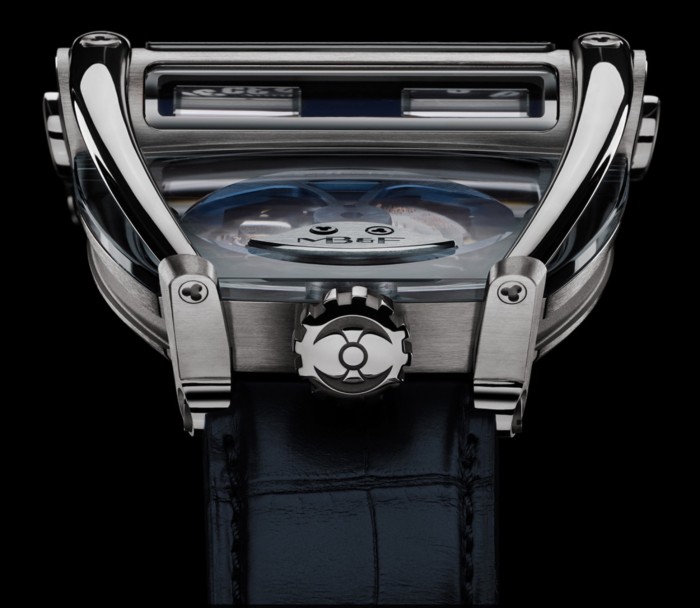
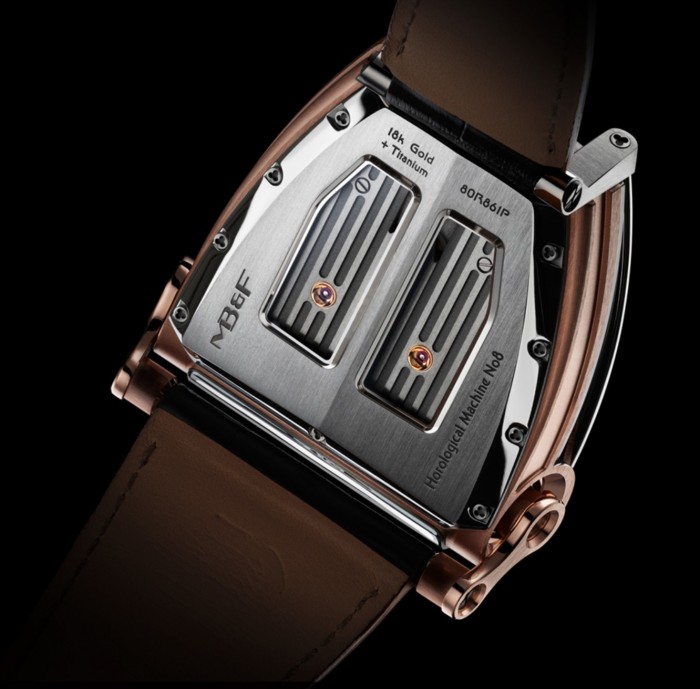
Behold the MB&F Horological Machine 8 – for those who like their time presented in stylishly complicated analogue form.
Bidirectional jumping hours and sweeping minutes glimpsed through sapphire crystal prisms in the titanium/gold enclosure, brushed gently by the pigskin leather of your handmade driving glove.
Behold the John The Baptists of the smart watch world.
Above: The Sinclair calculator watch kit (1976); Seiko Wrist Computer (1984); the Casio CMd-10B remote control watch (1993); the wrist PDA (2004) and Pulsar 18K calculator watch (1976), Nelsonic Star Trek II watch (1982) and Seiko TV watch (1983) and the Wrist Radio (1976).
Google’s new Android Wear operating system for wearables – social media, apps, jellyfish warnings and whatever you’re having yourself sent direct to your wrist.
The ‘planets’ rotate according to their actual solar years: Mercury goes round every 88 days, Venus: every 224 days, Earth: every 365 days, Mars: every 687 days, Jupiter: every 12 years and Saturn: every 29 years.
Uranus and Neptune are excluded because they take so long (84 and 164 years respectively) to orbit the sun, they would appear stationary on the dial.
Choose your lucky day and the Earth will align with the painted star to signify it.
Unveiled at the annual Salon International de la Haute Horlogerie in Geneva after three years of development, the timepiece is available to buy for a mere €180,000 and charge.