
Yearly Archives: 2013

9031626490210217(Assembling the polling station at the Labour Relations Commission, Haddington Road, Dublin, on Friday morning above and Dan Boyle at a Green Party think-in in 2011)

Dan Boyle writes:

Logic should have been to stay away, not to get involved. However much cynicism there was at what was being proposed and why, it seemed virtually certain that any proposal to abolish The Seanad would be guaranteed to succeed.

But democracy demands that arguments are made and heard. Even if those who wanted to make this case did so more out of hope than confidence. As time went on it seemed that the cynicism against politics that Enda Kenny wanted to ruthlessly use, was turning an opposite direction because of the hollowness and lack of sincerity people were sensing from the creator of this referendum.

Even then it still didn’t seem possible that a campaign could be won, the confidence being gained was that at least a fist could be made of it. It was a campaign of stimulating interest not winning hearts and minds. No person part of the NO campaign wanted to or was able to defend The Seanad as it is.

However it was also becoming clear that neither was The Seanad the repository of everything that is wrong with Irish politics, as an increasingly snide Fine Gael YES campaign was trying to portray.

While NO campaigners were at least being encouraged by having what felt like the stronger and far more sincere arguments, opinion polls and bookmakers were telling us otherwise.

The supposed strength of the Yes vote didn’t seem real either though. In whatever engagement there was with the general public in this campaign, and in truth it was little enough, there was no overwhelming sense that this was a burning issue for many people at all. In itself this was a factor that ended up turning many votes into the No column – that a question was being asked that few had wanted to be asked, when so many issues of greater seriousness were being sidelined.

What the opinion polls and bookies were not picking up was the difference between a soft yes and a hard no, as well as the army of the indifferent – fast becoming the dominant force in Irish politics these days.

Damage has been caused by this referendum. The damage will be most felt, and quite properly so, by The Taoiseach himself. This didn’t have to be done now or in the way it was. His and his government’s commitment to real political reform has been shown to be vacuous.

Then there is the collateral damage done to Sinn Féin whose plan to jump on the cynicism bandwagon has ‘blown up’ in its face.

Not that there are any real winners either. We are where we were with an imperfect political architecture and a political culture unable, or more probably incapable of changing itself. At best we have a springboard to have the debate that has been so long avoided, about the quality of our politics.

This debate should not only be about politicians or their parties but in opening ways in which the public does and can engage with political institutions. It has to be a deeper debate than the charade we’ve just had.

Dan Boyle is a member of the Green Party

(Mark Stedman and Sasko Lazarov/Photocall Ireland)
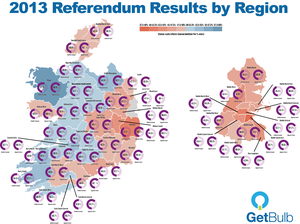
referendum results map fixed[Click to embiggen]

Jane from GetBulb writes:

We created this map to show the breakdown of results in the Seanad Referendum. We’re not in the business of political analysis, but we do love getting our spatial representation on.

The scale runs from blue (majority “yes” vote, yes being those in favour of abolishing the Seanad) to red (dark red showing a majority “no” vote). The patterns are interesting, in that the areas that returned a majority “no” vote roughly correspond to parts of the country that have larger urban centres, or are in the commuter belt for Dublin.


Election results at a glance


heatpaint

A Nissan Skyline R33 tricked out with heat-sensitive thermochromic paint (used in hypercolour T-shirts and mood rings) is exposed to cold water.

Granted, they should have used a hose, (or cooled the car and put it through a car wash) but you get the idea.

reddit/awesomer

Molloy


“The file was stamped “top secret” but it’s content related to one of the most explosive criminal investigations and trials this century. The file was so important that garda authorities were willing to trade it for a convict’s release from high security prison.”

“Within the folder were two documents, letters from a Circuit Court judge to the office of the Director of Public Prosecutions. They gave the judge’s thinking on a death that has mystified Ireland for nine
years.”

“Fr. Niall Molloy died in a violent argument in the bedroom of Theresa and Richard Flynn in Co. Offaly in 1985. The following year, with official investigations apparently concluded, Richard Flynn stood in a circuit court dock charged with manslaughter and assault.”

“He was acquitted after Justice Frank Roe accepted expert evidence that the priest may have not have died from his injuries but from a heart attack. An inquest jury found the priest died from head injuries sustained in the fight, a difference of opinion that led to nine years of speculation, some of it aired publicly in the Dáil.”

“This week it is Judge Roe’s letters to the DPP that bring new questions to a mystifying case. The Sunday Independent has also learned that Fr. Molloy’s last will and testament, believed missing for nine years, is said to have been sent to his Diocesan headquarters, and may have made provisions for Mrs. Flynn.”

“Judge Roe’s letters are remarkable, both for their contents and for the method by which they were made public. The Garda file in which they were held was one of 145 stolen by the late Martin Cahill, Dublin’s infamous General, from Garda headquarters.”

“Cahill used the file about Fr. Molloy’s death to bargain with the authorities, effectively promising its return upon release from an English high-security prison of a close criminal associate. The man was transferred to an open prison and then finally back to Ireland.”

“The file was returned but not before the General had taken photocopies of its content for further use. He told associates he planned to make its contents public, but he had not decided on the nature and date of their release when he died. Cahill had, however made sure a colleague was kept fully aware of the file’s location, and of its content.”

“Last week the Sunday independent was shown the two letters. One is hand-written and, from other examples of his hand writing, the hand of Justice Frank Roe, can be identified.”

“The first hand-written letter dates from before charges were made against Richard Flynn, and is a communication from Mr Roe to Eamon Barnes, the Director of Public Prosecutions. The letter says Mr Roe knew Fr. Molloy and the Flynns.”

“The second letter was written after the trial and is an explanation – the word ‘explain” is actually used – of Judge Roe’s reason for the dismissal of the charges against Richard Flynn.”

“Mr. Roe last week refused to discuss the letters. “That case is dead and buried,” he said. “I have nothing to say.””

“He also refused to comment on why he sent the hand-written letter to the DPP, and would not elaborate on his associations with Fr Molloy and the Flynns.”

“They were lovely people all of them.” he said “God bless them all.”

An extract from a front-page article by Veronica Guerin, published by the Sunday Independent almost 19 years ago, on October 16, 1994.

Related: The death of Fr Niall Molloy – as a member of the Flynn family, I’m appealing for the truth to be made known (Gemma O’Doherty, Irish Independent)

Previously: A Sordid Cover-Up

Gemma O’Doherty on Broadsheet.ie

Justice For Fr Niall Molloy (Facebook)

limerick postbikeDamn thieving hipster tykes.

Niall O’M writes:

The Limerick Post needs new bicycle stock photos. Please give generously. Also, why do the Guards want a bike destroyed?

Gun destroyed as bike gets new lease of life (Andrew Carey, Limerick Post)

90314390(From left: Simon Harris, Regina O’Doherty and Richard Bruton, Fine Gael’s Seanad Referendum campaign team)

Privately, they consume them as voraciously as a stray dog coming upon a scrap of food. The bigger parties, especially Fine Gael over the past decade, have been huge consumers of private polling. You can be as sure as night follows day the two lowest common denominator slogans that dominated Fine Gael’s posters – save €20 million and fewer politicians – came straight out of focus-group polling.

That was borne out by The Irish Times poll this week which showed that despite all the criticism of it being a “cheap shot”, the €20 million slogan was the pay-off line for the Yes campaign, with 43 per cent of Yes voters citing it.


Politicians publicly dismiss polling but are in fact in thrall to it (Harry McGee, Irish Times)


polling


With a week to go, the Yes side was comfortably ahead. The Irish Times/Ipsos MRBI poll conducted the previous weekend indicated a 24-point margin in favour of abolishing the Seanad. Then it vanished.


Why the voters proved the polls wrong on the day (Damian Loscher, irish Times)

(Mark Stedman/Photocall Ireland)