



Yearly Archives: 2016

The Hawe family home in Barconey, Ballyjamesduff, Co Cavan
Apart from one previous killing in the 1980s, the phenomenon of murder-suicides by parents in Ireland/Northern Ireland appears to have started around 2000.
There have been 24 incidents of completed or attempted filicide-suicides in the island of Ireland since the turn of the century. On average, there are only seven such cases a year in the United Kingdom.
So, why is this happening?
Unfortunately, because of the way in which filicide-suicide is currently dealt with it, it is almost certain that reported accounts are less complete than in the case of other crimes.
The inquest system – which is designed to focus on the cause of death of a victim rather than the motivation of a perpetrator – does not provide an adequate method of exploring the causes of filicide-suicide.
This is exacerbated by the fact that, due to the death of the perpetrator, such crimes are rarely followed by any criminal trial.
Much of the reporting and inquest proceedings involves the paying of tribute and sympathy to victims and perpetrators.
Media sensitivity and concern for surviving family members of the deceased also results in light reporting of the background to such crimes.
Overleaf, we have compiled all available information on each incident and, despite the lack of rigour in reporting these cases, some factors are notable..
The dramatic increase in filicide-suicide appears to largely coincide with an increase in the use of anti-depresssants.
Although in many cases the medical history of the perpetrators is not fully detailed, it appears that a number of the perpetrators had either recently commenced or ceased taking such medication.
A question arises as to whether or not this may have resulted in an extreme response to stresses, which might not otherwise have occurred.
The vast majority of the perpetrators were well regarded and integrated into the local community in which they lived. Most lived in rural areas and were active members of local GAA clubs and the local Catholic Church.
Something which may need to be considered is to what extent past sexual abuse of the perpetrators may be contributing to filicide-suicide in Ireland.
As with the role of anti-depressants, this is an issue which – although referenced in at least one of the cases listed – has been largely unexplored in coverage of these killings.
Without full State reports into all cases of filicide-suicides, it is not possible to ascertain what exactly is causing these crimes and take steps to prevent them occurring in future.
Such reports, which are mandatory in the United Kingdom in all cases of murder-suicides within 12 months of someone having dealt with mental health services, would not only provide information which would be of assistance in preventing future crimes but would also help the surviving family members of the deceased in understanding why exactly such crimes occurred.
Ironically, as illustrated by at least one of the cases referenced below, without a proper consideration of such crimes, these family members may not only be left without comprehension as to how such crimes occurred but may even become a target for gossip and misstatement in their local communities.
We will correct any errors.





MORE to folly.
Basketgolf
at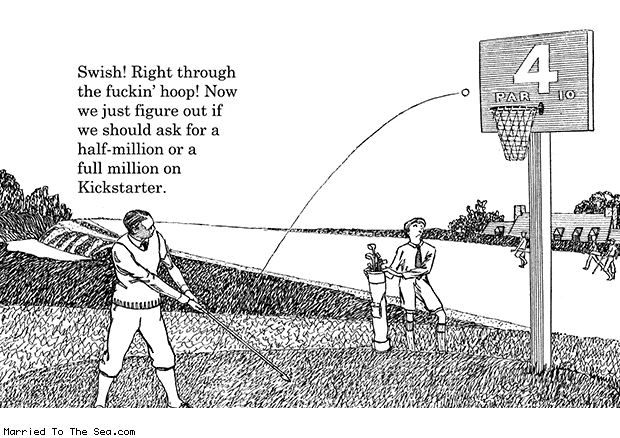

An excerpt from a 2008 Atlantic interview with director David Lynch, designed and directed by Jackie Lay. To wit:
A lot of artists think that suffering is necessary. But in reality, any kind of suffering cramps the flow of creativity.
[soundcloud url=”https://api.soundcloud.com/tracks/282537894″ params=”auto_play=false&hide_related=false&show_comments=true&show_user=true&show_reposts=false&visual=true” width=”100%” height=”450″ iframe=”true” /]
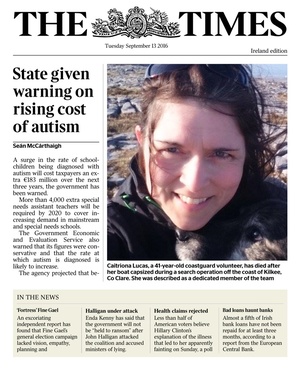
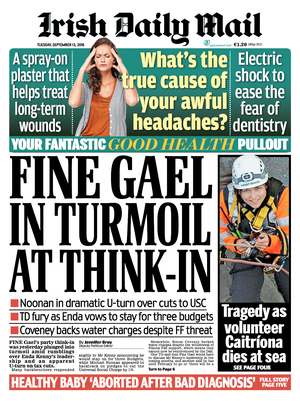
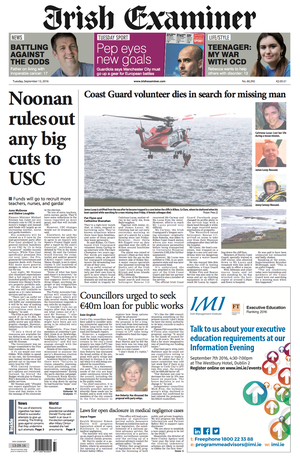
Taoiseach Enda Kenny, and Martin Hayden, chairman of the Fine Gael parliamentary party, at the party’s think-in in Newbridge, Co Kildare this morning, and the audio of an interview Mr Kenny gave to KFM Kildare this morning
On Saturday, Pat Leahy, in the Irish Times, reported that the C&AG found that hundreds of millions may have been lost in the sale of Nama’s Northern Ireland property portfolio, Project Eagle, to US investment firm Cerebrus.
It was reported that this loss may have been due to what the C&AG found to be “shortcomings” and “irregularities” in the sale.
The C&AG report is due to be published on Wednesday.
The report about the C&AG study followed a BBC Northern Ireland Spotlight programme into Project Eagle broadcast last week, which followed an earlier Spotlight programme in March – both of which made serious allegations about the Project Eagle sale.
Readers may recall how, on June 1, Taoiseach Enda Kenny told the Dáil:
“There has not been any allegation of wrongdoing against NAMA”.
In addition, on June 8, Mr Kenny told the Dáil:
“Nobody has presented me with evidence of wrongdoing by Nama”.
Further to this.
Taoiseach Enda Kenny spoke to Shane Beatty, of KFM Kildare, this morning, ahead of the Fine Gael’s knees-up think-in starting today in Keadeen Hotel, Newbridge, Co Kildare.
The C&AG report into NAMA was discussed.
From the interview…
Enda Kenny: “If I find… if I find, and our colleguess in Government, find that there is a case to be examined well then I won’t be opposed to that.”
Shane Beatty: “But viewers of BBC’s Spotlight will say we’ve already seen a case that I think we need to have an inquiry, why do we have to wait until Thursday?”
Enda Kenny: “There are two criminal investigations going on in a different jurisdiction.”
Shane Beatty: “None here.”
Enda Kenny: “None here, and the National Crime Agency in the UK have confirmed that there is no case that they have, or are in pursuit of, in repsect of NAMA down here. So, the C&AG’s report is about a ‘value for money’ audit and you, as was pointed out on many occasions… depending on the process you follow for valuations, you might get different results.
“If you, for instance, were to dispose of the properties now with the devaluation of Sterling you’d get a different result also. But I think this is an extensive report, we do need to read it, everybody needs to reflect on it. And if there are questions arising from the Public Accounts Committee’s engagment with NAMA, they are due in before them very shorty [September 22], I’m not adverse [sic] to taking action, but I need to know what is we are taking action on.
Shane Beatty: “Did you watch the Spotlight programme?”
Enda Kenny: “Yes I did, and I saw that, and I found it quiet incredible, but you know, Shane…”
Shane Beatty: “Incredible, how?”
Enda Kenny: “Nothing suprises me at the kind of activites that take place in politics. And in that sense I found it extraordinary to hear the audio report of engagements and meetings of certain personnel.”
Previously: Screech
Meanwhile, yesterday….
Labour TD and vice chairman of the Public Accounts Committee (PAC) Alan Kelly was interviewed on This Week by Colm Ó Mongáin following the reported findings of the C&AG report.
During the interview Mr Kelly said, in recent days, he was approached by a senior member of Nama ahead of Nama’s appearance before PAC on September 22.
From the interview…
Alan Kelly: The [C&AG] report on this should be released, and obviously then, Nama will come before the PAC. It’s a matter for Nama whether they want to make public statement on it, I believe they should, I believe they’ve been quite naive to a point in relation to this.
Even this week, a senior member of Nama contacted me to brief me before they met before the PAC. I redirected him to the chair of the PAC. I was not comfortable that selective briefings was the way to go to be appropriate given the situation we find ourselves in. But that just shows another level of naivety, I believe, in relation to Nama.
Colm Ó Mongáin: These briefings that were offered by Nama, how was that approach made and by whom?”
Kelly: “Ah well, I won’t, eh, get into individual, but, ah, just a call during the week to meet up. Look, I just explained the Public Accounts Committee is a different committee to every other committee, you know, it has different powers. And it wouldn’t be abnormal for other organisations to brief committee members of other committees but, in relation to this scenario, I think selective briefings wouldn’t be the way to go. And, obviously, I referred to the chairman in relation to this. But, for me, I didn’t think it was appropriately the way to deal with things.
Ó Mongáin: Is it your understanding that all members of the committee were offered these briefings?”
Kelly: “I have no idea, I was going to raise it with my committee colleagues when we meet. I doubt it, but I don’t know so I wouldn’t like to say indefinitely. But I will say this, I don’t think there was necessarily anything malicious or intentional in that way in relation to that contact… It’s another sense of naivety, I feel on the part of Nama in relation to how they do things. It gave me some concerns.”
Ó Mongáin: “Well, what did they want to tell you?”
Kelly: “Well that’s a matter for Nama. I understand that they’re in front of us in the coming weeks and I suppose they wanted to brief us on various different actions, but that would be a matter for Nama to state because obviously I don’t know because I didn’t meet them.”
Listen back to interview in full here
Transcript via Namawinelake
Earlier: ‘I Didn’t Enjoy The Election… But I’ve Got My Mojo Back’
‘Nobody Has Presented Me With Wrongdoing By Nama’
Eamonn Farrell/Rollingnews

From top: Independent Alliance junior minister John Halligan; Derek Mooney
Does John Halligan see his Junior Ministerial title as something that gives him a platform to speak out on issues that matter to him rather than a role coming with explicit responsibilities and duties?
Derek Mooney writes:
Though he may not realise it: John Halligan’s pronouncements over the weekend may just be a very small part of a world-wide phenomenon.
No, I am not claiming there is global movement to secure a second catheterisation (cath) lab for Waterford. What I am saying however, is that his statements, particularly his most recent ones, contain many of the elements of the decline of public language in politics that we have heard elsewhere.
I accept that Halligan and the local consultants in Waterford hospital are sincere in desperately wanting a second cath lab, but wanting something is not the same as needing it – especially when resources are not unlimited.
For that reason it was agreed as part of the Programme for Government negotiations that an independent clinical expert would be appointed to determine if the second lab was needed.
Halligan agreed to that proposal. The expert was appointed. The expert then produced a report which concludes that services should be improved but that a second cath lab was not necessary.
That is doubtless a bitter pill for Halligan to swallow, made all the more unpleasant from Halligan knowing that he had himself agreed to the process. He staked his local political credibility on the report concluding it would be necessary, indeed he told a local newspaper that it was just a “formality”.
He made a bet and he has lost it – in almost every sense of that phrase.
His response to this predicament of his own making is to take a leaf out of the political playbook of the likes of Brexit campaigner Michael Gove or even Donald Trump and conclude that the people have had enough of experts. So, he lashes out at everyone else threatening to bring all hell (I thought he was an avowed atheist) down on top of this government.
Has it occurred to Halligan or the Halligan-istas that he is potentially guilty of the same base cute-hoor behaviour he has condemned others for in the past?
If the case for Waterford is as strong as he, and the consultants in Waterford, say it is – then shouldn’t that case stand on its merits, rather than be imposed by political blackmail via threats of taking down the government?
As James Lawless, TD, Halligan’s opposite number in Fianna Fáil pointed out this week, Halligan has spoken out on almost every topic under the sun apart from those for which he was given specific responsibility as a Junior Minister: the promotion of science, technology and innovation.
While we all knew Halligan was a junior minister, I suspect that I was not alone in being a bit unsure as to what department he was assigned until Lawless reminded us of it last Friday.
Perhaps Halligan regards his Junior Ministerial title as more honorific than specific: something that gives him an elevated status, a platform from which to speak out on issues that matter to him, rather than a role coming with explicit responsibilities and duties?
To judge from his capacity to lurch from crisis to crisis it would appear that Halligan is not familiar with the great political truism of the late Mario Cuomo; you campaign in poetry, but you govern in prose. Perhaps he is, but has misheard it as you campaign in poetry, but govern in rhetoric.
To be fair, he would not be the first. Indeed, get outside of Waterford and he would be absolutely lost in the crowd as we can witness from the Brexit campaign and the ongoing US. presidential election.
Facts give way to feelings. Something is true because I feel it is… or, it should be, rather than because it can be independently and impartially verified. Everyone’s motives, bar mine, are suspect. Four legs good, two legs bad.
It is not a new trend, George Orwell was considering it back in the mid-1940s in his essay “Politics and the English Language”. It comes around like a Sine curve every couple of years and seems to be approaching its peak, once again, though this time accelerated and amplified by modern technologies.
A new book entitled: Enough Said, What’s Gone Wrong With the Language of Politics? by New York Times CEO and former BBC Director General, Mark Thompson examines the current slide in political discourse on both sides of the Atlantic.
Unsurprisingly, given the timing, Donald Trump comes in for some attention with Thompson picking up on Trump’s failings as an orator, but also pointing out that his often clumsy staccato delivery masks Trump’s deceptive I-tell-it-like-it-is “anti-rhetoric”, claiming that “This is the way generals and dictators have always spoken to distinguish themselves from the cavilling civilians they mean to sweep aside.”
Thompson also points the finger at Social Media. While I have taken issue with this argument in a previous Broadsheet column, Thompson does expand far beyond the simplistic it’s all Social Media’s fault and looks at other related factors, such as; the increasing number of people who get their news and views from partial online sources: sources which confirm their views and prejudices, rather than challenging them impartially. Score one for the MSM (mainstream media)
So, where does poor John Halligan fit in on this global trend?
Not high, but he is in there: inflated rhetoric; crude threats; convinced he alone is right; certain that everyone on the other side is duplicitous; dismissive of experts. He ticks most of the boxes, while ticking the rest of us off.
Derek Mooney is a communications and public affairs consultant. He previously served as a Ministerial Adviser to the Fianna Fáil led government 2004 – 2010. His column appears here every Monday mid afternoon. Follow Derek on Twitter: @dsmooney
Rollingnews

SPLUTTER!
Cool Hand Lucan writes:
Outside El Court Ingles in Madrid [Spain]. They appear to have already taken the St Patrick’s Cross out of the Union Jack before a Northern Ireland border poll is commissioned. A sign of things to come?

Nonso Anny-Nzekwue writes:
A short documentary on the the growing and changing youth culture in Ireland highlighting what goes down in the music, fashion, and creative scene whilst showcasing groups and artists in Ireland…