


Trumpgrets.
A page dedicated specifically to the exact moments that Trump voters realise the meme is beyond their control now.
What a time to be alive.



Trumpgrets.
A page dedicated specifically to the exact moments that Trump voters realise the meme is beyond their control now.
What a time to be alive.

With a Golden Discs voucher up for grabs we asked you to complete this sentence:
‘The most outstanding example of traditional music from the island of Ireland would have to be______________________________’
The competition was particularly stiff.
but there could only be one winner.
Scottser takes top prize for this probing analysis of The King of the Fairies by The Dubliners (above):
“This tune features a lovely modal device of introducing the sharpened 7th in a minor key, which is ordinarily proper to the major key. This play between major and minor is a very ‘gypsy’ feel, so nice and topical, given the current debate around traveller ethnicity. Oh, and John Sheahan is an absolute gentleman and a total legend.”
Runners up:
Harry Molloy:
“Would have to be the Tabhair Dom do Lámh by Planxty, bolted on to the end of the Raggle Taggle Gypsy. The bouzouki never sounded better! I remember when the Planxty Live at Vicar Street CD came out and was being advertised on TV, I heard a few people saying they would buy it based on that piece of music alone. Had it played at my wedding too.”
Eimear:
“The most outstanding example of traditional music from the island of Ireland would have to be Arthur McBride sang by Paul Brady. Every listen is akin to a shillelagh right in the feels.”
TheQ47:
“The most outstanding example of traditional music from the island of Ireland would have to be Mise Éire by Seán Ó Riada, because it combines the best elements of traditional Irish music in the classical music style. It always reminds me of Sunday afternoons at home with my late Dad listening to this while I washed the dinner dishes, usually with me giving out because he was listening to “this rubbish” instead of RTÉ Radio 2, and him telling me I’d appreciate this good music some day. He was right. He was wrong about James Last though, he was rubbish.”
Real PolitHicks:
“For me, though, the most outstanding example of traditional music from the island of Ireland is this fine choon from the legendary Trad/Rock band Moving Hearts. I used to go see them play every week in The Baggot, back in the day. They were far better live than anything they ever recorded, they’d set your heart racing and your foot tapping.”
Penfold:
“The most outstanding example of traditional music from the island of Ireland would have to be Fester and Ailin’s Tropical Diseases. Voices like angels, and model good looks.”
Thanks all.

What you may need to know:
1. The 2017 blockbuster previews keep coming, so here’s the Tom Cruise’s latest excuse to run fast and jump off things, The Mummy. He plays a military type charged with transporting an entombed mummy from the deserts of Egypt to London, only to find the creature (Sofia Boutella) is alive and set on causing chaos and revenge.
2. Yes, technically this is a remake of the immensely silly Indiana Jones rip-off The Mummy (1999), but it’s actually a franchise that goes all the way back to the 1930s, when the likes of Boris Karloff and Lon Chaney played the titular creature. Things got a bit out of control when Abbot & Costello got in on the act.
3. It’s a well-established fact that blockbusters and sequels aren’t enough anymore; at least four movies are required in any franchise, so Universal Pictures are getting the band back together.
4. So The Mummy is the first in a series that will see outings from Frankenstein’s monster, Count Dracula, The Wolf Man, Creature from the Black Lagoon, The Invisible Man, Bride of Frankenstein and more.
5 Russell Crowe plays none other than Dr. Henry Jekyll, of Dr. Jekyll and Mister Hyde. Here Jekyll is the head of Prodigium, an organisation which tracks the whereabouts of these creatures, which is presumably how the producers will crowbar those eventual team-ups off the page. They haven’t got a script yet, but they can bang one out by Friday.
6. Rather than the retro swashbuckling of the Brendan Fraser movies, or the gothic nature of, say, Penny Dreadful, this is a supernatural film set very much in the present, with what looks like the same globe-trotting antics as something like Mission: Impossible.
6. Tom Cruise seems to be giving less of a **** as he gets older. He’s got little to prove, and seems to choose roles based on what kind of stunts he gets to do. Rumour has it he actually spent a weekend in a body bag in a morgue before filming.
7. The Mummy is directed by Alex Kurtzman, the seasoned writer best known for the likes of the newer Star Trek movies. Kurtzman says he wants audiences to fall in love with each character first; if they can do that, then a world will present itself. “You have to make great individual movies, first and foremost,” he told journalists at a briefing last week. “And if you do that, then the audience will follow you.”
Verdict: The Meh-mmy.
Release date: J une 9, 2017

Now That’s What I Call Sectarian!
Packed with Christmas cheer, among other things.
Mmf.

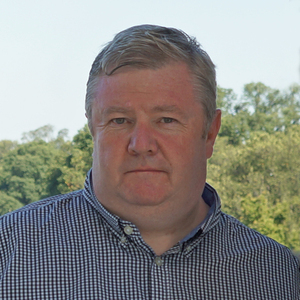
From top: Former Italian Prime Minister Matteo Renzi leaves an EU summit last June; Derek Mooney
A bad weekend for Europhiles?
Not a bit of it.
Derek Mooney writes:
I know it is a hackneyed old phrase and gets trotted out in almost every election discussion, but there is a very good reason Tip O’Neill’s “all politics is local” maxim gets so much airplay: it’s because it’s true.
Yet, somehow, commentators, pundits and even politicians forget this.
Take yesterday’s referendum result in Italy. No sooner had the exit polls showing a heavy defeat been announced but the Euro-sceptics, including Nigel Farage, were out in force to claim the result as a continuation of the Brexit/Trump trend.
Isn’t it curious how those styling themselves the biggest supporters of national sovereignty and the greatest opponents of EU integration are the ones who see every political development in terms of a pan European trend and not individual nation decisions? Mightn’t the factors underpinning the Italian result have more to do with local Italian politics than what is happening in the UK or France?
As it turns out, they do. While the lazy analysis will see it as just another phase of the Brexit/Trump populist train, the reality is that the Italian result was not about populism versus the establishment.
There were as almost many members of the establishment on the No side as on the Yes, including the centrist former Italian prime minister and EU Commissioner, Mario Monti, hardly your archetypal populist!
Though the winning No side also included the anti-establishment Five Star movement, they were not the insurgents – the No side were arguing the status quo. They were urging a rejection of Renzi’s proposals to make Italian decision making easier by reducing the size and power of the Senate and taking power back to the centre from the regions.
While the Italian result was widely predicted, including by pollsters, the Austrian Presidential result was not.
Right up to the last minute the polls in Austria were forecasting a very tight race with many pundits concluding that the far right’s candidate, Norbert Hofer, would emerge the winner. In the end, the moderate Van der Bellen had a comfortable win.
Not only does his victory deal the simplistic “populist wave” argument a blow, it also reduces the size of the headache facing Brussels today.
But before they start the celebrations in the Berlaymont, the far right FPO party is still on course to make significant gains in the 2018 Austrian parliamentary elections – though these are the same polls that called the presidential for the FPO, so maybe take that with a pinch of salt.
Before we reach the 2018 Austrian elections, we have 2017 to get through – and 2017 brings a series of crucially important general elections; in the Netherlands, France and Germany. The timeline is as follows:
March 15 – general election in The Netherlands
April 23 and May 7 Rounds I & II in the French Presidential election
Mid-June French parliamentary elections (2 Rounds)
Sept/Oct – German federal elections, polling date yet to be determined
And, remember, just after the Dutch elections and before Round I of the French presidential election we will likely have the UK’s triggering of Article 50, commencing formal Brexit negotiations.
Next year will be an important one for Europe, though I suspect those seeing it as the year that Europe starts to finally and irrevocably fall apart may not get their wish.
As with yesterday’s results, the outcomes will likely be a mixed bag of confusing signals. While it still looks unlikely – at least from this remove – that the far right or ultra-nationalists will end up in office in either France or Germany, the possibility of Geert Wilders PVV party ending up in coalition government in the Netherlands cannot be ruled out.
Meanwhile, what lessons will Brussels take from yesterday’s Italian and Austrian results?
Not only was the Italian result the clearer and more decisive of the two, it is the one that will likely have the most immediate impact in Brussels. Italy’s financial sector was in a precarious enough position before the referendum, so the result coupled with the instability that will follow Renzi’s resignation can only make an already bad situation worse.
As for the Austrian result, if it had gone the other way and the far right had won, then much of the focus that is now on Italy would have been on the far right’s victory and the alarm bells that it was setting off in Brussels. The response in Brussels will be a sigh of relief that they just have Italy to deal with and it is hard not to imagine that they had already factored the Italian defeat into the mix.
So, the Brussels response will likely be: as you were. This will also be the probable Brussels response to any emerging crisis over the coming year. The EU is set to effectively go into stasis or suspended animation until after the German elections next, with the Commission President Juncker appearing to have already personally commenced the process.
This should not be a period of inactivity here. The triggering of Article 50 negotiations in March 2017 should kick start a debate on this island as to how we see our EU membership and which way we want to see the EU go.
A good starting point for such a debate could be found in comments made by Scottish First Minister Nicola Sturgeon during her address to Seanad Éireann and in some of the responses from our own Senators. The First Minister spoke of:
“The sense that small countries can be equals in a partnership of many is something that appeals to us about the European Union”
This theme was picked up on by several Senators, including Fianna Fáil’s Mark Daly and independent Alice-May Higgins with Michael McDowell reflecting opinion across the Chamber saying that
“…the partnership of independent states in the EU echo the feelings of most Irish people towards the EU. It is not a super state but a partnership of individual states.”
He is right and it should inform our approach to the Brexit talks and what we want a post Brexit EU to look like, after all: all politics is local.
Derek Mooney is a communications and public affairs consultant. He previously served as a Ministerial Adviser to the Fianna Fáil-led government 2004 – 2010. His column appears here every Monday. Follow Derek on Twitter: @dsmooney
Earlier: A Limerick A Day
Pic: Getty


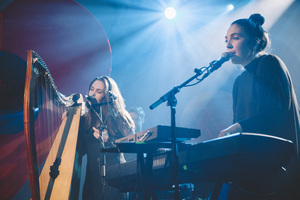
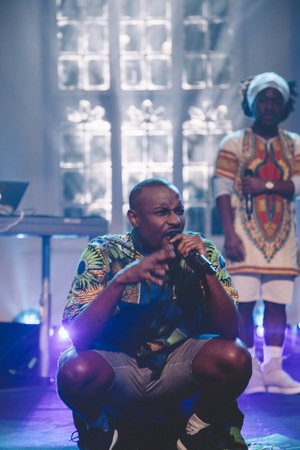
Scenes from the main stage of the Other Voices festival, held over the weekend in St James’s Church in An Daingean, Co Kerry.
(From top) Caoimhín O’Raghaillaigh and Cormac Begley, Kojey Radical, Lisa Hannigan, Girl Band, Rejjie Snow, Saint Sister, Rusangano Family.
Pics: Rich Gilligan

Right now.
Outside the Alexander Hotel on Fenian Street in Dublin 2.
Current and former employees of Independent News and Media (INM) and their supporters demonstrate against significant pension cuts at INM. The protest is being organised by Siptu and the National Union of Journalists (NUJ).
The protest is taking place as, inside the Alexander Hotel, INM shareholders hold an extraordinary general meeting (EGM).
Pic via Irish Congress of Trade Unions
Earlier: Free At 1.30pm?
UPDATE:

Ken Powell tweetz:
Suitably frosty reception for #Redacted at Alexander Hotel…
Update:
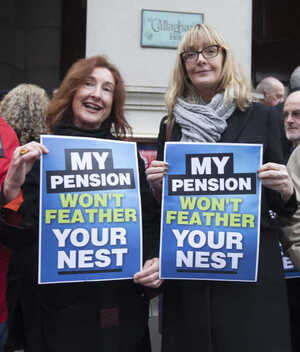


From top: Former Irish Independent journalists Claire Grady and Lise Hand; Seamus Dooley of the National Union of Journalist; the scene outside the Alexander Hotel, Dublin 2/
Eamonn Farrell/Rollingnews

Of this Terry Gilliam-inspired luridness, Cavan-based designers (and guaranteed Irish stocking filler) Wordbird tweetz:
Our tribute to GAA Legend Marty Morrissey
Irish-made stocking fillers to broadsheet@broadsheet.ie marked ‘Irish-Made Stocking Fillers’. No fee.


Charming illustrations of everyday life and nature drawn on vintage sheet music, using the notes and musical notations as a framework by Russian illustrators Alexei Lyapunov and Lena Ehrlich.


The Alesssi Buckle Tube Squeezer by Gabriele Chiave.
A chrome-finished zinc/aluminium/magnesium/copper alloy tube wringer doodad for €16.
But think of the savings.