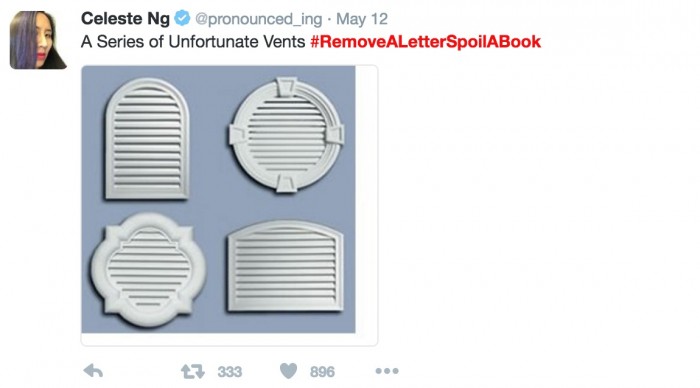
#RemoveALetterSpoilABook – join in here.
You know you want to.



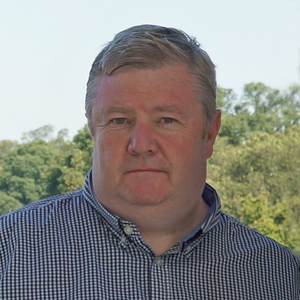
From top: Brendan Howlin and Alan Kelly at Labour Party’s Annual James Connolly Commemoration at Arbour Hill Cemetry yesterday; Derek Mooney
Labour’s Alan Kelly rose without trace and now won’t go away.
Derek Mooney writes:
“There’s no Labour problem that Ken (Livingstone) can’t make worse.”
This was Alan Johnson’s response to the former London Mayor’s latest unwelcome intervention in a UK Labour row.
Substitute the name “Alan Kelly” for “Ken Livingstone” and Johnson’s axiom could just be as applicable here.
Perhaps it’s his pugnacious ‘I tell it like it is’ style, but Alan Kelly has come to be personally identified with two of the last government’s biggest political failures: Irish Water to the housing crisis, not to mention his “power is a drug… it suits me” interview or his penchant for adding to his own party’s travails.
While Kelly’s supporters can argue that he inherited the policy messes that were Irish Water and housing/homelessness, he knew what he was getting into and still decided that the best approach was the one he adopted: the unpopular populist.
So, why is the Labour party giving even the slightest consideration to making Kelly its next leader?
The sad reality for Ireland’s oldest political party is that the choices facing it are severely limited. While it can opt for the safe pair of hands that it is Brendan Howlin, Howlin comes with a lot of baggage, not least over 20 years as a political insider, even when Labour was in opposition, Howlin managed to hold office as Leas Ceann Comhairle 2007 – 2011.
Sean Sherlock may seem, in contrast, like a more likeable and fresher option, indeed the 400+ people who replied to my Twitter poll rated him much higher than Kelly, but that very freshness that may be his biggest weakness.
Sherlock has never been seriously tested and does he possess the gravitas or presence to carve out a niche for Labour against so many bigger opposition beasts? The same questions hang over Jan O’Sullivan.
So does Labour have to take another look at Kelly?
It’s the question Labour TDs will be asking themselves over the coming days and – depending on their decision – it may be the question that party members will have to wrestle with thereafter, if Kelly’s nomination can get past the parliamentary party.
Given that Kelly secured over 50% of the vote when he won the Deputy Leadership back in July 2014, the parliamentary party would be unwise to deny members the right to have the final say.
To deny Kelly the right to run, in favour of a Howlin coronation, may look like a good idea on paper, but it is the last thing that a party – that is now closer to extinction than Fianna Fáil was back in early 2011 – should do.
Labour needs to reconnect itself with its members and supporters – finding a way to cut the membership out of deciding on who should lead the fightback, is no way to start that fightback.
If they handle it right Labour can benefit from having a leadership contest, with plenty of constituency hustings, where members get to grill those looking to lead them back from the wilderness.
Let Kelly run. Let him explain his record as deputy leader and his central role in the party’s demise and – most importantly – allow him the opportunity to show if there is something… anything… more to him than political ambition and hunger.
How much do we really know about Kelly, even after last Friday’s Late Late Show interview and his July 2015 Saturday Night with Miriam one?
No a lot, I suspect – well not anything substantive. There is more than a hint of the “rose without trace” about Kelly.
It is as if he arrived fully formed on the political scene back in 2007 when he became a Senator.
His progress to the Cabinet table was fast-tracked thereafter in two-yearly steps: in 2009 he was elected to the European Parliament; in 2011 he returned from Europe to become a T.D. (managing to jump two steps in one bound by becoming a Minister of State within a month of becoming a TD), leading finally to his becoming deputy leader and Minister for the Environment in 2014.
Though his supporters may point to his less than flattering media coverage as a counter argument, to the outside observer Kelly has had a charmed political career to date.
He has moved seamlessly up the political ranks and achieved senior ministerial office in the same time that it has taken others to manage to just make it on to the local Council (or not, in the case of yours truly).
Has that all been due to his drive and ambition alone?
Perhaps it has – and as other pundits have observed, drive energy and ambition are in desperately short supply in the Labour party right now.
But so too is humility and the capacity to recognise just how far out of touch the Labour Party became with its voters under Gilmore Burton and Kelly.
Are these traits readily associated with Kelly? That’s a matter the Labour party members will have to consider in the weeks ahead – if they are given the chance.
Derek Mooney is a communications and public affairs consultant. He previously served as a Ministerial Adviser to the Fianna Fáil led government 2004 – 2010. Follow Derek on Twitter: @dsmooney
Rollingnews

Gulp.
Tenacious Ken Foxe writes:
A TOTAL of 66 former public servants has received lump sum payments worth in excess of €200,000 over the past five years.
That includes one individual who received a golden handshake worth an incredible €428,000 and another who was paid out €382,000 from state coffers.
In all, 142 people – including departmental secretaries general and other former public servants – received lump sums worth more than €160,000, at a total cost to the state of €28.8 million.
That means an average pay-out of just over €200,000 per person, with tax only paid on lump sums in excess of €200,000 under rules introduced on 1 January 2011.

Taoiseach Enda Kenny in Castlebar earlier today to lay the foundation stone for a new swimming pool
Again.
Independent.ie reports:
Mr Kenny was speaking in Castlebar where he insisted he would only step down as Taoiseach prior to the next election.
“I’ve always said that my intention would be to serve the full term but not to lead the party into the next general election.
The Taoiseach said he was recently stopped on the street by a man who thanked him “for volunteering to run our country.”
Mr Kenny said the man had expressed his astonishment that so many people who put their names forward to be elected to Dáil Eireann do not want to have anything to do with Government and do not want to have anything to do with making decisions.
“So that’s why the responsibility is on me as leader of the largest party to put together a Government that is now in situ with the assistance and agreement of other parties in Opposition and at Government level will try to implement in the very best way we can the Programme for Government that we have set out,” he added.
Right so.
Previously: The Man With One Point
Pic (and video): Mayo Advertiser (Facebook)

Darragh Ó Tuathail, of the British Irish Chamber of Commerce, writes:
The UK Brexit Referendum will take place on June 23. The latest Economist Brexit poll puts those who wish to remain in the EU at 41% and those who wish to leave at 40%, which those undecided at 14%.
British people and Irish registered to vote in the UK living abroad (including in Ireland) must register by close of business today.
There are also over 500,000 Irish people eligible to vote in the UK, phone your family, friends, colleagues and make sure they register to vote by the final closing date of June 7.
UK-based Irish readers can register here.
Graphic: The Economist
Previously: Irish May Sway Brexit Vote (Bloomberg)
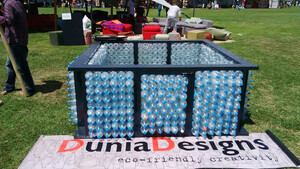


Evanna Lyons, from Meath, and Alexis Cronin [above on couch – brother of the ‘sheet’s Olga], from Cork, have founded an upcycling initiative in Arusha, Tanzania.
Evanna and Alexis convert plastic bottles and bags into furniture – then funnel some of the profits back into the community.
Darragh Murphy, in today’s Irish Times, reports:
Dunia Designs pays teams of workers to clean discarded plastic bottles and bags they collect in the thronged city’s townships and incorporate them into hard and soft furnishings. And then they give away their profits.
It sounds good, if aesthetically problematic. Walking into the Dunia Designs workshop in Arusha’s Ilboru quarter (after a death-defying ride on a “picky picky” motorcycle), I expect to find uninviting objects of austere minimalism.
Not so. The company’s founders, Evanna Lyons and Alexis Cronin, wanted to make furniture they would buy themselves. “That was our whole aim all along,” says Lyons, a psychotherapist from Meath who also works in the local hospital. “It had to be impossible to tell it from any other furniture. And nobody believes it until you sit on it.”
I ask to see some samples – and am informed they are all around me, and indeed under my backside. Most of the furniture is made using upcycled plastic, local fabrics and frames made of “greenwood” (processed street waste made into planks as durable as any wood).
… In the teeming, chaotic, rutted streets around Ilboru, there are several schools, but they don’t come free. Lyons and Cronin want to spend half of their Dunia profits sending as many children to school as they can afford – currently three in primary, five in secondary and five in tertiary education.
… Eleven months on, and they are making pool tables, looking into making bricks out of shredded plastic and are about to supply furniture to Fumba Town, a new eco-city in Zanzibar.
Once completed, Fumba Town eco-city will comprise 1,500 houses, plus apartment blocks, hotels and restaurants on the semi-autonomous archipelago, which is particularly plagued by plastic refuse.

A very impressive graduation short written directed and animated by Karis Oh. To wit:
A story about an artist who learns about the importance of the things unseen as she gets to draw a stranger’s portrait.
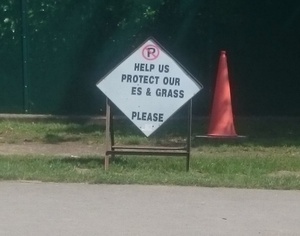

SPLUTTER!
John Downey writes:
Spotted in Phoenix Park near the Zoo….
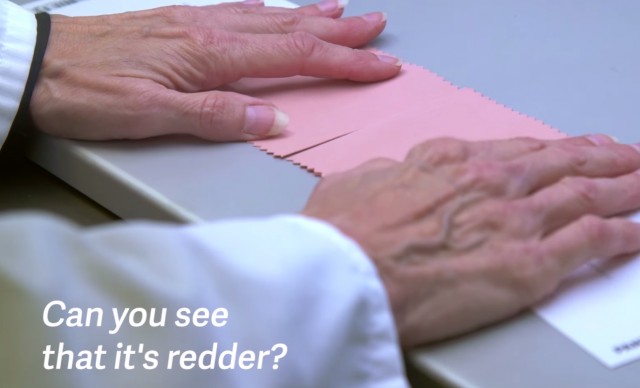
A short film by Quartz. To wit:
Designers and artists all over the world use Pantone’s color guides to make sure their blue is actually blue. Like a Webster’s dictionary for color, Pantone guides are a standard against which anyone can check their own work. Those standards are created at Pantone’s factory headquarters in Carlstadt, New Jersey. In this video, Quartz talks to the workers who maintain and enforce those standards.