
Yearly Archives: 2017

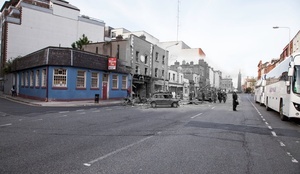
From top: The first of the three Dublin car bombs went off at about 5:28pm on Parnell Street, Dublin 1; The second went off at about 5:30pm on Talbot Street, Dublin 1 and a third exploded at about 5:32 on South Leinster Street, Dublin 2 beside the railings of Trinity College.

Today Is the 43rd anniversary of the Dublin and Monaghan Bombings in 1974.

Thirty three people were killed and 300 injured when three car bombs in Dublin and one in Monaghan were detonated.

It was the deadliest attack of the Troubles and the deadliest terrorist attack in the state’s history

Further to this.

I don’t believe in the concept of an ‘objective truth’. One’s perceptions are always influenced by time, place and one’s paradigm. But I think that a great deal of postmodern criticism and the ‘objective’ position has thrown out the baby (a fair shot at what actually happened) with the bathwater of bias.

It is fair, therefore, that I make it clear where I am coming from when I write about the 1974 Dublin Bombing – which, remember, killed 27 people on the spot and injured 137 others, a few so seriously as to cause their deaths late on.

It was not nothing. It was a major outrage.

One of my daughters, who was a student at the Royal Irish Academy of Music around the corner on Westland Row, was there are the time and place of the South Leinster Street bomb. And I visited both sites There has been a long debate about who did it.

In his book, Garret FitzGerald says simply, ‘Bombs set off in Dublin by Loyalist paramilitaries.’ I think that is too simple. It was a time of crisis: the Loyalist strike and the collapse of the Sunningdale Agreement.

I hope I always make a distinction between ‘I know’ and ‘I believe’.

The former indicates evidence exists that I find convincing, strong enough to stand up in a court of law. But one cannot live life like that.

I have many important beliefs, which cannot be so validated, but on which I am willing to base actions. In the latter case, I hope I will always say ‘I think’ and ‘I believe’ rather than ‘I know’. The Dublin bombing is like that.

I came to the conclusion that there was some collusion between Loyalist paramilitaries and British military intelligence (the last two words are oxymoronic), and I said so. There are lunatics and mountebanks in all intelligence services, in my very limited experience, as well of course as decent people doing their duty.

But I have no doubt that the policy was to soft-pedal investigations, though they had killed a lot of innocent people. We must not offend the British; we must not give comfort to the IRA.

But again it seems to me that not pursuing the matter was precisely the sort of weakness that validated the IRA’s physical force policy: ‘If the government in Dublin won’t protect us from Loyalist and British thugs, we have to do it ourselves.’

Quite a powerful argument in a nationalist ghetto. We left a couple of decades of nationalists feeling that the government in Dublin had betrayed them.

The outcome of long agitation was the eventual setting up of a tribunal under a very distinguished Supreme Court judge, Mr Justice Barron. In the conclusions of the Barron Report, he deals mainly in what he can prove.

But the doubts remaining, which he also expresses impeccable fairness, I believe to be terrifying. The consequences are alarming.

I think this was an example of state terrorism by the British. I believe that my country, at a time when I was part of the government, also practised state terrorism, and though unaware of this at the time, I am deeply ashamed.

All this I feel is worth saying because I believe that state terrorism is widespread, and I hate all terrorism, wherever it is coming from.

The argument that ‘we’ are nice and therefore don’t do it, while ‘they’ are nasty so they it all the time, simply does not convince. Consistency is important. To have two standards is bad: ‘What is sauce for the goose is sauce for the gander’

From Nothing Is Written In Stone: The Notebooks of Justin Keating (Lilliput Press)

Justice For The Forgotten

Montages by Keaney

You may recall artist Shane Berkery.

And the nude diptych – of himself and the director of the National College of Art and Design (NCAD) Prof Declan McGonagle.

Shane ended up removing from his end-of-year exhibition at the NCAD in June 2015.

Further to this…

The People We Meet write:

I randomly walked into a Shane Berkery exhibition over a year ago and have been following him ever since. I emailed him on a Monday and we were done filming on Tuesday. His work is beautiful and he’s a super nice guy. 100% on his way to being a painting rockstar

Shane Berkery (Facebook)

The People We Meet (Facebook)

Previously: Penis Mightier Than The Sword

Thanks David O’Carroll

Minister for Housing Simon Coveney announcing details of the €200m Local Infrastructure Housing Activation Fund (LIHAF) in March

Readers may recall how, last June, it was reported that Minister for Housing Simon Coveney was to make a €200million ‘local infrastructure fund’ available to developers.

The purpose of the fund is to “relieve critical infrastructural blockages and enable the delivery of large-scale housing on key development sites”.

This fund is called the Local Infrastructure Housing Activation Fund and in his Rebuilding Ireland: Action Plan for Housing and Homeless document, Mr Coveney says:

“In return, clear commitments will be required around the accelerated pace and scale of delivery of homes in the right locations and with affordability built in, reflecting the scale of the State’s investment on behalf of its citizens.”

According to Mr Coveney, between August 2016 and October 2016, 21 local authorities submitted 74 proposals for funding.

Mr Coveney told the Dáil last month:

On 28 March 2017, I announced funding for 34 projects under LIHAF. The cost of these projects is €226.46 million, of which €169.65 million would be funded under LIHAF with local authorities funding the remaining €56.81 million.

These public infrastructure projects will be key to the delivery of 23,000 housing units over the next four years, with a longer term projection of up to 70,000 units as the selected sites are fully built out.

In addition, last month, Mr Coveney said:

“There is a strong focus on affordability in the projects being funded under LIHAF. Local authorities were specifically asked to focus on affordability in considering what proposals to put forward and have received commitments from housing developers with regard to affordability.”

“It is expected that local authorities will work quickly to deliver public infrastructure which in turn will ensure that significant housing can be delivered in the period up to 2021. The substantial increase in housing supply should ensure that the house prices are competitive.”

Further to this.

Laoise Neylon, in the Dublin Inquirer, has been asking if the developers who have benefited from this funding have been building social and affordable housing units and, if so, how many?

Readers will note that all developers are required, by law, to build 10 per cent social housing in all developments where are more than nine units.

Ms Neylon writes:

“…there has been little detail about exactly how many affordable homes there will be on the sites that benefit from the fund, which are spread across 15 local authorities.

One of the biggest housing sites to get LIHAF funding for infrastructure was Cherrywood, to the south of the city [Dublin], where 8,000 new homes are planned. The government gave €15.19 million for road upgrades and a bridge there.

“About 60 percent of the site is owned by the developer Hines, according to its spokesperson Robert Hanley.

But Hanley was unable to say how many of the 8,000 units would be affordable in the development, or to directly answer a series of questions asking how many affordable units there would be and what cost they would be.

“Cherrywood will have 10 per cent social housing in line with current requirements,” said Hanley, by email on 10 May.

But social housing and affordable housing are not the same. Social housing is owned by local authorities, while affordable housing might be privately owned, but would be either purchased or rented at a lower cost.

The 10 per cent social housing doesn’t satisfy the requirement for affordable housing under LIHAF, according to a Department of Housing Spokesperson Eddie Kiernan.

“The provision of the required 10 per cent under Part V will be a factor in evidencing affordability but it must also extend to the rest of any relevant private housing on the site,” said Kiernan.

“On 15 May, in response to questions about how many affordable units there would be on the site, a spokesperson for Dun Laoghaire-Rathdown County Council said that “there is currently no affordable housing scheme in operation”.

“After a series of follow-up queries, a spokesperson for Dun Laoghaire-Rathdown County Council sent an email on 16 May, saying that the council is in negotiations with the developer to secure an element of affordable housing at Cherrywood.” 

“It’s unclear why this agreement is not already in place.”

Anyone?

Despite €200million subsidy for developers, questions over affordable housing (Laoise Neylon, Dublin Inquirer)

Thanks Sam

The Pogues

Last week, we asked you to select your favourite song recorded by The Pogues excluding Fairytale of New York.

A Golden Discs voucher worth TWENTY FIVE euros  was up for grabs so the competition was particularly intense.

But there could only be one winner.

In reverse order so:

The Sick bed of Cuchulainn (1985)

Liam Deliverance writes:

” Not including Fairytale, the finest song The Pogues ever recorded is The Sick Bed Of Cuchulain. Musically it has not a lot to recommend it although it’s hard to dislike the slow-fast-slow-fast style typical of Pogues tracks and the witty and rambunctious delivery. Lyrically though, magnificent. No-one else but Mr McGowan could write a song like this. Lyrics here

Worms (1988)

Al Jeers writes:

‘Not including Fairytale, the finest song The Pogues ever recorded is Worms. It’s the last track from “If I Should Fall from Grace with God” and there’s a very long gap between the penultimate track and so it arrives horribly and unexpectedly. It’s a musical approximation of the horrors. I kind of like it.

The Broad Majestic Shannon (1988)

Pat Walsh writes:

Not including the magnificent A Fairytale Of New York, the finest song recorded by The Pogues is The Broad Majestic Shannon from their second album because even though it has some similarities to the tune of Fairytale, it also stands apart from it & because it captures the memories of the summers that Shane spent visiting his relations in Tipperary when he was a young fella. Liam Clancy also does a great version of the song.

Fiesta (1988)

Daisy Chainsaw writes:

Not including Fairytale, the finest song The Pogues ever recorded is Fiesta because I pogo round the place like a lunatic to it… and then wonder why my knees need replacing!

Therave adds:

The best Pogues song would be Fiesta, Preachers pub on Washington Street in Cork was once owned by a guy called Ted, Ted loved the song but the regulars loved it more and at random points in the night Ted would blast it up on the stereo to which the crowd would go berserk , dancing on seats and tables…….. ahhh the good old days.

White City (1989)

Friscondo writes:

White City is an Irish tune about Shane’s love of London. Best, maddest gig, I was ever at was seeing them in Dec 1988 in Brixton Academy. Kirsty McCall guested and one of the guys I was with went missing for three days, on the night. He met a girl from Reading and went on a major session. Turned up on the Sunday totally blasé. Honourable mentions to Body of an American, The Old Main Drag, A Pair of Brown Eyes and Thousands Are Sailing.


A Pair Of Brown Eyes (1985)

Orla Smith writes:

Not including Fairytale, the finest song The Pogues ever recorded is…I love them all but it has to be  A Pair of Brown Eyes – it’s Shane’s anti-war song that rivals ‘Waltzing Matilda’. Cait’s smokey harmonies comforting Shane’s raspy sorrowful tone, arguably the best example of how he actually could sing back in the day.

The song has everything the Pogues were all about.  Shane’s song writing is unrivaled but when it’s combined with the genius and musicality the rest of the gang are blessed with – it’s pure magic. I saw them when I was nine, snuck into The Stadium on South Circular Road by me auntie’s in 1991 and it set me up for life!


Haunted (1986)

PMCD writes:

Haunted is sung by Cait O’Riordan and was first featured on the soundtrack to Alex Cox’s Sid & Nancy back in 1986. In many ways its the best thing about the movie – though I’ve always had a soft spot for Gary Oldman’s Sid Vicious. The song’s got one of McGowan’s most beautiful lyrics and its chorus of, “I want to be haunted by the ghost of your precious love” is pretty spine-tingling stuff. Is it as good as A Rainy Night In Soho? Hmmm.”

Winning song:

A Rainy Night In Soho (1986)

Harry Molloy writes;

A Rainy Night in Soho because it’s simply a lovely bit of songwriting and a simple but beautiful piece of music.

Thanks all

Hic.

Golden Discs

Last weeK: Póg Their Thoín

Get down off that!

Sligo-based carpenter and artist Neil O’Connell has today launched a website for his company, NOC On Wood.

His handmade furniture includes bespoke, fantasy-themed children’s beds, including (from top) Culleenamore Camper Bed, €1,650; Coney Dumper Truck Bed, €1,150; The Lough Gill Boat, €1,350; Van Bed, €1,250.

NOC On Wood

Thanks Annie West

Irish-made stuff to broadsheet@broadsheet.ie marked ‘Irish-Made Stuff’. No fee

Readers may recall the recent controversy over Saudi Arabia’s inclusion in the UN Commission on the Status of Women.

And the Minister for Foreign Affairs Charlie Flanagan refusing to say if Ireland voted for or against this inclusion.

Yesterday.

In the Dáil.

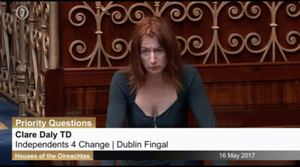
Independents 4 Change TD Clare Daly suggested that Ireland did vote for Saudi Arabia’s inclusion and that it did so because of the arms export licences that Ireland issues to Saudi Arabia.

Clare Daly: “It is clear, despite that it has not been publicly acknowledged by Government, that Ireland voted for Saudi Arabia to be part of the UN Commission on the Status of Women. The question beggared belief with many people, given Saudi Arabia’s record on women’s rights and human rights.

Maybe the answer lies in the question in front of the Minister about the massive spike in the licences issued – documented in the report published by the Department of Jobs, Enterprise and Innovation about arms exports – in 2015 and the first six months of 2016 to the Saudi Arabian alliance, which has been involved in the bombardment of Yemen.

“What is going on in a neutral country, particularly when all of the weapons involved are in category ML5? It includes very serious activities, such as bombing computers, gun-laying equipment, weapon control systems and so on.”

Mary Mitchell O’Connor: “The EU has a range of sanctions in place in respect of countries engaged in conflicts. All licence applications are considered having regard to these measures. Sanctions can include arms embargoes and various restrictive measures including prohibitions on the provision of targeted goods and services. My Department observes all arms embargoes and trade sanctions when considering export licence applications. There are no EU sanctions in place in respect of Saudi Arabia.

All export licence applications, whether for dual-use or military goods, are subject to rigorous scrutiny, and are considered in the light of the spirit and objectives of the 2008 EU Common Position on Arms Exports. My officials are in regular contact with the Department of Foreign Affairs and Trade on export licensing issues. They consult with that Department in respect of all military export licence applications. My officials seek observations on any foreign policy concerns that may arise in respect of a proposed export. Such factors are subject to review in the light of developments in a given region.

“Any observations which may arise from this examination are considered in the final assessment of any licence application. My Department may refuse an export licence, following consultation with the Department of Foreign Affairs and Trade and other EU and non-EU export licensing authorities, as appropriate. As indicated in the annual report, my Department issued one military export licence with Saudi Arabia as the ultimate end-user. This was in 2015 in respect of category ML5 military products, which includes electronic control devices and components.

Daly:There has been no movement since I asked the Minister the question last time, except for the 1,200 dead Yemeni children, the tens of thousands injured and the 4 million suffering from acute malnutrition.

“I asked the Minister about the EU Common Position on Arms Exports, which prevents sale of arms to a country if there is a clear risk that the military technology or equipment to be exported might be used in the commission of serious violations of international humanitarian law. We know that the British Parliament, on a cross-party basis, has recommended the suspension of arms exports to Saudi Arabia, until a UN-led investigation into violations of human rights is concluded.

“The UK is not even a neutral country. We are.

“We should be leading on these matters, particularly when it is also the case that we should be careful about selling arms to countries with links to terrorism. We know from Ms Hillary Clinton’s emails, no less, that Saudi Arabia arms ISIS. It is ridiculous that we continue to issue arms export licences to this country which is involved in war crimes. It is not good enough.

“I did not ask the Minister about an arms embargo and do not want to hear about it. Why, against that backdrop, would we not institute a presumption of denial policy, which could be brought in overnight and put us to the forefront on these very important human rights issues?

Mitchell O’Connor: “The Deputy mentioned export licences. I said one military export licence was issued. We do not export arms. The key consideration in dealing with military export licence applications is to establish if there are concerns with the end-user or proposed end-use. This process may include consultation, as I outlined earlier.

“My Department consults with the Department of Foreign Affairs and Trade. In addition, end-user certificates are always required as a further control measure. End-user certificates provide information on the proposed transaction. They certify that the company will be the final recipient of the goods being exported and include an undertaking that the goods will not be used in connection with weapons of mass destruction.

“Individual licences are valid for the export of a specific quantity of goods to a specific end-user within a 12-month period. A new application must be made for any exports above that provided for on the original export licence. All new and repeat licence applications are subject to the full export licensing scrutiny process. All licence applications are considered in the spirit and objectives of the 2008 EU Common Position on Arms Exports.”

Daly:Does the Minister presume that it is a coincidence that we have gone from zero arms sales to Qatar and declining arms sales to the UAE to a significant uptake in both of those figures in 2015? All of the arms exports to Saudi Arabia were in the category of ML5. That category includes weapon sites, bombing computers, gun-laying equipment and weapon control systems.

These are not incidental bits of hardware. The issue of the destination and final end use actually makes no difference to our obligations under the EU common position, which states that if there is a risk of this military technology or equipment being used in the violation of human rights, then they should not be exported. That is the question that is being asked.

“It does not really matter if the weapon components stop off in another country on their way to Qatar. Our obligations in that instance are the same. I ask the Minister to look at the issue of a presumption of denial within the Department whereby, even as an interim measure, we could take a step and institute overnight that if anybody from these countries applies for a licence to export arms to Saudi Arabia, they can be refused. The Government has not dealt with that. I must ask the Minister about it. We are talking about lives, war crimes and a violation of human rights.

Mitchell O’Connor:The information I have in front of me outlines that there was one military export with Saudi Arabia as its final end user destination. These were not for the production of arms. Sometimes they are components for helicopters and Jeeps. I do not think the Deputy can jump to the conclusion that we are exporting arms or components for arms. I do not think that the Deputy can do that at all…”

Daly: “That classification is there.”

Mitchell O’Connor: “…because our Department and the Department of Foreign Affairs and Trade take an extreme view and make sure that the applicants are denied if there are any questions to be asked in that instance.”

Transcript: Oireachtas.ie