Yearly Archives: 2019

Emma Langford – Goodbye Hawaii

There’s a brilliant moment in Shane Serrano‘s video (above) for Emma’s first single from her forthcoming second album when it switches, like Woody Allen’s ‘Midnight In Paris‘, from the present day to another bygone era.

It’s a kind of magic, just like the Limerick singer’s velvety voice which gives this breezy jazz-pop ditty that Friday feeling.

Nick says: Aloha goodbye.

Emma Langford

RTÉ’s Áine Lawlor; Dr Peter McKenna of the HSE

This afternoon on RTÉ’s News At One.

Journalist Áine Lawlor spoke to Dr Peter McKenna, the clinical director of the women’s and infants’ programme with the HSE – after nobody from the HSE was available to speak to RTÉ’s earlier shows Morning Ireland or Today with Seán O’Rourke.

The lunchtime interview followed it emerging last night that approximately 800 women who had CervicalCheck tests carried out between October 1, 2018, and June 25, 2019, have not received their test results.

This has been blamed on an IT issue at a Quest Diagnostics laboratory in Virginia in the US.

Most of the women affected were getting repeat tests for the human papillomavirus HPV – which can cause cervical cancer – because Quest had previously failed to carry out HPV testing on the women’s initial smears within the 30-day limit.

RTÉ reported last night that the HSE told the Department of Health on Wednesday that it became aware of the IT problem in June.

This lunchtime, Dr McKenna told Ms Lawlor that the HSE knew there was a “computer glitch” in February.

From the interview:

Áine Lawlor: “The lesson on Gabriel Scally’s report about open disclosure and honesty and transparency with the women who are fundamental to the future of CervicalCheck and who depend on CervicalCheck – that lesson has not been learned by the health service.”

Dr Peter McKenna: “I wouldn’t agree with that, in principle. I think that there’s elements of this problem that only emerged to the HSE in the last ten days or so. And the extent of what needs to be communicated with women is not yet currently absolutely certain.”

Lawlor: “OK, well let’s try and establish the facts. So we’re talking about 800-plus women who had repeated cervical smear tests done between October 2018 and June 2019. Is that right?”

McKenna: “Yes, and these are women whose cytology results were known and they had a minor degree of abnormality and in order to see whether they needed to go for coloposcopy or not, an additional test of HPV was carried out.”

Lawlor: “So, in lay person’s language, they had had a previous smear test that had shown some abnormalities related to HPV and this was a repeat smear test to see whether there’d been any changes. Is that right?”

McKenna: “It’s a refinement, it’s a, a papaloma test, rather than a repeat smear test.”

Lawlor: “OK, so it was a more advanced test.”

McKenna: “It was a more advanced test, now, if you…”

Lawlor: “And the computer broke down when?”

McKenna: “No, no, sorry, just to go back even further than that. These 800 women were women who had had a HPV test carried out but, as you may remember, towards the end of last year, it transpired that the tests had been done on an out-of-date kit. I don’t know if that…”

Lawlor: “I think everybody remembers every twist and turn of this unfortunately Dr McKenna. So they had gone for tests again after that, is that right?”

McKenna: “No, so the kit was out of date. And those women that had come back as positive – they were treated as if the result was correct.

“And those women, who the result had come back as negative, it was said ‘no, we should take this seriously and we will repeat the test’. And so, 800 of these women, whose tests have come back as negative initially on the HPV, were then retested.”

Lawlor: “OK. And when did the computer breakdown?

McKenna:It was known in February that there was a computer glitch and…”

Lawlor: “Where was it known exactly, Dr Peter McKenna, because most of us knew nothing about this until yesterday and today. So the question is: this computer failure goes back to February.

Who knew about that back in February? And who has known about that since?

McKenna: “Well, my understanding is that, if I could just finish, that it was known in February and…”

Lawlor: “By whom?”

McKenna: “In whom the tests results altered were informed by CervicalCheck in February. So there was a small number of the 800 women, in whom the results were different, and they were informed directly by CervicalCheck. So the women who were affected were informed as soon as it was known.”

Lawlor: “But who knew about the fail…what does the computer failure involve? When did it happen and who knew about it?”

McKenna: “The computer is designed to…the computer of the labs overseas is designed to communicate with the computer here. And that triggers a, a cascade of letters. It was appreciated that wasn’t working and a manual system was put in place, as far as the HSE knew.”

Lawlor: “OK, it was appreciated by whom? Who appreciated this? And who made the decision to put the manual system in place? And why was none of this made public?”

McKenna: “Right. The answer to the names, I couldn’t give you. I don’t know. But however, it was appreciated within the screening service because the screening service put alternative, manual arrangements in place.”

Lawlor: “And did the HSE know that these computers weren’t working? And that manual arrangements were now being put in place to write to women? And was anybody checking that that was actually happening?”

McKenna: “The service did know that the computers were not speaking to each other – that is absolutely correct and the HSE were reassured by the fact that the women were being written to manually, or sorry, their GPs were being written to manually.”

Lawlor: “So the women’s doctors were being written to, by whom? Who was responsible for…”

McKenna: “By the laboratory.”

Lawlor: “By the laboratory.”

McKenna: “Yeah.”

Lawlor: “So CervicalCheck told the HSE and everybody understood that the laboratories would write to the women…”

McKenna: “Would write to the GPs….”

Lawlor: “Would write to the women’s doctors…”

McKenna: “Yeah…”

Lawlor: “And when did it emerge that this was not happening?

McKenna: This only came to the knowledge of the screening programme and the HSE in early July.

Lawlor:In early July, but a number of months had passed. Had it not occurred to anybody to get back and check, given the sensitivity and, as you say, there have a lot of twists and turns in all of this and we have had the Scally Report which has emphasised the importance of transparency – particularly if women are to go on turning up for smear tests as part of the cervical screening programme.”

McKenna: “I can absolutely understand that question. The HSE and the screening are very disappointed that the arrangement that they thought had been put in place wasn’t working. And this will be investigated as to why this element was not followed through by the contractor.”

Lawlor: “But this is what happened in the first place isn’t it? Somebody thought somebody was telling the women but nobody was?”

McKenna: “No, it’s not quite the same as that. That was the result of an audit. This is probably, in some ways, more important than actual clinical results – there was a delay in communication.”

Lawlor: I’m still kind of flabbergasted. Just one other thing – did the minister know? The minister’s department? We know that the HSE knew about this and understood it was being dealt with by the laboratory, and this only emerged in the last while, that you found out that the letters weren’t happening.

Was the minister’s office across this?

McKenna: “I would not…I don’t know the answer to that. I’m sorry.”

Lawlor: “OK, so you don’t know whether the Department of Health was involved?”

McKenna: “I don’t. No.”

Lawlor: “You said you can understand why women might not have confidence after everything. I mean this comes across like almost like a last straw, doesn’t it, for many women?”

McKenna: “It certainly doesn’t sound good. But I think it’s important to point out that these women have had cervical cytology – they do not have a severe grade of cervical abnormality. If they did they would have been referred directly to colposcopy. This is a delay in communicating the result of a second or a refined test which would indicate whether they should or shouldn’t go on to colposcopy.”

Lawlor: “Well we appreciate you coming on the programme to talk to us today.”

Listen back in full here

Earlier: ‘Why Wait Until An Hour After The Dáil Goes Into Recess To Let The Information Out Publicly?’

Meanwhile…


Joy Division – Day Of The Lords

Feargal Ward writes:

Myself and the writer/filmmaker Adrian Duncan were asked to make a music video by New Order for one of Joy Division’s tracks from the Unknown Pleasures album (40 year anniversary). The video (above) was just released.

We are both based in Berlin and were drawn to that city’s propensity for collapsing regimes as part of our response to this incredible piece of music...

In fairness.

Feargal Ward

Previously: The Lonely Battle Of Thomas Reid


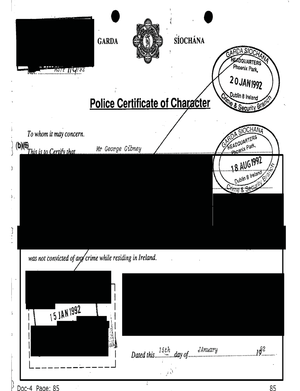
From top: a certificate of character signed by An Garda Síochána for George Gibney’s US visa application in 1992; former Irish swimming coach George Gibney; journalist Irvin Muchnick (right)

This morning.

American sportswriter and journalist Irvin Muchnick spoke to Seán O’Rourke on RTÉ Radio One about former Irish swimming coach George Gibney.

Mr Muchnik is visiting Ireland this week as he launches the second eBook edition of his book about Gibney.

Gibney was charged with 27 counts of indecency against young swimmers and of carnal knowledge of girls under the age of 15 in Ireland in April, 1993.

However, he moved to the United States in 1995, the year after an unusual and controversial decision by the Supreme Court led to the quashing of these charges.

He was also granted a visa during a visit to the United States in 1992 – seemingly aided by a Garda character reference – a year after people who had been abused by him started to speak up and organise themselves.

Justice Roderick Murphy’s later Government-commissioned report into sex abuse and Irish swimming in 1998 concluded that Gibney’s accusers “were vindicated” by the accumulation of Garda evidence.

These accusers included a woman who alleged she was indecently assaulted by Gibney on a swimming trip to Holland in 1990 and, the following year, raped by him in Florida in June 1991.

From this morning’s interview…

Sean O’Rourke: “I gather that you believe that this year, 2019, might signal some changes in this case. Tell me why.”

Irvin Muchnick: “Well, the reason is that widespread scandals in the Olympic sport programmes in the United States have come to light through the USA Gymnastics scandal and there are federal investigations of racketeering and insurance fraud involving USA Swimming , USA Taekwando and other groups and those are the real reasons why 2019 I think is going to be the year of reckoning for George Gibney.”

“We’ve learned from a Freedom of Information Act case that Gibney unsuccessfully applied for American citizenship in 2010, I believe, hoping to inoculate himself from these ongoing serial efforts to get him extradited and brought back for justice in Ireland.

“And in a quirk, he was denied citizenship because he lied on his application about his Irish past but, strangely, nothing happened in terms of his Green Card and his permanent resident/alien status in the United States.

“So, what my new reporting has uncovered is that there’s not just paperwork issues with George Gibney but perhaps other acts he committed while he was in America.

“He was the leader of a church group, medical mission, to Peru that involved a strange Catholic sect called the Sodalitium Christianae Vitae and those are some of the things that are coming to the fore for federal investigators right now.”

O’Rourke: “Coming back, you say he tried in 2010 to get American citizenship but he was declined it or denied it on the basis that he had filed false information?”

Muchnick: “Right. What the Freedom of Information case documents revealed is that US Citizenship and Immigration Services kicked his application back to him and said ‘you want to give this another go?’ because you have to disclose not just whether you have ever been convicted of a crime but whether you’ve ever been arrested, charged, indicted.

“And evidently he didn’t comply because his citizenship application was denied.

“But the weird Catch-22 is that, at the same time, another federal agency in the Department of Homeland Security, Immigration and Customs Enforcement put out a letter that said he could not be removed from the country because he had never been convicted.

“So this is the conundrum that we face this year.”

O’Rourke: “And how is he getting on, living in the United States? I mean you and other people have shone a lot of light on his background here in Ireland and on the questions that have been asked. So how has he been doing? He’s there now over quarter of a century?”

Muchnick: “Right it’s a front-page story in Ireland, it’s kind of crickets in major media. I have a small outlet trying to shine light on this and he’s basically hiding in plain sight. He coached briefly, we think, because of a recommendation from the American Swimming Coaches Association – which should be accountable, as should be USA Swimming.

“But after his Irish past was exposed locally, in Colorado, in 1995, he backed away from his swimming career but he’s had various jobs. He’s now living in Altamonte Springs, Florida, we believe, just north of Orlando.

“And I call it hiding in plain sight.”

O’Rourke: “But is there any reason to believe, I mean, you say, you talk about this background of scandals in gymnastics and taekwondo and US Olympic circles, but why should that, or how might that be brought to bear and turn up the heat on George Gibney?”

Muchnick: “Well the reason is that there are federal investigations looking into all these things. I think the FBI and other federal agencies are a little bit embarrassed that they were asleep at the switch on the gymnastics scandal. So they’re looking to, to make good on that, and clean up the Olympic programmes in some way.

“So I think, paradoxically, by not having this intense focus just on Gibney, he’s marginally out there and I do know that investigators have been reading my reporting and have determined to act on it.”

O’Rourke: “And is there a sense that what he might face would be deportation or would it be extradition?”

Muchnick: “Well it would be extradition. It’s kind of thing where the Americans are saying ‘after you, first’. And the Irish are saying ‘we want you to do something’. The Garda and American law enforcement have to start talking to each other under EU protocols and share information.

“We know that Gibney had one known crime on American soil in 1991 in Tampa, Florida, and so that could be a basis for…”

O’Rourke: “Is that a conviction now?”

Muchnick: “No, it’s not.”

O’Rourke: “Strictly speaking, you cannot say someone has a known crime unless they’re convicted of it.”

Muchnick: “That’s correct and that’s always been the difficulty at getting at this. But my understanding is that in Ireland there’s been a revisiting of that controversial 1994 Supreme Court ruling that effectively quashed his indictment and that could be looked at again. There could be new victims…”

O’Rourke: “There could be new victims coming forward or new claims that will have to be investigated.

“Do you know, as of now, whether there is a request for George Gibney, submitted to the US authorities by the gardai here or by the Director of Public Prosecutions, for his extradition to this country?”

Muchnick: “I think we know pretty clearly there is not one as yet. However, in 2015, TD Maureen O’Sullivan did ask the Director of Public Prosecutions to look at this again. And I understand that that matter is ongoing.”

O’Rourke: “I know that every time this case is discussed, it causes distress to the victims. They must feel disheartened that it drags on. I think some of them have found a way of just putting it behind them in so far as is possible. And accepting that they’re not going to see justice. But, you know, with no apparent resolution, I’m wondering why you continue to pursue it, Irv. Do you actually think you’re getting somewhere?”

Muchnick: “I do and I’ll tell you why in a moment. But I am looking forward to meeting a victim while I’m on my Dublin visit tomorrow. I do understand the pain that they’ve endured for many years and I do understand that many of them are ambivalent at this point, having had their hopes dashed so many times in the past, as to whether this is even good for them to do this.

“But my message to the Irish is that this is not just about the victims, this is about a system of institutions in global sport that enable bad actors, like George Gibney, to do what they do. And so it’s so important to hold accountable Swim Ireland, USA Swimming, most especially the American Swimming Coaches Association and so I hope that we can work together on that, moving forward to clean up sports.”

O’Rourke: “And what about the current climate in which, for instance, you have President Trump speaking out strongly against, I suppose what he would describe, generally, as undesirables. I mean might that somehow contribute to increasing the pressure on George Gibney?”

Muchnick: “That’s a great point and a great question and I think that it’s the real reason there’s hope right now. That even though Donald Trump has weaponised the immigration question and he’s demonised Central Americans and Muslims, not so much white Europeans, there’s still a movement there is some indication that bad guys from Ireland have been sent back, other than George Gibney.”

O’Rourke: “But do you know, or do you know of particular individuals in the United States’ system of immigration and law enforcement, whatever you want to call it, who are on this case?”

Muchnick: “Yes. I know that there are federal agents who are involved in these swimming investigations who are taking a specific look at George Gibney right now.”

O’Rourke: “OK, well no doubt you and we will continue to keep an eye on this situation and bring any developments to our audience. Journalist, investigative journalist, Irvin Muchnick, thank you very much for coming in.”

Muchnick: “Thank you for having me.”

Listen back in full here.

Previously: ‘There Is No Excuse’

Unreasonable Delay


Last night.

Olympia Theatre, Dublin 2.

The opening night of ‘Copper Face Jacks: The Musical’ which runs until August 10.

Everyone (apart from us) was there!

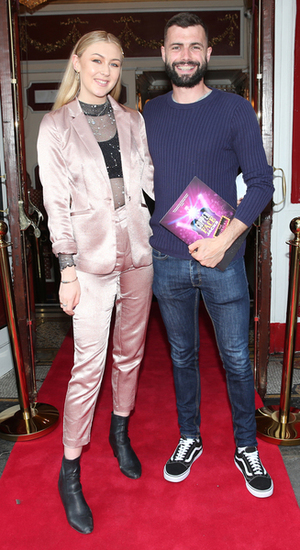
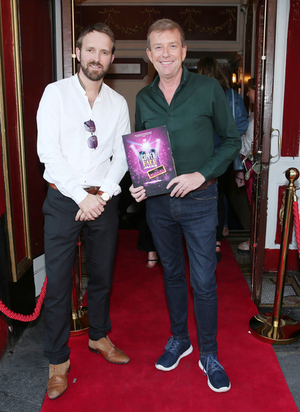
Including…from top: Nurses Gill Carty and Cara Carton; Eadaoin Fitzmaurice and John Sharpson; Frances Fitzgerald MEP; Alex Dunlop and Sars Kavanagh; Musical creator Paul Howard and Mary McCarthy; Gemma Cullen Kenny and Joe Conlon; Chris Dylas and Ashling Brody; Fiona Claffy and Siobhan Ross; from left: Jonathan Killeen ,Donal Skehan and Sean Kavanagh; Ian Gamble and Alan Hughes; from left: Laura McNaulty , Clelia Murphy and Mariead Ronan; Valerie O Leary and Lauren Butler; Kerri Nicole Blanc; Patricia Garry and Deiric Hartigan.

Leon Farrell/Photocall Ireland/Rollingnews

Behold: the Bentley EXP 100 GT concept – a ‘vision’ of Bentley’s planned all-electric ultra luxury grand tourer recently revealed via a live stream.

Despite being 5.8 metres long and weighing in at 1.9 tonnes (relatively light for a Bentley), the real-life EXP will do 0-100km/h in 2.5 seconds with a top speed of 300km/h and a 700km range on a full charge.

Price as yet tba but if you have to ask…

uncrate

This morning.

The European Parliament published its first results of its post-election Eurobarometer survey.

Asked if “taking everything into account, would you say that Ireland has on balance benefited or not from being a member of the EU?”, 89 per cent of Irish respondents said “yes” – 21 per cent more than the EU average.

The programming really works.

FIGHT!

The survey can be read in full here