



MORE to folly
Covers to broadsheet@broadsheet.ie



MORE to folly
Covers to broadsheet@broadsheet.ie
https://vine.co/v/e1lvlzujneW/embed
John Gallen writes:
Can you shed any light on this, a camera crew were told to stop filming on Barrow Street because Google own it? “It’s Google property” said security.

 Viggenseeker writes:
Horrified
Western Australia, in fairness.
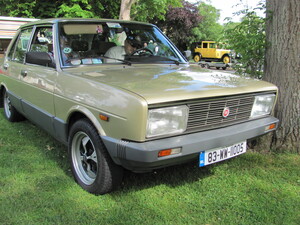


Patrick ‘Carspotter’ Cummins completes his look at his favourite jammers from the NCBI Classic & Vintage Show with two Italian stallions and a French commercial survivor.
1. 1980 Fiat 131: “The Wicklow-based owner is very proud of his Fiat 131 Supermirafiori. I’ve always been a fan of these cars and I just caught this on camera before he left the show grounds. It will be on display again at Bray Seafront in August and the Garden of Ireland run in September. I might even get to ride shotgun!”
2. 1978 Fiat X19: “This was bought by its current owner in 1984 and, save for a little bit of bodywork repairs, no major mechanical work was needed. Everything is original bar the radio and this X19 sees the roads every weekend year round. There was a later 1989 model parked beside this in equally pristine condition.”
3. 1969 Renault Saviem Tipper: “Another car-park find, owner Rory Parker bought this left-hand drive example in Co. Wicklow. The unusual vehicle has been used for a bit of film work too.”
Pics: Patrick Cummins

Bring home your rubbish.
Conor C writes:
Spotted in Dublin 7 yesterday evening. What has your neighbourhood got to offer?
FIGHT!

Several young male migrants speak about their experiences of living in Ireland in a new video released by the Immigrant Council of Ireland.
It follows the ICI conducting a study which looked at the experiences of 40 men between the ages of 16 and 28 who were born outside of Europe and now live in Ireland.
Those interviewed identified discrimination at school, in sport, at work and by public authorities as the main challenges they face.
Read the full ICI report here
Meanwhile, separately… in yesterday’s Sunday Times, Gabrielle Monaghan reported:
“Ireland now has the most educated immigrants in the EU, following a wave of migration from Eastern Europe during the boom, a new report has indicated.”
“Some 48% of the so-called “new Irish” have a third-level qualification, compared to 35% of their native counterparts. This gives Ireland the largest share of educated foreigners in the EU, and the third-highest among the 34 western nations in the OECD, after Israel and Canada. Most of Ireland’s immigrants, 71%, received their education abroad.”
“The findings are contained in a joint report by the OECD and the European Commission aimed at overturning policymakers’ preconceptions about immigrants. Indicators of Immigrant Integration 2015: Settling In showed that just 20% of new arrivals have a low level of education.”
Anti-racism training needed by Gardaí and immigration services, study claims (Irish Examiner)






Unbounded – a huge sculpture by Ben Butler made from 10,000 sticks of poplar wood snaking through the art gallery of Rice University in Texas.
It’s all about complex phenomena emerging from simple processes.
But you knew that.


This afternoon.
Dublin Castle, Dublin.
Comic-tached actors in WW1 British Army uniforms shooting a RTÉ documentary about the events of 1916 .
Who do you think you are kidding Mr Lloyd George, etc.
Pic: RollingNews.ie
Meanwhile…

Name those jammers anyone?
RollingNews.ie

Further to ‘whiffygate’…
Today FM reports:
“Senator Fidelma Healy Eames says its sad and disappointing the way people have reacted to her using the word wiffy.”
“She made the reference during a debate last week on a bill which would ban certain abusive comments online.”
“Speaking on the Anton Savage show she said she deliberately used the French pronunciation of the word because she was talking about tourists.”
Healy-Eames was speaking French when she said ‘wiffy’ (Today FM)
Previously: ‘Do You Have The Whiffy Code?’
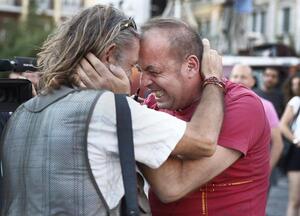
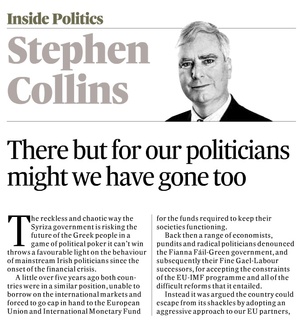
Celebrations last night in Athens, Greece (top) and a column on Saturday from Stephen Collins, Irish Times Political Editor
It’s Oxi Monday.
Greece has rejected spin, bullying and extreme media bias.
Dr Julien Mercille writes:
It is now clear that the NO side has won the referendum in Greece by a substantial margin of 61% to 39% for the YES side. Therefore, the Greek people have rejected the bailout offer from their creditors and associated austerity conditions.
What this does for now is to give a democratic mandate to Syriza to negotiate for a better bailout package with European authorities, which may now involve some debt relief. It remains to be seen to what extent the creditors will be influenced by the referendum’s outcome, however.
The result is a tremendous victory for ordinary people over European elites in every capital, who have tried to bully the Greeks into accepting more austerity while piling up more debts on their shoulders.
The arrogance of power was visible all along. As it became clear that the NO side would win, Brian Hayes, the Fine Gael MEP, called on Syriza’s leaders to “ditch their aggressive, provocative language”. Nevermind that it is the troika, not Syriza, that has inflicted pain on Greece.
It is also important to observe that even if heralded as a great democratic moment, the referendum could only be partially considered as such. Democracy is supposed to refer to the expression of one’s opinion as coming out of a free exchange of ideas and discussion about a subject. There isn’t supposed to be blackmail in that process.
But this is what the Greeks have endured in the days before the vote and before.
First, shortly after Alexis Tsipras, the Greek Prime Minister, announced that a referendum would be held, the European Central Bank (ECB) decided to restrain credit to Greece, forcing its banks to close and pushing the country deeper into crisis, a move that has been widely recognized as financial blackmail. And the troika has always been opposed to Syriza. Earlier, in February, the ECB had cut off its main credit line to Greek banks in a move difficult to justify on economic grounds.
Second, this has been compounded by the last five years of drastic austerity implemented in Greece, resulting in a deterioration of the economy and social fabric. Effectively, Greece is now faced with a humanitarian crisis. Voting in such a situation of fear and desperation is not exactly one’s idea of ideal democracy.
Third, the Greek and European media have been hysterically in favour of a YES vote, repeating ad nauseam that a NO vote would lead to catastrophe. That’s not a balanced and open discussion of the issues, it’s mere propaganda.
For example, the Irish Times’ weekend edition had four opinion pieces on Greece. Three were clearly in favour of a YES vote.
Alan Ahearne, the right wing economist who was adviser to Minister for Finance Brian Lenihan in 2009-11 when austerity package was rolled out in Ireland, had a piece criticising Syriza for supposedly being guilty of weakening the Greek economy which allegedly was doing great before it came to power. Nevermind that it is the troika austerity policies enacted by the governments that preceded Syriza that crashed the economy.
Recall that Ahearne, not so long ago, authored a report entitled “Condoms and House Prices: The Irish Experience”. In it he claimed that contraception was a “major factor” in pushing up house prices to such high levels.
Ahearne also praised NAMA as a “bold and radical action” and “a proven way of solving banking crises” because it “protects taxpayers”. He also said that austerity was “necessary in countries with large fiscal deficits”, especially in Ireland.
Does it matter to the Irish Times that this record turned out to be wrong on every count? Not at all, it seems, as Ahearne still gets his op-eds accepted for publication.
John Bruton, the former Fine Gael Prime Minister, also had an article trying to discredit the views of Nobel Prize winning economists Paul Krugman and Joseph Stiglitz, who both advocated a NO vote.
In the third article, Stephen Collins talked about Syriza’s “juvenile behaviour” which he said was “risking the future of the Greek people”, something which apparently “throws a favorable light on the behavior of mainstream Irish politicians” who he claimed have done the right thing here during the financial crisis (nevermind the policy of austerity). He also says that the last bailout to Greece gave it “the most generous lending conditions ever”, but nevermind the fact that the country has been plunged into a humanitarian crisis.
The fourth piece was by Diarmaid Ferriter, and is supposed to give the balance needed by adopting a position more supportive of Greece. But when you read the piece, it is so mild that you wonder if anybody would be convinced by it. Indeed, it talked about the role of a Cork man in Greece’s war of independence in 1801, whose relevance to the current referendum is beyond me. It also discussed a few things said by the Irish government about Greece in the 1970s, whose relevance again escapes me.
The idea of “balance” in journalism is always brought up by the mainstream media to pretend they are objective and impartial. However, this is problematic for two main reasons.
First, it is not true. The mainstream media is very biased towards the interests of those in power and is not balanced at all. That’s why you see many right wing economists, financial “experts” and politicians from the austerity parties (Labour, Fine Gael, Fianna Fail) writing and talking in newspapers and on the radio and television. However, you very rarely see trade unionists and members of progressive organisations allowed to do the same.
Second, the goal of journalism should not be to reach some kind of mystical “balance”, but simply, to tell the truth. For example, austerity applied in an economic downturn is anti-growth: so just say it like that.
How ridiculous the idea of “balance” is can be understood with a number of examples. Imagine we had a referendum about whether or not to grant the right to vote to women (if they didn’t have it). Would we then really hope to have 50% of news pieces giving us all the supposed arguments why women are too stupid, irresponsible, immature and emotional to get the right to vote? No, we’d just want to be told that women should be able to vote.
It’s the same thing for any other topic. When the subject is inherently debatable, fine, we should aim for “balance”. But there are so many important issues that are rather clear and which only require to be explained for what they are.
In any case, this time, the propaganda lost. But many other battles are coming up this week, as a deal still has not been struck with Greece.
@JulienMercille is lecturer at UCD and the author of The Political Economy and Media Coverage of the European Economic Crisis: The Case of Ireland (2015, Routledge). His new book, Europe’s Treasure Ireland (Palgrave), will be out this month.