Author Archives: Admin

Screen Shot 2015-03-09 at 10.12.59

Bishop Kevin Doran at his ordination as Bishop of Elphin in the Cathedral of the Immaculate Conception, Sligo, last year

But enough about Joseph and Mary.

Bishop of Elphin Kevin Doran joined Chris Donoghue on Newstalk Breakfast this morning, to discuss the upcoming gay marriage referendum on May 22 and same sex parenting.

Grab a warm tay and a hot blanket.

Kevin Doran: “The term, ‘marriage equality’, which is being used a lot is misleading in the sense that what people are actually campaigning for here is not marriage because, by definition of same-sex relationship, includes some of the elements of marriage such as love, care, affection and perhaps a long-term commitment and so on. But it doesn’t include the openness to pro-creation which is one of the essential dimensions of marriage. And I’m not just saying that, from the perspective of the Catholic church or Christian tradition. I think if you look at cultures, older than any of the main religions, you find that part and parcel of the whole reason for marriage and for the reason for the State or, if you like, society getting involved in marriage was because it had to do with the important business of children.”

Chris Donoghue: “OK, well look, first of all, the referendum, we are not being asked about marrying our mothers or our sisters, the exact wording is ‘marriage may be contracted, in accordance with the law, by two persons without distinction, as to their sex’ but I just want to go back to church teaching because you have been, I think in that comment, and any gay person listening to that, will know that you’ve been friendly, you’ve been friendly and open in your comment. But what is the Catholic church’s view of gay people? Where do gay people come from or are some people just born, and they’re gay?”

Doran: “Well I don’t think the Catholic church is particularly expert on that, I think the jury is out. My own personal perspective would be, some people perhaps have a predisposition, genetically, to being gay. Perhaps, in some cases, people are gay because of contexts, circumstances related to their own experience of life as young people. One of the things I’d suggest also, from my own experience, as working as a university chaplain, would be that many young people in their late teens are confused about their sexuality, understandably and I think I’d have to say I was myself, and the thing about it is, some young people get drawn into a gay relationship because, some how or other, they don’t feel that they’re sure about being heterosexual, so they’re trying this out..”

Donoghue: “They experiment..”

Doran: “So there’s an element of that involved in it as well.”

Donoghue: “But do you accept, cause you’ve said both things there, you’ve said nurture and you’ve also said nature, that some people are born and they just are gay, just like some people are born and they just are straight.”

Doran: “I did say that I’m not an expert on this but I made the point about it is, I think the jury is out on it. The reality is not so much about the way people are born as when you look at the meaning of human sexuality, it has both an emotional dimension to it and it has a very clear physical and biological dimension to it, which is oriented towards the generation of new life.”

Donoghue: “You see, because Bishop, what I’m getting at, in listening to the church on this debate is, the previous pope, Pope Benedict, said, in 2005, “homosexuality was an intrinsic disorder”. One of your peers, Bishop Aguilar in Spain, last year, said, ‘homosexuality is a mental disorder that could be treated’. I’m just trying to get at where the church is at, is it a sin to be gay?”

Doran: “No it’s not, no. It goes back to the kind of conversation you were having with Ivan earlier on, that sometimes technical, philosophical language is not the best way to communicate what we’re talking about. There’s obviously a difference between orientation and the way people behave and in reality, you see, what the church asks of people who are homosexual, by orientation, is exactly the same as what the church asks of people who are heterosexual, that they reserve sexual relationships to marriage. Now it’s a completely different question then to say that we believed marriage is between a man and a woman and we believe that this is not something that’s not just a religious view but it’s something that is part and parcel of what cultures, for thousands of years, have recognised as being important to society.”

Donoghue: “You see the reason I was asking about what is the church’s belief on where being gay comes from because if some people are born and they are straight and others are born and they are gay, then that’s as god intended.”

Doran: “That would be to suggest that if some people who are born with Down syndrome or Spina Bifida, that that was what god intended either. I mean I think the thing about it is, I can’t see into the mind of god…”

Donoghue: “But the things you mentioned Bishop, to be fair, are conditions, they are disabilities, your sexual orientation is not a disability.”

Doran: “Well I’m not entering into that, I’m just simply saying that it would be wrong to suggest that everything that happens, happens because god intended it, I mean if that were the case, we’d be kind of talking about a very different kind of god to the kind of god that Christianity believes in.”

Later

Donoghue: “Can we just be clear? Do you accept, Bishop, that May the 22nd has nothing to do with children? May the 22nd the referendum is about redefining marriage.”

Doran: “Oh no, I don’t accept that at all and the Government has been trying to pull the wool over people’s eyes, saying this, because what’s actually happening in the referendum on May 22, if it were to be passed, would be because there’s a redefinition of marriage, it’s also a redefinition of parenthood because, while the Government is currently putting through legislation, the Children and Family Relationships Bill, which redefines parenthood, that would still only have only the force of law but it would gain the force of the constitution in a referendum that would change the meaning of marriage.”

Donoghue: “But the referendum says nothing. The wording: ‘Marriage may be contracted, in accordance with law by two persons without distinction as to their sex.”

Doran: “Yeah, but you obviously haven’t heard what I’m saying. There’s an essential relationship between marriage and the giving of life to, and caring for, children.”

Donoghue: “What I’m saying is…”

Doran: “Ad so when you change the meaning of marriage, you change the relationships of parents because if children are now, to have say, two parents who are of the same sex, that…”

Donoghue: “But children do, Bishop. As in lesbian people, lesbians, gay men they are already parents..”

Doran: “They’re not parents. You see the point about it is…”

Donoghue: “But they are, all over Ireland. They have children.”

Doran: “They may have children but that’s the difference, you see that’s the point, people who have children are not necessarily parents. This legislation that the Government is introducing, the Children and Family Relationships Bill, seems primarily focused about making it possible for people in various different relationships to have children. It’s not about ensuring that children have their parents.”

Listen back here

Pic: Donnybrook Parish

dalemcdermottDale McDermott on Saturday

Dale McDermott gave his end of term address as President of Young Fine Gael at the YFG conference in The Radisson Blu Hotel, Ennis Road, Limerick at the weekend.

He closed his speech with a deeply personal plea.

The immediate challenge however for the next National Executive of Young Fine Gael is the Marriage Equality referendum. Young Fine Gael needs to play a significant role in this campaign.

Accepting my sexuality and being honest about me to family and friends was an agonisingly difficult and damaging journey. “Coming out” as it’s termed was the hardest thing I have had to do in my entire life.

For years, being gay consumed my mind – I hated it. I was depressed; I felt that I could never achieve my potential and that a limit would be placed on how far I could go. I thought I would face ridicule by those close to me, that I would be shunned by society and that the door to happiness would close for eternity.

I realised after years of mental agony that hiding who I really was would mean I would never be happy. I nervously took a leap of faith and told my family and close friends that I was a gay man. Since then I haven’t looked back.

I can say with absolute honesty that “coming out” has made me into the person I am now – happy, confident and even more determined to achieve whatever I aspire.

At the same time however, I know what it is like to be the teenager in the classroom, hiding under a thin veneer of “straightness” because of an institutionalised fear of what my peers would say and do if my veneer was scratched.

I know what it’s like to feel that the only way I can fix my problem is by pretending it simply doesn’t exist or even during my darkest days, by ending it all entirely. No one should have to go through that mental roller coaster especially during his or her teenage years. Sadly, for some, this is what being gay is like in our modern day republic.

Equality and freedom is the basis of any republic. While gay Irishmen and Irishwomen enjoy freedom, they are not equal.

They cannot marry the person they love and that means they cannot participate in our society in a full and complete manner. Inequality is instilled in our minds and if you were a gay teenager in a classroom at the moment, how would you feel knowing that in 21st century Ireland, you are not equal and you cannot marry the person you love?

The thought process would of course be negative and in my personal circumstance it added to my mental woes.

In May, Ireland will be given the opportunity to right what has been a wrong inflicted on the LGBT community in our country. Not only will a Yes vote bring forth a new dawn on the night that exists for many gay people throughout this country, it will also tell the teenager in the classroom who is struggling with their sexuality, like me only a few years ago, that it is okay to be who you are in modern day Ireland, that it is okay to feel strongly for someone, no matter their gender.

I don’t want to have to leave my country that I have grown up in for twenty-two years but I feel that if Ireland decides to keep the status quo and deny marriage equality, I will have to.

This is a great country. On May 22nd, Ireland will vote on Marriage Equality. On that same day, I will finish the final examination of my college degree. I hope that on May 23rd, I wake up an equal citizen in my country.

A country that welcomes and embraces diversity. One that grants equal rights to each and every one of its citizens, including the right to marry. The alternative is that I enter an Ireland that simply does not believe its gay citizens deserve the same rights as everyone else. A country disguised as an Orwellian Animal Farm that would proclaim I am equal; just some citizens are more equal than others.

I will therefore have to decide if that is a country that I want to live in and the answer at the moment is sadly no. I want the rest of my life to be exciting, fun, challenging but most of all; I want to share my life with someone who I love.

If Ireland rejects the referendum on marriage equality, I will be forced to leave my family and friends because my country will refuse me the right to share my life with the person I love.

Our forefathers believed in equality. From the very roots of ours nation’s beginnings, equality, liberty and fraternity were etched in their minds when dreaming of the much yearned for republic. The words of our proclamation:

“The Republic guarantees religious and civil liberty, equal rights and equal opportunities to all its citizens, and declares its resolve to pursue the happiness and prosperity of the whole nation and all of its parts, cherishing all of the children of the nation equally and oblivious of the differences carefully fostered by an alien government, which have divided a minority from the majority in the past”.

I speak not only to you in this room, but also to the country. Please don’t make me leave my country. Please support marriage equality.

Dale McDermott (Facebook)

YFG

Screen Shot 2015-03-09 at 09.57.07

Like photography?

Gearóid G writes:

“Dublin University Photography Association was last week announced the Best Overall Society in Trinity College for 2014/2015. Our annual End of Year Exhibition launches this Thursday (March 12) at 7pm in the Copper House Gallery, Synge Street and features portfolios from 11 student photographers. An accompanying photobook will also be launched on the night and will be for sale for €7.”

Dublin University Photography Association (Facebook)

90372561
t4_-371666110Gorse Hill, Killiney, last week (top) and Dr Julien Mercille (above)


Dr Julien Mercille writes:

Since 2009, there have been 3,865 home repossessions in Ireland (1,114 were ordered by courts and 2,751 were voluntarily surrendered or abandoned).

Also, the Central Bank has just released new figures showing that there are still more than 100,000 homes in arrears, or 15% of mortgage accounts. The evidence suggests that banks will seize even more homes in the near future.

If an opinion poll was taken today asking Irish people, ‘Can you name one of those repossession cases?’, probably 95% would answer ‘the rich guy in Killiney whose Gorse Hill mansion Vincent Browne showed us on television… the one with a tennis court, swimming pool, stone lions, and a nice view on the Bay’.

The ‘rich guy’ is Brian O’Donnell, a solicitor and developer who not so long ago controlled a €1 billion property empire but went bankrupt in 2013.

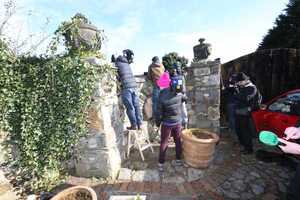
When Bank of Ireland moved to seize his €7 million palatial house over an unpaid debt of €71.5 million, a group calling itself the New Land League tried to block the repossession.

It just so happens that the New Land League, set up in 2013, is led by Jerry Beades, who is also a developer and a former member of Fianna Fail’s National Executive who collaborated closely with Bertie Ahern in the not so distant past.

According to press reports, he also accumulated multi-million euro bank debts over which he has been in legal battles with the banks.

The media has paid so much attention to that story that by now we know a lot about the intricate details of the lives of the O’Donnells, Jerry Beades, Gorse Hill itself and the New Land League. Yesterday, in a long Sunday Independent front-page ‘Exclusive’, ‘first-ever’ interview, the children of the O’Donnells told their stories. And that passes for investigative journalism.

One issue is, why is the media so focused on this case, but not on the thousands of others who have or are at risk of losing their house?

For example, just as the Gorse Hill soap opera is unfolding, a Limerick father called Ger Lonergan who is undergoing treatment for cancer risks losing his home due to a mortgage debt of €32,000.

He became unable to make payments due to illness and was diagnosed a few months ago with cancer. Permanent TSB has asked for a possession order to seize the house in which he lives with his wife and two daughters. Mr Lonergan says he gets a disability payment of €78 a week.

Whatever the details of this specific case, it’s not hard to imagine many other similar ones in the country. And ‘imagine’ is the right word, since we haven’t heard much about them.

The reason is that our mass media is not representative of popular interests. It cares about those of the better off and the stories that concern them, but not so much about the conditions faced by ordinary people.

That’s why all newspapers have ‘Business’ and ‘Money’ sections, but no ‘Poverty’ or ‘Human rights’ or ‘Deprivation’ sections. There are ‘Sports’ and ‘Lifestyle’ or ‘Living’ sections, but those don’t challenge Ireland’s power structure or injustice (they’re just about shopping and entertainment), so they may be printed.

The same goes for sensationalist stories like Gorse Hill. Narrowing down the discussion to the swimming pool and the paintings in the house, while not making links or comparisons with ordinary people at risk of losing their homes saves the government and bankers some embarrassment over kicking out ordinary and sick people out of their homes.

Another effect is that whenever the important issues of repossessions, evictions and mortgage arrears are brought up in public discourse, the picture conveyed is one of arrogant rich people living in mansions and too stubborn to vacate their house that they bought thanks to property speculation during the housing bubble years.

Many of us will have little sympathy for such individuals and might even secretly cheer for the courts and banks to kick them out of their house.

The result is that issues of repossession and arrears are misrepresented and turned upside down, and thousands of people whose lives are directly affected by them will not receive the attention they deserve.

@JulienMercille is lecturer at UCD and the author of The Political Economy and Media Coverage of the European Economic Crisis: The Case of Ireland. He will provide evidence to the Banking Inquiry on the role of the media during the housing bubble years.

Related: Banks attempt to repossess 7,000-plus homes (irish Times)


0y4g80hOHBIcfixRKUNqDklQs0QS8XG8Aedl0ACX_1E,HuhSK2C-SmbiL6t88vuKP_t157VGOskhH6OXtp3CmnADxMjfogObkBtn20_UxrI5WR6_hiQ8Nj7-bWBSAzPres,jh-_KUo5zptEOwLXQJ5pONI1j8wDcf1AQvLFTUyG3ho,EAqBckzyiLKrQ8n2vHQhevV7dphjPQzVBFHU9w-7GVM3Ff_inKpfM9t0ID8V8_847FEXGsFP-DFkMB4cC9F3LU,IONF_ygdVsxS1828joBeUGEi527CgxGCfSoV2TEO3lU,wxLOLDT2m6e4gP0sQyIaEqwALIBDs2Yevm_0tdpIlhAekILbFUI_50t1-NunMXT_QFx8qsas-BoFa1Xl3qqpNM,3JOGj4rMpWLoBDQ1K9oQdufE9nV1yw0zs9w2AVClQcE,TPrteu4IbGmgiiKtRgNB4Ms7nu3L8eGPPVfyMcS8hcw5urdSGeqzW2jhNxd8lJJFcou23U7PduA2dQyjGVkMvU,YYkD6vOD1By8G80EIHfsVyG5VxZqwpp9C6b2S4EwSR0,YCLT1HgCU5D7-8sb3ZQYsrSIky3KhVDUrP-OfrgxKwITMBQrO9397I_l-rSe2ciGagt1FoELSLoS_qgVv5sCx0,dUzrPbClIVHHb43gl-WJLBr6P1DlxvrtWoXZl6iMUts
yHD-mBLvrppu-4cP7jSxQyZVc8Ny7YJffjidAPKMp5I,j6OYHWlKNtXvtDNn5eyf8RPLGhe2fUOgrZVAFld1C0s,FkoHusKIopk6qPeRSqi0vRtMMuPuEdk63zJsTDkFP6w

This afternoon.

Sandymount Strand, Sandymount, Dublin 4.

Dog Day Afternoon.

A  gathering of 250 warm-hearted mutts and their owners from all over Dublin raising €1200 in aid of Dogs Trust, sponsored by new Irish dog treats company Ruby and Duke.

Owned by controversial canine lover Niall ‘Get Poop Done’ Harbison .

FIGHT!

Ruby And Duke (Facebook)

Niall Harbison