

Author Archives: Admin

17098447_1264037323643748_4609777203332495076_n

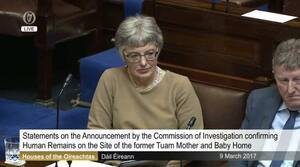
This morning.

In the Dáil.

Before deputies made statements about the confirmation last week that human remains have been found at the site of the former mother and baby home, run by the Bon Secours order, in Tuam, Co Galway.

The Minister for Children Katherine Zappone told the Dáil that, by the end of the months, she will publish an interim report that the Commission of Investigation into Mother and Baby Homes gave her last September.

She also said a scoping exercise will be carried out to examine calls for an expansion of the commission’s terms of reference “to cover all institutions, agencies and individuals that were involved with Ireland’s unmarried mothers and their children.”


From Ms Zappone’s speech:

Experience tells us it can take time to shine a light on dark periods of our history. The truth is hidden. Sometimes hidden in plain sight.

It takes the brave testimony of survivors, long studies by historians and the dogged determination of investigative journalists to bring a spotlight to events which were previously only whispered about – in this case for generations.

It is now almost a week since the Commission of Investigation into Mother and Baby Homes confirmed what we had all feared.

Today I wish to place on the record of this House the Commission’s update that significant number of human remains are buried in the site of the old Mother and Baby Home in Tuam.

For survivors, loved ones and campaigners such as the tireless Catherine Corless it was a moment of vindication. After decades and years of hard work, determination and unwavering commitment the truth has been laid bare for us all to see.

This House, and our entire state, owes a debt of gratitude to Catherine Corless for her work.

Many men and women alive today spent time in that institution, either as children or as young women. Today I offer them my personal solidarity and, as a citizen, my personal apology for the wrongs that were done to them.

Deputies will know that the Commission of Investigation into Mother and Baby Homes continues its work.

You will also know that cases have been made that the terms of reference of this Commission should be reviewed.

I want to acknowledge the calls made since Friday for an expansion of the Terms of Reference to cover all institutions, agencies and individuals that were involved with Ireland’s unmarried mothers and their children.

I can commit to Deputies that a scoping exercise will be carried out to examine this. As Minister I will be announcing the detail of this exercise in the coming weeks. As Minister I will also be publishing the second interim report of the Commission by the end of this month.

I am also mindful that by design the Commission is largely concerned with questions of legality; of legal liability, of compliance with the laws of the day and so on.
These are important questions.

They are however not the only issues which we should consider.

What happened in Tuam is part of a larger picture.

Part of a tapestry of oppression, abuse, and systematic human rights violations that took place all over this country for decades.

As a modern open society we must not treat these as isolated incidents but rather confront what was a dark period in an honest, mature and reflective way. We must acknowledge that what was happening in these institutions was not unknown. We must acknowledge that what was happening in these institutions was not without the support of many pillars in society.

We must acknowledge that this very House debated legislation that allowed for those residing in institutions such as County Homes to work for little or nothing in return for the so-called charity that was shown to them.

Lest we contend that people did not know what was happening, let us remember that some members of this House spoke out against it.

In the Finance Committee debates on the Health Bill 1952, which took place in July 1953, Deputy Kyne condemned putting unmarried mothers in county homes to effectively involuntary labour as “having revenge on her”.

While Deputy Captain Cowan described as “absolute brutality” the fact, as he described it, that “They are not let out even”.

Earlier than that — before our Constitution had been finalised — members of the Oireachtas also raised questions about the ill-treatment of so-called illegitimate children.

Thus, as I said, this history may be dark, but it was not entirely unknown. We must acknowledge that sometimes it was fathers and mothers, brothers and uncles, who condemned their daughters, sisters, nieces and cousins and their children to these institutions.

And that sometimes it was not.

We must accept that between 1940 and 1965 a recorded 474 so-called “unclaimed infant remains” were transferred from Mother and Baby Homes to medical schools in Irish universities.

We must listen to, record, and honour the truth of people’s experiences. We must commit to the best of our ability to recognising, recording and making reparations for the truth.

Making these commitments and honouring them will not be easy. But we must – for those who suffered and also for future generations.

Establishing the truth is important for many reasons – but not least to ensure that the darkness of the past will not return in the future.

Irish women and Irish children must never have to endure such suffering again. As a feminist, as an Independent Minister and as an Irish woman I feel a moral and ethical compulsion to reach beyond the legal questions of what happened in Tuam and elsewhere.

That compulsion is driven to try to arrive at this truth. For it is only from acceptance of the truth that we can move past it; not by drawing a line under it, but by highlighting it.

By recognising it as part of our history and part of our national story.

By commemorating and memorialising it.

By honouring its victims.

By recognising the part that individuals, communities and institutions played in it.

By making sure that, while we still have time, we look to those who are still alive and accept their accounts of what was done to them, and of the wrongness of that. In the coming days, as Minister, I will start a conversation with advocates, with historians and scholars specialising in transitional justice.

The United Nations defines transitional justice as the set of approaches a society uses ‘to try to come to terms with a range of large scale past abuses’. Transitional justice puts survivors and victims at the heart of the process. It commits to pursuing justice through truth.

It aims to achieve not only individual justice, but a wider societal transition from more repressive times, to move from one era to another.

Taking a transitional justice approach means that we will find out and record the truth, ensure accountability, make reparation, undertake institutional reform, and achieve reconciliation.

In doing this I want to acknowledge the many people who have contacted me personally in recent days to tell me directly of their experiences. It is important to also ensure that we learn from international best practice in transitional justice, such as the Museums of Memory in Argentina and Chile, for example.

There may also be lessons to be learned from processes used to establish the truth in other contexts and other countries.

Writing about the Mother and Baby Home in Tuam, as well as other matters, in the London Review of Books last year, our Laureate for Irish Fiction, Anne Enright, said: “The living can be disbelieved, dismissed, but the dead do not lie. We turn in death from witness to evidence, and this evidence is indelible, because it is mute”.

Let us not disbelieve; let us not dismiss.

Let us commit to do justice not solely through law, but through speaking and listening, and through believing what our eyes, our ears what our compatriots tell us.

Transcript via Katherine Zappone

Yesterday: What’s In It That’s So Frightening?

Screen Shot 2017-03-09 at 00.04.12 Screen Shot 2017-03-09 at 00.04.37 Screen Shot 2017-03-09 at 00.05.03

A size comparison of the spaceships of Star Trek by Metaball Studios who qualifies it thus:

Not all the ships of Star Trek. Only the most important.

Photon torpedoes fired.

Related: Star Trek: Just The Spaceships

And the mother of them all: Know Your Spaceships

likecool

Screen grab

This morning.

Social Democrat co-leader Catherine Murphy (top) called for, among other things, the removal of the Angelus from RTÉ. The comments were made during Dail statements on the Announcement by the Commission of Investigation confirming Human Remains on the Site of the former Tuam Mother and Baby home.

Ms Murphy said:

“When I first raised this issue in this House back in 2014 following my reading of Catherine Corless’s research I called at the time for the site at Tuam to immediately be declared a crime scene with Gardaí, crime scene techs, forensic anthropologists and anything else needed to establish the exact details of this atrocity.

And make no mistake, it was and is an atrocity. A mass grave of 796 tiny bodies, discarded like trash.

I listened to the Taoiseach’s speech yesterday about the culpability of the State and society. But the State- for the vast majority of time since it’s foundation the State itself was Fine Gael and or Fianna Fáil.

They were the ones who presided over debates in the chamber which referred to children born outside marriage in the most disparaging and disgusting terms and who wilfully handed over their responsibility for these women and children to a Church and they knew to be merciless at best.

So when we talk about the culpability of the State and Society, know that it was not Joe & Josephine Soap who condemned these women to a life of shame and the murder or export of their children, it was the Fianna Fáil or Fine Gael led State and their complete abdication of responsibility while being fully aware of the life they were consigning those women and children to.

The attitudes which prevailed were perpetuated by every arm of the state – the guards, the medical profession and the political system thus allowing the church to run free with their campaign of terror and castigating women for some perceived sin.

How utterly and tragically ironic that those same nuns who labelled those women as immoral, saw nothing immoral about neglecting a child to the point of death then disposing of their body in a septic tank.

And this is not the dark ages we’re talking about. The legacy of these acts are current or just one generation removed. The relatives of these women and children are still alive.

In 1995 when children playing on the site discovered skulls, it was not the police who were called for, it was a priest. He was called to bless the site then everybody went about their business as usual. The State once again turned a blind eye.

The horrors of the mother and baby homes cannot be properly put into words. The rumours of clinical drug trials have not been properly addressed and there was enough evidence of such trials in Tuam for the then Minister Kathleen Lynch to call for the Terms of Reference to include vaccine trials as part of the inquiry.

That didn’t happen and instead the terms referred to the ‘care arrangements including institutional practice with regard to health, safety, welfare and interests of mothers and children.’ It is not clear if possible vaccine trials were included.

A man from the area spoke to me recently of playing on the site and discovering hundreds of used vials buried in the grounds. And as we are all too painfully aware, such barbaric trials were not uncommon in other mother and baby homes.

So while there is now a collective wringing of hands – 2 years after it was first suggested publicly that there may be a mass grave in Tuam – the fact remains that the horrors of Tuam and other mother and baby homes existed because the State permitted the Church to control some of our most fundamental institutions and the sad fact is that not much has changed today.

We have got to take the Church from our schools, from our hospitals and medical care and from our politics. It is unacceptable that children are regularly discriminated against in our education system based on religion,

it is unacceptable that religious orders can hold any influence over medical institutions and the healthcare provided particularly to women; and it is unacceptable that the Dáil opens up every day with a prayer that is not representative of all elected members or citizens; and it is unacceptable that our national broadcaster, funded by the State, subjects citizens of all faiths and none to the angelus bells twice daily.”

These are relics of a bygone era and if Tuam has shown us anything it is this – the State must take responsibility for its citizens and the Church has no legitimacy in the healthcare or education of those citizens.”

Yesterday: What’s In It That’s So Frightening?


6-24 Screen-Shot-2015-10-13-at-10.21.22-AM Screen-Shot-2015-10-07-at-3.50.30-PM Screen-Shot-2015-10-07-at-3.50.11-PM Screen-Shot-2015-10-07-at-3.49.47-PM Screen-Shot-2015-10-07-at-2.53.19-PM 10-20 9-21

The majestic Moscow Metro (opened by Stalin in 1935) photographed over two weeks last year by Canadian photographer David Burdeny.

Burdeny spent a year trying to gain permission for the shoot and had to work after midnight, paying by the hour to capture the opulent interiors of various city stations, emptied of passengers.

Currently on show at the Jennifer Kostuik Gallery in Vancouver as part of an exhibition entitled A Bright Future – New Works from Russia.

hyperallergic

corless

Historian Catherine Corless

On the Late Late Show…

Gareth Naughton writes:

Without the extraordinary persistence of Catherine Corless the fate of the Tuam Babies may never have come to light. She’ll be joining Ryan Tubridy to talk about why she was so determined to get to the truth and persevered despite coming under intense pressure from people who doubted the veracity of her claims. She will also be joined in studio by survivors of the Mother and Baby homes…

The Late Late Show on RTÉ One at 9.35pm

Earlier: Children of A Lesser God

‘Virtue Signalling’ About Dead Babies

Previously: Our Worst fears


C6eP8VdXQAAEeAT

This morning.

Drury Street, Dublin 2

Buzz writes:

Lads.. I think we’ve reached peak coffee shop… in a car park on Drury Street =… ah here!.

Update:

compt
redress3


This morning, The Office of the Comptroller and Auditor General published a  report on the cost of the child abuse inquiry and redress schemes.

Via The Comptroller

The work of the Commission to Inquire into Child Abuse and of the Redress Board is largely complete. Costs to the end of 2015 of the child abuse inquiry and redress are an estimated €1.5 billion.

Both the cost to the State and the time required to bring the process to a conclusion have hugely exceeded original estimates.

The Commission’s work cost an estimated €82 million – the Department of Education and Skills initially forecast the cost at €2.5 million.

The final report of the Commission, often referred to as the Ryan report, was published in May 2009.

The redress scheme accounts for the largest element of the costs, at an estimated €1.25 billion.

The original forecast cost of the scheme was €250 million.

By the end of 2015, awards totalling €970 million had been made to 15,579 claimants – an average award of €62,250. 85% of the awards were at or below a level of €100,000 per person. The highest award made was €300,000.

By 31 December 2015, the Redress Board had approved legal cost payments of €192.9 million to 991 legal firms in respect of 15,345 applications.

17 legal firms were paid between €1 million and €5 million each and seven firms were paid amounts between €5 million and €19 million each.

Outside of the redress scheme, other supports have been put in place to assist the former residents of the institutions. The overall spend on health, housing, educational and counselling services is estimated at €176 million.

Government policy was to pursue the sharing of the cost of redress on a 50:50 basis with the religious congregations.

This would require the congregations to contribute €760 million.

To date, the congregations have offered the equivalent to about 23% of the overall cost.

Contributions received from the congregations up to the end of 2015 represent about 13% of the cost.

An indemnity agreement was signed in 2002 between the State and 18 religious congregations, who agreed to contribute to the costs of redress by transferring property, cash and other resources totalling €128 million, of which €21 million remains to be transferred to the State at the end of 2015.

Following the publication of the Ryan Report in 2009, the congregations offered additional cash and property valued at €353 million.

This combined offer was revised to €226 million

in September 2015. Six years after the publication of the Ryan report, only €85 million (38%) of the €226 million offer has been received by the State.

Full, text here

Yesterday:  Spotting The Woods For The Trees