Author Archives: Bodger

This morning.

Iveagh House, Dublin 2

Minister for Housing, Planning and Local Government Eoghan Murphy (left) with Minister for Finance and Public Expenditure and Reform Paschal Donohoe arriving for the launch of Home Building Finance Ireland….

… the state’s new financing initiative for the residential construction sector, will offer loans of up to €35m to house builders.

HBFI has been established to fill a funding gap for smaller builders. It will lend to developments of as few as 10 houses or apartments. The company’s website, which went live on Friday, states that it is open for expressions of interest.

HBFI will be funded with €750m from the Ireland Strategic Investment Fund (Isif). A borrowing entity must provide a minimum of 20% equity of a building project, which can include the site value. HBFI will provide up to 80% of the project cost.

Home Building Finance Ireland to lend up to €35m to house builders (Niall Brady, The Times Ireland edition)

Rollingnews

Meanwhile…

This morning.

College of Anaesthesiologists (!), Dublin 2.

Minister for Housing Eoghan Murphy (fourth left) with the Interim Board of the LDA (Land Development Agency) ahead of the first meeting of the Board

Leah Farrell/RollingNews

Meanwhile…

Brexit: No change to backstop, Ireland insists (BBC)

This morning.

Sarah Burns, in The Irish Times, reports:

More than 11,600 borrowers received advice and support from Abhaile, the State’s mortgage arrears and debt resolution service over a two-year period, according to a recent report.

The Department of Justice and Equality, and the Department of Employment Affairs and Social Protection, who co-ordinate the scheme, published annual reports reviewing the take up and outcomes of Abhaile between July 2016 and June 2018.

Over that time, 11,695 borrowers received financial advice and negotiation support either from a personal insolvency practitioner (5,154 households) or a dedicated mortgage arrears adviser (4,960 households).

More than 11,600 households seek debt advice from State body (Sarah Burns, The Irish Times)

Charles Haughey’s grandson Cathal Haughey is running for Fianna Fáil in Clontarf, Dublin, in May’s local elections.

In politics sometimes your name
Can get you ahead of the game
But is it really fair
For a young man to wear
The badge of his grandfather’s shame?

John Moynes

Yesterday.

On Twitter.

Requests were made by gardaí, via their Twitter account, for the videos above to be removed from Twitter.

The videos contain footage taken by cyclists.

The requests prompted some on Twitter to ask the gardai what law was being broken by the posters…

Anyone?

Gardaí fears over dangerous driving videos ‘have no basis’ (Catherine Sanz, The Times Ireland edition)

Previously: “As Much As €40,000 Each”

From top: President of the High Court, Peter Kelly; Master of the High Court Ed Honohan

Yesterday, President of the High Court Peter Kelly signed a direction to remove debt cases from the Master of the High Court Edmund Honohan.

The High Court Practice Direction (HC 84) on summary summonses (debt collection claims), signed by Justice Kelly, states:.

“Pursuant to the provisions of Section 10 of the Courts (Supplemental Provisions) Act 1961 I hereby direct that from Monday 4th February, 2019 all motions seeking liberty to enter final judgment pursuant to Order 37, rule 1 of the Rules of the Superior Courts shall, in lieu of being set down for hearing before the Master of the High Court, be set down for hearing before a Judge of the High Court and shall be listed in a common law motion list on an appropriate Monday.”

The Rules of the Superior Courts were brought into force by Statutory Instrument (SI) 15 of 1986 passed by the Superior Court Rules Committee exercising its powers under Section 36 of the Courts of Justice Act, 1924, Section 68 of the Courts of Justice Act, 1936 (as applied by the Courts (Supplemental Provisions) Act, 1961, section 48), and Section 14 of the Courts (Supplemental Provisions) Act, 1961.

Order 37 Rule 1 of the Rules begins:

“Every summary summons endorsed with a claim (other than for an account) under Order 2 to which an appearance has been entered shall be set down before the Master by the plaintiff, on motion for liberty to enter final judgement for the amount claimed.”

Section 10 of the 1961 Act mentioned in the Practice Direction (see above) and subsection 4 states:

“There shall be exercisable by the President of the High Court all jurisdiction which, by virtue of any enactment which is applied by section 48 of this Act, was, immediately before the operative date, vested in or capable of being exercised by the existing President of the High Court.”

Also, Section 36 of the Courts of Justice Act 1924  states that the Rules

“shall be made or annulled or altered only with the concurrence of a majority of a committee consisting of the judges of the Supreme Court and the High Court, the President of the Incorporated Law Society of Ireland, and two practising barristers, of the senior and junior Bar respectively, to be selected by the Council of the Bar of Ireland”

With this in mind, ‘Bewildered Former Devil’ asks:

‘Isn’t the Practice Direction effectively changing the Rules? If so, why isn’t this being done by Statutory Instrument like all other amendments to the Rules to date?

There is nothing I can see in Section 48 (the Courts of Justice Acts and the Courts Officers Acts) allowing the President to unilaterally change the Rules of the Superior Courts.

Also, perhaps the committee indeed have met and sanctioned this change by statutory instrument but then presumably the Master (a current member of the Superior Courts Rules Committee) would have known about it in advance.  Mr Honohan said last night on [RTÉ One’s] Prime Time that he didn’t.’

Anyone?

Earlier: “It Is, In Fact, The Way The Job Should Be Done”

Yesterday: Here Comes The Pane

Meanwhile…

This afternoon.

Federal Courthouse, Fort Lauderdale, Florida, USA

Donald Trump confidante Roger Stone attempts to speak to reporters following his arraignment charged with seven counts, according to a grand jury indictment made public by US Special Counsel Robert Mueller’s office.

Earlier:

https://www.youtube.com/watch?v=fbSUHsKpoNo

CNN footage showing FBI arrive at Roger Stone’s Florida home to arrest him.

‘The indictment alleges that [long-time Donald Trump confidante] Roger Stone made multiple attempts to contact WikiLeaks through an intermediary about documents stolen from the Democratic national committee and Hillary Clinton’s presidential campaign, and passed on information to Trump’s election campaign team about the documents.’

Trump ally Roger Stone arrested on seven charges in Mueller inquiry (The Guardian)

Video shows FBI at Roger Stone’s house (CNN)

Meanwhile…

Meanwhile…

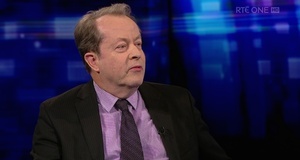
Master of the High Court Ed Honohan with David McCullagh on last night’s Prime Time on RTÉ One

Last night.

At the end of RTÉ One’s Prime Time.

Journalist David McCullagh briefly interviewed the Master of the High Court Edmund Honohan.

It followed the decision of the President of the High Court Peter Kelly to remove all debt cases from Mr Honohan.

From the interview…

David McCullagh: “When did you hear about this decision?”

Edmund Honohan: “A reporter rang me. I haven’t officially been told anything by anybody. Nobody has contacted me officially from the president’s office or any other official source.”

McCullagh: “There is a statement up on the website I suppose but you haven’t been directly approached.”

Honohan: “I haven’t been approached. I haven’t had any explanation offered to me.”

McCullagh: “Ok. How do you think you’ve performed in handling these particular cases?”

Honohan: “Extremely well.”

McCullagh: “Well, you would say that I suppose wouldn’t you?”

Honohan: “Yeah. Well, I’ve been there now for in excess of 15 years. I think you have to go back a little bit. A previous master, Patrick Lindsay, Paddy Lindsay, a Fine Gael TD and Minister at the time, he wrote in his autobiography, I brought it in for you here and it’s quite interesting. He said, when I took up the position, he says,

‘Any day that I worked after lunchtime as a Master [of the High Court] was rare,’ he said. ‘I go through things fast, I attributed the speed with which I was able to turn over an awful lot of work to the honesty and integrity of people appearing before me. There were very few people, I can think of only one, whose word I could not take. And generally, if asked, ‘are your proofs in order?’, or ‘are your papers in order?’ and the answer was yes, then you knew, you could believe what you were told.’

“In other words, he wasn’t reading the papers. Now, I read the papers and I find a surprising number of errors. And my function is to arrange those papers so that they’re in order for a fair hearing downstairs [before the High Court]. And if I find a mistake, I can invite the plaintiff to correct the mistake and if he declines to correct the mistake, then the papers are not in order, and I strike out the summons. Now this may be a source of difficulty, there’s no difficulty about it because that decision can be appealed.

“The real problem seems to be that there’s a perception that if I strike out the summons, that I’m acting in some kind of quasi-judicial manner, I’m not. I’m pointing out that there’s an error in the paperwork, it’s not ready to go on. And I have a duty, under the 2003 Act, to ensure that the hearing which transpires later on, downstairs is a fair hearing for both sides.”


McCullagh:
“Now, just because people might not be that familiar with the legal system. You’re not a judge. It’s a quasi-judicial function. But it’s an administrative thing, to make sure that all the ducks are lined up in a row.”

Honohan: “That’s it yes. You’d often have very, very silly mistakes like affidavits of service not being before the court or affidavits which don’t state the means of knowledge of the deponent. But it’s becoming more and more difficult actually, in relation to the probative value of evidence.

We have Supreme Court decisions now which are of great assistance to the courts which are not actually being read by the practitioners. And they’re not actually being filtered through to the High Court so if I pick up a case and I find there’s a mistake, which causes me to draw attention of the practitioners to the new decisions that are coming forward from the Supreme Court – I point this out. And boy there are plaintiffs who do not like it.

They’re the plaintiffs who are churning out papers on a factory basis and if I say ‘oh, I’m sorry, but I’m going to have to adjourn this, they’ll say ‘why?’. Then I’ll say, ‘I’m going to strike out the motion because the papers are not in order’, they’ll say ‘we’ll appeal that’. This is not a difficulty, it is in fact the way the job should be done. Because the papers should be in order.

Otherwise you do not have the opportunity for both sides to effectively participate.

Now I’m dealing with a lot of lay litigants. I don’t know if you understand the concept of ineffective participation – that’s when you’re there in court and you don’t know what’s going on. It’s my job to try and spoon feed these people, to enable them to get to grips with the process that’s before the court.”

McCullagh: “OK, now as you say, you don’t know why this particular decision has been taken. But it’s fair to say that you have been vocal, you have been perhaps controversial. A lot of people would know that you’ve spoken up in favour of people who’re facing repossession and so on…”

[Honohan nods in agreement]

McCullagh: “Would some people wonder whether you’re impartiality might be in question?”

Honohan: “No, no, I can’t imagine how? Because a level-playing pitch in the courts is what the objective is. And there’s no way that I’m making a judgement which is actually impacting on the actual strict legal rights of either party. I’m simply making sure that both parties are ready and prepared to deal with the case when it comes on before the court.”

McCullagh: “You also, famously, recently brought a hammer into your courtroom to break a window because the room was too stuffy?”

Honohan: “Yes..I’m sure that’s not the reason for the change…”

McCullagh: “Well, your room will presumably be less busy now if these cases are…”

Honohan: “Those windows have been fixed actually, so I’m delighted with that.”

McCullagh: “Ok. Edmund Honohan, thank you very much indeed for joining us.”

Watch back in full here from 29.32

Related: Removing Ed

Yesterday: Here Comes The Pane

Yesterday: What’s The Deal?
