
Examples of media and social media monitoring carried out by the Department of Justice
In recent days.
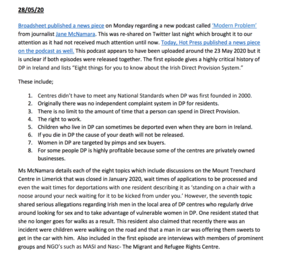
The Movement of Asylum Seekers, along with Ken Foxe and Sian Cowman, obtained a tranche of documents totalling 494 pages from the Department of Justice detailing how the department has been monitoring media articles, Twitter exchanges about these articles, and criticism posted on Twitter about direct provision.
MASI has said it has learned that the Department of Justice directed its Transparency Unit to conduct the monitoring after MASI refused to delete a tweet about the death of an asylum seeker at the Central Hotel in Dublin on April 15 last.
The documents show that, on April 16, the Deputy Secretary General at the Department of Justice Oonagh Buckley wrote to MASI members Lucky Khambule and Bulelani Mfaco saying that the department couldn’t understand why MASI tweeted about this death at the hotel “in such an insensitive manner”.
Ms Buckley said that the person who died had family living in Ireland and the gardai were on the way to tell the family about the death at the time of the tweets. She said another department official had asked MASI to remove the tweets on April 15 but that MASI had refused.
Ms Buckley also included a copy of the International Protection Accommodation Service’s Critical Incident Policy (which was established last November).
She also wrote: “Indeed our request was met with another tweet to the effect that the Department was engaging in a culture of secrecy. Nothing could be further from the truth.”
Ms Buckley also informed MASI that the letter she was writing to them would be copied to all NGOs “involved in the briefing sessions to date”.
Many may consider MASI’s claim that the department works in secrecy utterly plausible, given it’s unclear how many people have died by suicide in Direct Provision since it began in 1999, how deaths in direct provision are recorded, and especially given the aftermath of the death of Sylva Tukula.
In August 2018, asylum seeker Sylva Tukula, who was living in the Direct Provision system in Galway city, died of natural causes. It later emerged that she had been buried in May 2019 without the knowledge of her friends or fellow residents at the centre where she had lived – even though they were assured they would be notified once arrangements for her burial would be made.
Ms Tukula, who identified as a transwoman, died in the men’s-only Great Western House Direct Provision centre in Galway. At the time of her death, it had been reported that she had requested to be moved out of the all-male centre where she reportedly had a single room.
On April 18, MASI wrote back to the department and highlighted the lack of transparency surrounding deaths of people living in direct provision, saying:
‘The UN’s Committee on the Elimination of Racial Discrimination, informed by submissions from Irish civil society, recently called on Ireland to, amongst other things, “Ensure transparency regarding deaths in direct provision centres and collect and publish data on such deaths.” The IPAS Critical Incident Policy does not address this.’
The dossier, dated from April 23, 2020 and runs until June, begins with the noting of an Irish Times article which quotes Dr Eamonn Faller, an infectious disease specialist registrar at Cork University Hospital, describing direct provision centres as “powder kegs for Covid-19”.
The article includes calls from the Irish Refugee Council and Sanctuary Runners to have vulnerable people living in direct provision moved out of cramped centres to protect them from contracting Covid-19.
The dossier then goes on to include criticisms of direct provision both related, and unrelated, to Covid-19, until the end of June.
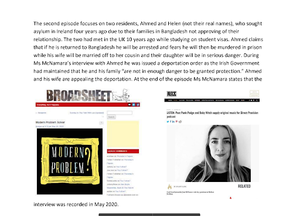
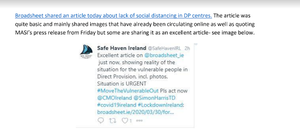
The collection of material includes media articles, tweets about these articles and, separately, tweets about direct provision. It predominantly focuses on tweets from the Movement of Asylum Seekers in Ireland (MASI) but also includes tweets from celebrities, prominent media figures, politicians, lawyers, journalists, news outlets, civil liberty campaigners, charity and NGO workers, and what the department calls “online activists”.
It mainly involves screenshots of their tweets and links to their individual Twitter pages but also, in many instances, makes a note of the number or ‘likes’ or ‘retweets’ a tweet received. It also notes comments made under media articles.
The full dossier of 15 PDFs can be read here
Last year, solicitor Simon McGarr revealed how the Department of Employment and Social Protection monitored his media appearances and tweets concerning the Public Services Card.
Meanwhile, yesterday, in a story about the dossier by Ellen Coyne in the Sunday Independent, Ms Coyne reported:
The Department of Justice said it started a new policy of monitoring social media during Covid-19 to improve its communications strategy.
The department said it has also started monitoring tweets about An Garda Síochána, prisons, family law, domestic violence and family courts. It said monitoring social media allowed it to “correct any inaccuracies raised, investigate complaints and respond accordingly”.
Anyone?
Department of Justice officials monitor posts criticising Direct Provision on social media (Sunday Independent)




