

Private Eye.
On shelves tomorrow (against considerable odds).
Thanks Bernard



This morning.
New Road, Clondalkin, County Dublin
Pre-2011 pay-scale teacher Neasa Moloney (top left) supporting her colleague, lower tier post-2011 pay scale teacher Sarah Kelly outside Colaiste Bride School on a day of action across Ireland by members of the Teachers’ Union of Ireland (TUI) over unequal pay.
It’s heartbreaking.
Everyone’s in tiers.
No school for thousands of students as TUI strikes over equal pay (RTÉ)

Number of people in temporary emergency accommodation defined by the dept as having “no (or minimal) supports.
November 2018:64
December 2018:66November 2019: 64
December 2019: 22502,186 in 1 month in accommodation without proper onsite supports.#AskWhy #GE2020 pic.twitter.com/veuHpi7B24
— ICHHDUBLIN (@ICHHDUBLIN) January 30, 2020
From top: Eoghan Murphy and Richard Bruton (head down) at the Fine Gael General Election 2020 manifesto launch; tweet from Inner City Helping Homeless
Last week
The Department of Housing released its latest homeless figures which showed there were 9,731 people (6,309 adults and 3,422 children) living in emergency accommodation in the final week of December 2019.
This represented a decrease of 387 adults and a decrease of 330 children compared to the figures for November 2019 when there were 10,448 people (6,696 adults and 3,752 children) living in emergency accommodation in the final week of November 2019.
However…


…homeless charity Inner City Helping Homeless (ICHH)have been questioning the figures, last night writing:
“Last week the Department of Housing released the homeless report for December 2019 alongside their report for the fourth quarter of 2019.
The report stated a reduction of 717 people from the report for November 2019.
Upon further inspection we noticed a huge difference in the number of people listed as being in a TEA (Temporary Emergency Accommodation), an accommodation type with “No (or minimal) supports on site”.
The increase in this particular section was 3,146% [from 64 in Dublin in November to 2,250 in December] We were quick to highlight this on our social media platforms as it didn’t add up alongside the number of people that were removed in the space of one month.’
They added:
‘Upon further investigation on both the Department’s website and the Rebuild Ireland website, we noticed that the report had actually been updated due to miscalculation however this update was never communicated to either homeless charities nor the media based on the feedback we have received.
What is clear from our investigation was that the first report was an error due to invalid data entry.
On the first report the figures under PEA/STA were the total of people in PEA’s so should have been added together.
Instead they were put in incorrect columns and not added which explained the increase of 3,146% in the TEA column however with a general election a week away this wasn’t communicated to anyone.
A deeper comparison of the fourth quarter report versus the December report doesn’t show how it could be possible that 717 fewer people were homeless in December vs the November report.
“Using Dublin as an example the December report stated there were 94 less families homeless in Dublin. When we look at the quarterly report from the department it shows the number of families entering homelessness each month versus the number of families exiting homelessness.
According to their own report 44 new families became homeless in December while 98 families exited homelessness which is a difference of 54 families not 94.
This has raised alarm bells with regards to the entire report as the last time we saw a decline like this the Department had reclassified 1,606 people and removed them from the homeless list despite some councils stating they disagreed with the decision.
We have submitted a Freedom of Information request to clarify both how so many people exited emergency accommodation in December and why the errors in the original published report was not communicated correctly.’
Anyone?

Ah now.
This morning.
Carlosfandango writes:
In an extremely packed car park in Tallafornia [Tallaght, Dublin], this driver was being a tad conservative with their spatial awareness…


Yes.
Please consult your spin doctor.
General Election coverage at Independent Newspapers in the three days since Sinn Féin’s dramatic rise in the polls.
Rog writes:
They’re taking it well….
Sinn Féin stumbles over tax as IRA murder casts shadow (Independent.ie)

Hey @AerLingus, I’m not one to normally take to Twitter to complain but think this is important. I have just experienced my 2nd return long haul flight where there were no vegan or even vegetarian meals available. (1/5) pic.twitter.com/JGJ1ZRwICv
— Ollie Shiel (@olivershiel) February 4, 2020
Good morning, Ollie. Meal requests need to be preordered 48hours prior to departure. Please message us here for any future travels. We hope this helps.
— Aer Lingus (@AerLingus) February 4, 2020
I pre ordered their meal on the outgoing long haul and the return. The outgoing was well prepared but on the way home, I noted that someone else seemed to get my pre ordered meal and I was left with very little going home. This was last year to LA.
— Liz (10) (^_^) Ⓥ (@Lionesskeeper) February 4, 2020
In fairness @AerLingus it should be a regular inflight menu option. Not something requiring a 2 days request notice! Considering the impact aviation has on our environment. Wouldn’t plant based vegan options as standard be a welcome positive?
— Dublin Vegfest (@DublinVegfest) February 4, 2020
Anyone?/FIGHT!


Jack Chambers losing the plot – #GE2020 focusing minds. 😇#cblive pic.twitter.com/tmDUVxACK2
— Mick Caul (@caulmick) February 3, 2020
Poor Jack Chambers – I really hope someone is collecting him after the show. It’s very late. #Cblive #GE2020 pic.twitter.com/8Aos3wOVTN
— Mick Caul (@caulmick) February 3, 2020
Last night.
On RTÉ One’s Claire Byrne Live, Ms Byrne held a climate debate.
During the debate, Fianna Fáil’s Jack Chambers took issue with Ms Byrne’s questioning of his party’s climate change policies and said she was being “very unfair” and “disingenuous”.
He accused of her trying to “undermine” the party’s climate action plan by raising the fact that their manifesto pertaining to climate change contains promises about child pornography, Traveller rights and female representation. Mr Chambers argued that those matters come under the remit of the “broad” line department.
Mr Chambers said:
“It’s unfortunate RTÉ spends all it’s time looking at polls and process and not looking at the issues and climate action.”
Later, speaking about Sinn Féin, he said:
“They oppose everything to be populist and it’s a new kind of Trumpism in Irish politics.”
Sinn Féin’s Eoin Ó Bróin, who was sitting on the same panel with Mr Chambers, told him to “be serious”.
Mr Chambers replied:
“You want the public to take you seriously? I think you need to be serious. What about, what about, what about, what about the Special Criminal Court? What about the Special Criminal Court? Do you support the Special Criminal Court in this country?”
He then turned to Ms Byrne:
“You see, these are the hard questions. The media has spent the last two weeks talking about polls and if Mary Lou McDonald is in or out of the debate. I’m glad she’s in the debate tomorrow night [tonight] so she can face the scrutiny because it’s all about the big drama and obsession with Sinn Féin.”
Sounds familiar?
Watch back in full here
Meanwhile…

From front page of today’s Irish Times
This morning.
The Irish Times reports in full on its Ispos/MBRI poll which puts Sinn Féin at 25%, Fianna Fáil at 23% and Fine Gael at 20%.
The results were announced at 10pm last night.
RTÉ to invite McDonald to take part in leaders’ debatehttps://t.co/F3lVetLWpC
— RTÉ News (@rtenews) February 3, 2020
This evening.
“RTÉ is very mindful it has a duty to the public to reflect events as they unfold.
During the course of the campaign and over recent days RTÉ has taken into consideration the notable change in the dynamic of the campaign on the ground, and representation and statements by political parties.
The dynamic has also been consistently reflected in all opinion polls since the campaign commenced.
We now consider it necessary to amend our original approach, respond to the changes in the campaign, and continue to put the audience first in the making of Tuesday night’s programme.”
RTÉ statement this evening.
Mary Lou McDonald to take part in leaders’ debate (RTÉ)
Earlier…

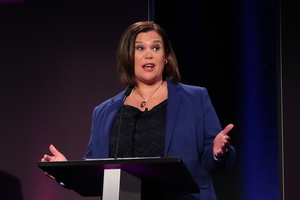
David McCullagh and Miriam O’Callaghan of RTÉ’s Prime Time; Sinn Fein leader Mary Lou McDonald, during the seven way RTE leaders debate
On January 14 last, Taoiseach Leo Varadkar announced that the election would take place on Saturday, February 8, 2020.
The following day, January 15, RTÉ released a press statement announcing details of its TV election debates. It noted:
“In the final days of the campaign The Prime Time Leaders Debate will see the party leaders from the two largest political parties invited to take part in a live head-to-head studio debate.”
“In approaching election coverage the RTÉ Election Steering Group has regard to objective and impartial criteria, such as the results of the last comparable election (in this instance, the General Election 2016) and the results of intervening elections, such as the 2019 Local and European elections. Other factors are also considered in RTÉ coverage of the campaign.”
This morning.
RTÉ’s Political Correspondent Paul Cunningham reports:
“RTÉ’s General Election steering committee will meet at 11am to consider representations from Sinn Féin for Mary Lou McDonald to participate in the Prime Time leaders’ debate tomorrow night.
“Under the existing plan, the debate will be between the Fine Gael leader Leo Varadkar and the Fianna Fáil leader Micheál Martin.
“Sinn Féin’s Pearse Doherty, who made the request to RTÉ in person yesterday, has argued that recent opinion polls prove that the criteria used to exclude Ms McDonald are redundant.”
More as we get it.
Meanwhile…

Prime Time presenter Miriam O Callaghan with, from left: Micheál Martin of Fianna Fáil, Enda Kenny of Fine Gael and Eamon Gilmore of The Labour Party before a three-way leaders’ debate during the 2011 General Election
From the book Electoral Management: Institutions and Practices in an Established Democracy: The Case of Ireland by Fiona Buckley and Theresa Reidy…
In a chapter by Kevin Rafter:
Televised leaders’ debates have been a feature of Dáil elections since February 1982 with the sole exception of the 1989 election when agreement was not reached to organise a debate.
The seven debates between February 1982 and May 2007 shared several common features. In the first instance, participation was confined to the leaders of Fianna Fáil and Fine Gael, the two largest parties, which in effect turned the encounters into ‘Prime Ministerial debates’ as holder of the office of Taoiseach (Prime Minister) have been drawn from these two parties.
In addition, there was always only one televised debate per campaign, and all these debates were hosted by RTÉ.
The nature of the leaders’s debate changed in the 2011 general election. The number of debates increased to four while the number of host broadcasters increased to three with the involvement of TV3 and the publicly owned Irish language service, TG4.
The debate on TG4 took place in the Irish language (all earlier debates were in the English language).
Finally, and undoubtedly the most important change in 2011 was an increase in the number of participating party leaders.
The leader of the Labour Party, traditionally the third largest party participated in all four debates while one of the debates was a five-way encounter involving all parties with a minimum representation in the outgoing Dáil.
Since 1988, the organisation of presidential debates in the USA has been overseen by an independent commission although they are still defined by ‘behind-the-scenes arguments about everything from the format of the questioners to the length of the response time, the placement of cameras, the height of podiums, and the location of water glasses’.
In an Irish context, these ‘debates about the debates’ involves private interaction between the main political parties and broadcasters. At the 2011 general election, each of the three broadcasters ultimately involved in broadcasting debates (RTÉ, TV3 and TG4) negotiated separately with the five main political parties. This was a different approach to the UK experience where the broadcasters ‘communicated and agree a concerted approach’.
RTÉ’s hosting of two leader debates in 2011 was preceded by eight months of informal conversations, email communication and formal face-to-face meetings.
In a post-election review, one RTÉ executive offered advice for colleagues involved in future debate negotiations:
“…avoid getting drawn into lengthy discussions on formats or rules and regulations – we make the TV, they provide the candidates – and at no stage did we get drawn into the sorts of intricate rules which were a feature of the UK debates.”
...The importance of being impartial and fair, and being seen to be so, was a central feature of RTÉ’s approach to election coverage in 2011.
Indeed, at the final internal SC [steering committee] meeting before polling day it was noted ‘with satisfaction that RTÉ’s coverage hadn’t featured as an election story and this was very welcome as an indication that we were providing extensive, accurate and fair coverage’.
There you go now.
RTÉ committee to meet over Sinn Féin participation in election debate (RTÉ)

This morning.
Liberty Hall, North Dock, Dublin 1
People Before Profit’s Richard Boyd Barrett (left) and Brid Smith launch the party’s “Charter of Workers Rights” at the James Connolly Memorial Statue.
The charter proposes a shorter working week, a living wage of €15 an hour, mandatory sick and maternity pay on the full rate, union recognition for all workers and a right to strike.
Mr Boyd Barret said:
“Our workers are the most productive of anywhere in the Western world with the highest levels of productivity, but they have the lowest share of the national economic cake
We have one of the youngest populations anywhere in Europe and the plan of both Fine Gael and Fianna Fáil, I’m fearful, is to have us working longer than any other worker in Europe, before they are entitled to their pension and that doesn’t add up
I think there is a historic shift happening in Irish politics away from the two party system of Fianna Fáil and Fine Gael with a majority of people looking for an alternative.”
Meanwhile…
After outlining their Charter of Workers Rights, Bríd Smith entertained the gathered media singing a verse of “James Connolly“.
People Before Profit propose shorter working week and longer holidays (RTÉ)
