




Ikiru – an ‘exotic shorthair boycat’ from Bradford.
His tongue. It’s always out. He can’t help that.



Ikiru – an ‘exotic shorthair boycat’ from Bradford.
His tongue. It’s always out. He can’t help that.

No, but it sure does look like that.
Behold: the Crescent nebula (the aforementioned pulsating brain) and the Soap Bubble nebula (that ‘orb’ [what are the chances?] at bottom left) – two globular clouds of dust and gas drifting through the star field between our Milky Way and the constellation of Cygnus. To wit:
Both were formed at a final phase in the life of a star. Also known as NGC 6888, the Crescent was shaped as its bright, central massive Wolf-Rayet star, WR 136, shed its outer envelope in a strong stellar wind. Burning through fuel at a prodigious rate, WR 136 is near the end of a short life that should finish in a spectacular supernova explosion. Discovered in 2013, the Soap Bubble Nebula is likely a planetary nebula, the final shroud of a lower mass, long-lived, sun-like star destined to become a slowly cooling white dwarf. Both stellar shrouds are 5,000 light-years or so distant. The larger Crescent Nebula is around 25 light-years across.
(Image: Michael Miller, Jimmy Walker)


International works by French street artist Mantra, who has a thing for butterflies – their richly hued scales, their delicate antennae – whether depicted pinned behind the trompe l’oeil of glass display cases or sunning themselves on the side of buildings, as if poised to take flight. Colossal sez:
…the focus on butterflies revolves around his artistic ambitions because the vivid creatures allow him to experiment with color, shape, and texture. Each specimen is rendered freehand before the artist adds detail and the illusory shadows that make them appear three-dimensional. By painting various Lepidoptera species again and again, the artist is “repeating a mantra,” a detail of his practice that informs the moniker he works under.






Less than tasty treats from the Rate My Plate Facebook page, to which folk submit pictures of their horrid grub.

Theramin wunderkind Carolina Eyck showcases her impressive gestural skills with a rendition of Nikolai Rimsky-Korsakov’s notoriously challenging ‘Flight Of The Bumblebee’.
Buzzin’.

Behold: a tumultuous cosmic conflict – a Star War, if you will – in the region of spiral galaxy UGC 1810. To wit:
The featured galaxy is labelled UGC 1810 by itself, but together with its collisional partner is known as Arp 273. The overall shape of UGC 1810 — in particular its blue outer ring — is likely a result of wild and violent gravitational interactions. This ring’s blue colour is caused by massive stars that are blue hot and have formed only in the past few million years. The inner galaxy appears older, redder, and threaded with cool filamentary dust. A few bright stars appear well in the foreground, unrelated to UGC 1810, while several galaxies are visible well in the background. Arp 273 lies about 300 million light years away toward the constellation of Andromeda. Quite likely, UGC 1810 will devour its galactic sidekick over the next billion years and settle into a classic spiral form.
Related: You Weren’t There Man, You Don’t Know…
(Image: NASA, ESA, Hubble, HLA; Processing & Copyright: Domingo Pestana)

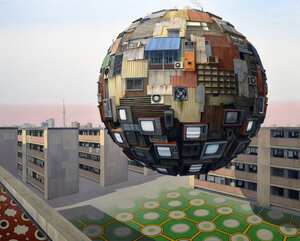


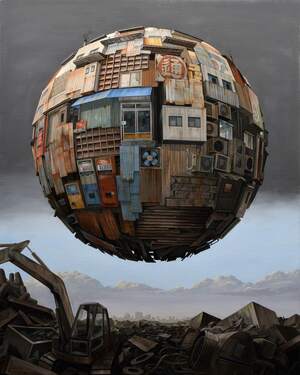
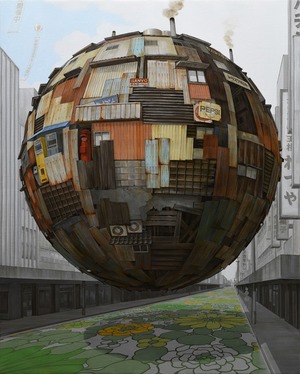
The Patch: oil paintings by Japanese artist Masakatsu Sashie: intricately detailed urban amalgamations ‘hovering gracefully between the worlds of a nostalgic past and a potentially dystopian future’.
Bit like ourselves, really.



An atmospheric and thought provoking short by Gökalp Gönen in which a ship-bound interstellar traveller discovers why his robot guardian hasn’t permitted him to disembark at a single habitable planet.
#OnThisDay 19 October 1953 – Official opening of Busáras, designed by architect Michael Scott. @Buseireann @stwarchitects pic.twitter.com/kCxgEsRRce
— Dublin Festival of History (@HistFest) October 19, 2020
Name those virtually identical black jam jars, though.
