

Previously: Poor Sandbag



Behold: a sharp telescopic view of galaxies toward the constellation of Pegasus, far beyond the stars of our own Milky Way. To wit:
Prominent at the upper right is NGC 7331. A mere 50 million light-years away, the large spiral is one of the brighter galaxies not included in Charles Messier’s famous 18th century catalog. The disturbed looking group of galaxies at the lower left is well-known as Stephan’s Quintet. About 300 million light-years distant, the quintet dramatically illustrates a multiple galaxy collision, its powerful, ongoing interactions posed for a brief cosmic snapshot. On the sky, the quintet and NGC 7331 are separated by about half a degree.
(Image: Robert Eder)


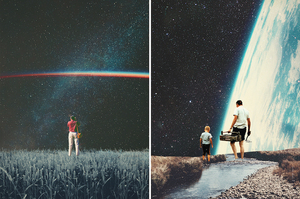
Digital collages merging vintage photographs, botanics, astronomy and all manner of scavenged copyright-free imagery by anonymous Greek art duo Frank Moth, who describe their work as “nostalgic postcards from the future.”
Available as prints here.

A pleasing five part combination cover of The Beach Boys ‘I Get Around’ and The Beastie Boys ‘Fight For Your Right (To Party)’ by Kevin Miller and his four friends.
Of course the second verse is omitted. It’s 1964, daddy-o.


Behold: the Mercedes Benz EQC 4×4² – a conceptual all-electric offroad version of the G-class EQC SUV with portal axles giving a 29cm ride height.
Proprietory software analyses driving parameters, giving audio feedback to the driver and piping sound to the outside world via speakers behind the headlights.
No word as yet on whether the concept will ever make it to full production.
Still.
Vroom.

Last night.
Colum Cronin tweets:
Giant, determined flower stretching towards the night sky on Vernon Street, Dublin 8
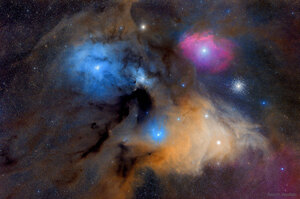
The many processes of the Rho Ophiuchi ‘dark nebula’ highlighted by the colour of its clouds. To wit:
The blue regions shine primarily by reflected light. Blue light from the Rho Ophiuchi star system and nearby stars reflects more efficiently off this portion of the nebula than red light. The Earth’s daytime sky appears blue for the same reason. The red and yellow regions shine primarily because of emission from the nebula’s atomic and molecular gas. Light from nearby blue stars – more energetic than the bright star Antares – knocks electrons away from the gas, which then shines when the electrons recombine with the gas. The dark brown regions are caused by dust grains – born in young stellar atmospheres – which effectively block light emitted behind them. The Rho Ophiuchi star clouds, well in front of the globular cluster M4 visible here on the upper right, are even more colorful than humans can see – the clouds emits light in every wavelength band from the radio to the gamma-ray.
(Image: Amir H. Abolfath)