

Author Archives: Chompsky


Another diverting animated video essay from The School of Life – well worth a watch if you have time on your hands, especially too much time. To wit:

We long to get all our work done in order to have free time. But we should be very careful with leisure. Having nothing left to do work-wise can be a very dangerous challenge for our psyches: it can  bring on despair and self-loathing. It may be that always having projects on the go can insulate us from mental unwellness.

Previously: Come Out Of The Cupboard You Boys And Girls

curiousbrain

Behold: the BMW Blechmann R18 – a redesigned long distance cruiser for BMW Motorrad  by bike builder Bernhard ‘Blechmann’ Naumann (whose claimed method is to ‘design as he works’, never planning in advance).

The bike has all manner of retro callbacks from classic pinstriping and sporty knee cutouts on the tank to a kidney shaped headlight reminiscent of the marque’s auto grille.

Can’t have. Only for looking at.

uncrate

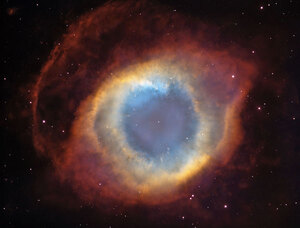
Behold: NGC 7293, aka the Helix nebula, ‘The Eye Of God’ or “The Eye Of Sauron’  – one of the closest to Earth of all the bright planetary nebulae. To wit:

How did a star create the Helix nebula? The shapes of planetary nebula like the Helix are important because they likely hold clues to how stars like the Sun end their lives. Observations by the orbiting Hubble Space Telescope and the 4-meter Blanco Telescope in Chile, however, have shown the Helix is not really a simple helix. Rather, it incorporates two nearly perpendicular disks as well as arcs, shocks, and even features not well understood. Even so, many strikingly geometric symmetries remain. How a single Sun-like star created such beautiful yet geometric complexity is a topic of research. The Helix Nebula is the nearest planetary nebula to Earth, lies only about 700 light years away toward the constellation of Aquarius, and spans about 3 light-years.

(Image: C. R. O’Dell, (Vanderbilt) et al. ESA, NOAO, NASA)

apod

This is what a crescent moon actually looks like. But we never see it this way because our eyes can’t simulataneously discern between such light and dark regions. To wit:

Called earthshine or the ‘da Vinci glow’, the unlit part of a crescent Moon is visible but usually hard to see because it is much dimmer than the sunlit arc. In our digital age, however, the differences in brightness can be artificially reduced. The featured image is actually a digital composite of 15 short exposures of the bright crescent, and 14 longer exposures of the dim remainder. The origin of the da Vinci glow, as explained by Leonardo da Vinci about 510 years ago, is sunlight reflected first by the Earth to the Moon, and then back from the Moon to the Earth.

Now for yeh.

(Image: Miguel Claro (TWAN, Dark Sky Alqueva))

apod