Author Archives: Chompsky
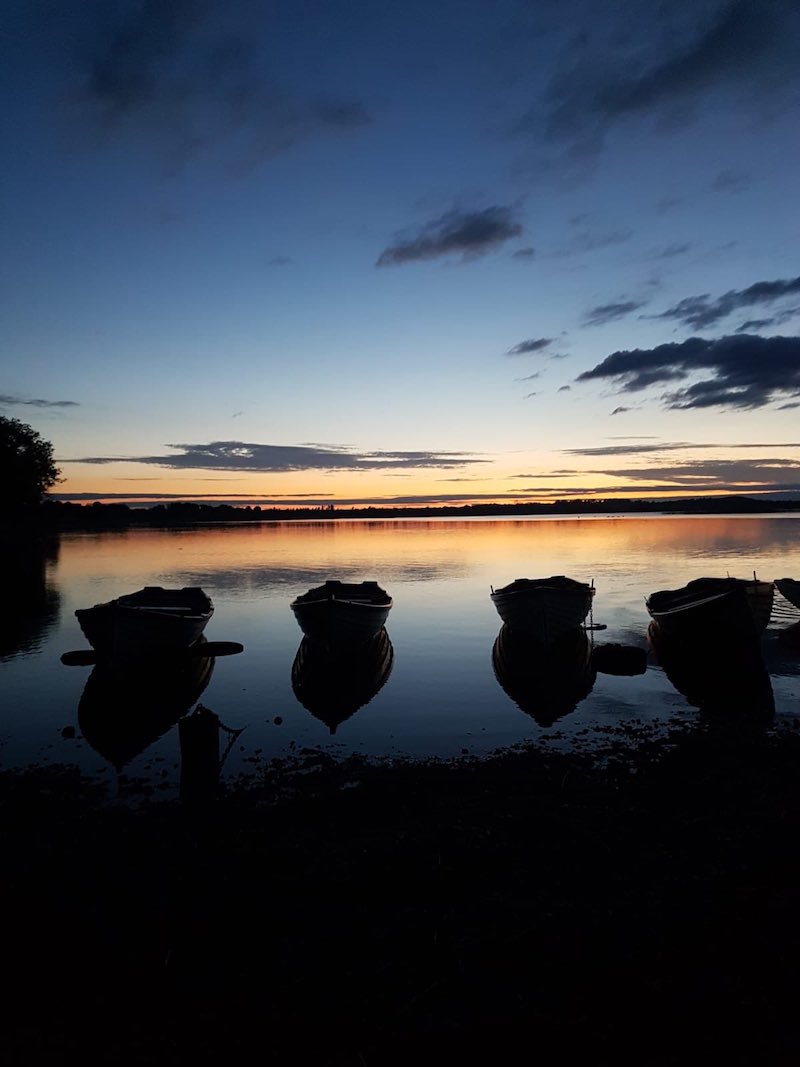
Lough Owel, Mullingar, last evening at 9pm.
(Thanks Aaron McAllorum’s old man)
Furthermore…
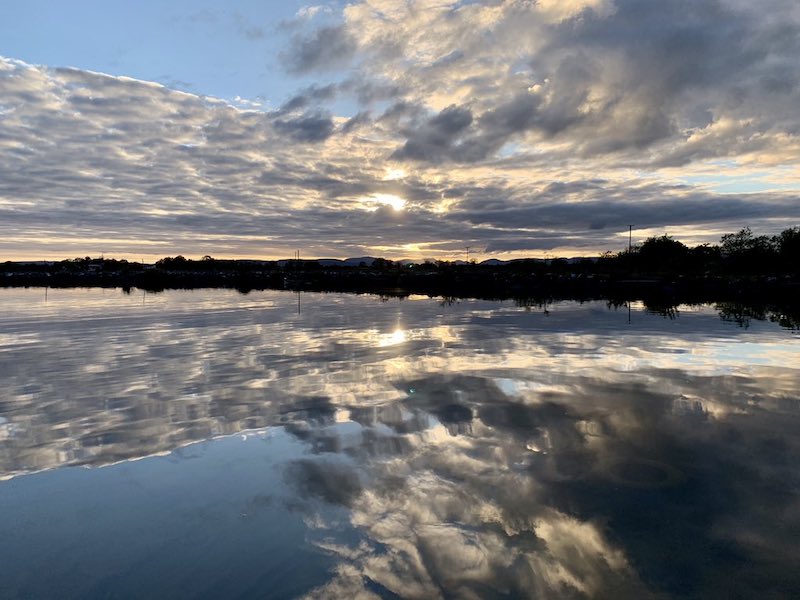
Lough Corrib, Galway last evening.
(Thanks NUIG Students’ Union)


A moodily impressive short by artist Yang Yongliang that combines the light of cities with the stars in the night sky.
The film was originally made for the 70 metre wraparound screen of the MGM Coral Theatre so it’s best viewed full screen in a darkened room.
Steel Life
at
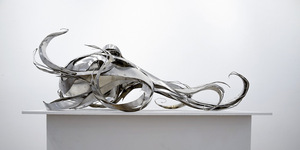


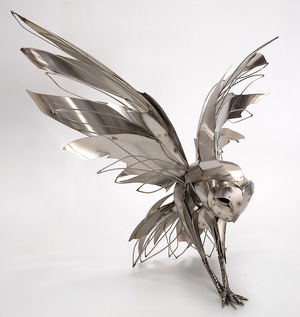


The stainless steel sculptures of Australian artist Georgie Seccull (bottom pic) who sez of her process:
We are born out of chaos in darkness and come into the light—my process is much the same: I begin with a thousand pieces scattered on the ground, then working almost like a jigsaw puzzle, I pick them up one by one and allow each piece to come together organically and dictate the outcome
More of her work here.
A Right Pair
at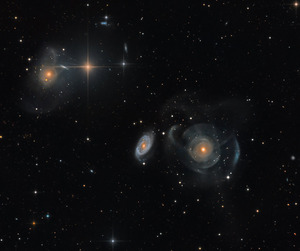
Behold : the twin galaxies of Arp 227 – a mere 100 million light years from here. To wit:
Swimming within the boundaries of the constellation Pisces, Arp 227 consists of the two galaxies prominent right of centre, the curious shell galaxy NGC 474 and its blue, spiral-armed neighbour NGC 470. The faint, wide arcs or shells of NGC 474 could have been formed by a gravitational encounter with neighbor NGC 470. Alternately the shells could be caused by a merger with a smaller galaxy producing an effect analogous to ripples across the surface of a pond. The large galaxy on the top lefthand side of the deep image, NGC 467, appears to be surrounded by faint shells too, evidence of another interacting galaxy system. Intriguing background galaxies are scattered around the field that also includes spiky foreground stars. Of course, those stars lie well within our own Milky Way Galaxy. The field of view spans 25 arc minutes or about 1/2 degree on the sky.
(Image: Martin Pugh)
Top Birds
at

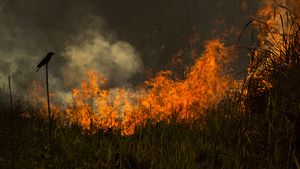


 The ten category winners of the 2020 Bird Photographer of the Year competition.
[From top: “Electric” by Carlos Cifuentes Torres, (White Stork Ciconia ciconia. Seville, Spain); “Fairy landing on Earth,” by Shu Qing, (Whooper Swan Cygnus cygnus. Sanmenxia, Henan, China); “A new beginning” by Swayamsiddha Mohapatra, (Indian Roller Coracias benghalensis. Kaziranga National Park, India); “Swifts over Iguazú Falls” by Francesco Filippo Pellegrini, (Great Dusky Swift Cypseloides senex. Iguazú Falls, Misiones, Argentina); “Hoopoe flight at low speed” by Gadi Shmila, (Common Hoopoe Upupa epops. Israel); “Perfect camouflage” by Moshe Cohen, (Eurasian Scops-owl Otus scops. Kibbutz Hatzor, Israel); “Ropewalker” by Nicolas Reusens, (Sword-billed Hummingbird Ensifera ensifera. Papallacta, Ecuador); “Feeding frenzy” by Greg Lecoeur, (Cape Gannet Morus capensis. Port St Johns, South Africa); “On the attack!” by Georgina Steytler, (Great Crested Grebe Podiceps cristatus. Perth, Western Australia). and “End of the day” by Majed AlZa’abi, (European Shag Gulosus aristotelis. Vardø, Norway).]
Explore the full collection here.


A 2017 short by UK based animator Prawta Annez in which a beachside battle for towel space becomes a cipher for global political tensions.
Unmaskable
at

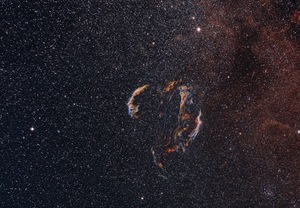
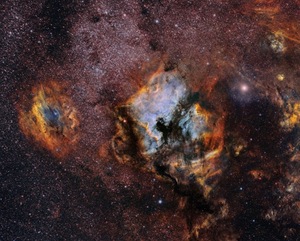
Behold: the spectacular skyscape of interstellar dust and glowing hydrogen gas near the northern end of the Great Rift and the constellation Cygnus the Swan. To wit:
Composed using 22 different images and over 180 hours of image data, the widefield mosaic spans an impressive 24 degrees across the sky. Alpha star of Cygnus, bright, hot, supergiant Deneb lies near top centre. Crowded with stars and luminous gas clouds Cygnus is also home to the dark, obscuring Northern Coal Sack Nebula, extending from Deneb toward the center of the view. The reddish glow of star forming regions NGC 7000 and IC 5070, the North America Nebula and Pelican Nebulas, are just left of Deneb. The Veil Nebula is a standout below and left of centre. A supernova remnant, the Veil is some 1,400 light years away, but many other nebulae and star clusters are identifiable throughout the cosmic scene. Of course, Deneb itself is also known to northern hemisphere skygazers for its place in two asterisms — marking the top of the Northern Cross and a vertex of the Summer Triangle.
View full size here.
(Image: Alistair Symon)