
Author Archives: Chompsky

Behold: a whirlwind of star formation at the centre of Messier 8 – the Lagoon Nebula. To wit:

Visible near the image center, at least two long funnel-shaped clouds, each roughly half a light-year long, have been formed by extreme stellar winds and intense energetic starlight. A tremendously bright nearby star, Herschel 36, lights the area. Vast walls of dust hide and redden other hot young stars. As energy from these stars pours into the cool dust and gas, large temperature differences in adjoining regions can be created generating shearing winds which may cause the funnels. This picture, spanning about 15 light years, features two colors detected by the orbiting Hubble Space Telescope. The Lagoon Nebula, also known as M8, lies about 5000 light years distant toward the constellation of the Archer Sagittarius.

(Image: NASA, ESA, Hubble; Processing & Copyright: Diego Gravinese)

apod


THESE are Northern Lights.

A spectacular aurora captured outside Östersund in Sweden in 2016. To wit:

Six photographic fields were merged to create the featured panorama spanning almost 180 degrees. Particularly striking aspects of this aurora include its sweeping arc-like shape and its stark definition. Lake Storsjön is seen in the foreground, while several familiar constellations and the star Polaris are visible through the aurora, far in the background. Coincidently, the aurora appears to avoid the Moon visible on the lower left. The aurora appeared a day after a large hole opened in the Sun’s corona allowing particularly energetic particles to flow out into the Solar System. The green colour of the aurora is caused by oxygen atoms recombining with ambient electrons high in the Earth’s atmosphere.

(Image: Göran Strand)

apod

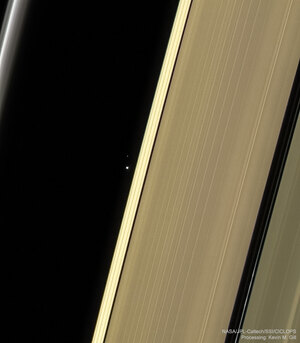
Those two dots visible between Saturn’s rings? That’s the Earth and the Moon. To wit:

Just over three years ago, because the Sun was temporarily blocked by the body of Saturn, the robotic Cassini spacecraft was able to look toward the inner Solar System. There, it spotted our Earth and Moon — just pin-pricks of light lying about 1.4 billion kilometers distant. Toward the right of the featured image is Saturn’s A ring, with the broad Encke Gap on the far right and the narrower Keeler Gap toward the center. On the far left is Saturn’s continually changing F Ring. From this perspective, the light seen from Saturn’s rings was scattered mostly forward , and so appeared backlit. After more than a decade of exploration and discovery, the Cassini spacecraft ran low on fuel in 2017 and was directed to enter Saturn’s atmosphere, where it surely melted.

(Image: NASA, ESA, JPL-Caltech, SSI, Cassini Imaging Team; Processing & License: Kevin M. Gill)

apod