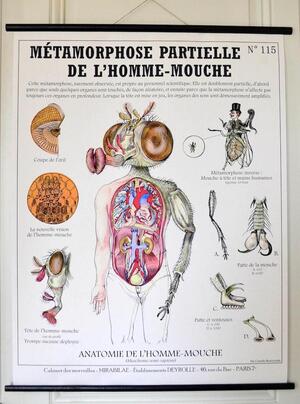


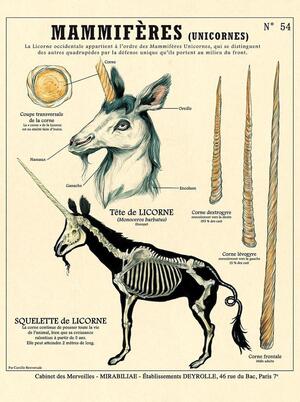
Artworks by French chimérologist Camille Renversade: mythical and fantastical creatures depicted and directed in the style of vintage Deyrolle illustrations.
Available as prints here.



Artworks by French chimérologist Camille Renversade: mythical and fantastical creatures depicted and directed in the style of vintage Deyrolle illustrations.
Available as prints here.


An animated short by Argentinian director Fernando Livschitz in which the Austrian capital becomes an absurd, floating, Slinkified carnival city.

Keep left.
New social distancing on Bray seafront last evening.
(Thanks Scoob)


An imaginative exploration of love and loss by London-based animator Lizzy Hobbs. To wit:
Following the end of a stormy love affair, Expressionist artist Oskar Kokoschka enlists in the First World War. After suffering serious injuries in battle, he experiences a series of memories and visions as medics transport him through the forests of the Russian front.


Top: Ballybunion Co. Kerry last Friday.
Pix 2/3: Valentia Island on the morning of Pieta’s Darkness Into Light sunrise Appeal on Saturday.
(Thanks Joanne)

Behold: the mighty gas giant Jupiter getting its Hallowe’en pumpkin on: captured in infrared by astronomers at the Gemini North Observatory in Hawaii. To wit:
Gemini was able to produce such a clear image using a technique called lucky imaging, by taking many images and combining only the clearest ones that, by chance, were taken when Earth’s atmosphere was the most calm. Jupiter’s jack-o’-lantern-like appearance is caused by the planet’s different layers of clouds. Infrared light can pass through clouds better than visible light, allowing us to see deeper, hotter layers of Jupiter’s atmosphere, while the thickest clouds appear dark. These pictures, together with ones from the Hubble Space Telescope and the Juno spacecraft, can tell us a lot about weather patterns on Jupiter, like where its massive, planet-sized storms form.
(Image: International Gemini Observatory, NOIRLab, NSF, AURA; M. H. Wong (UC Berkeley) & Team; Acknowledgment: Mahdi Zamani; Text: Alex R. Howe (NASA/USRA, Reader’s History of SciFi Podcast)



TLDR? Adenosine Triphosphate.
A sobering reflection on life, the Universe and everything from the always fascinating German education design studio, Kurzgesagt. To wit:
Picture yourself as a slinky falling down an escalator moving upwards – the falling part represents the self replicating processes of your cells, the escalator represents the laws of physics, driving you forwards. To be alive is to be in motion but never arriving anywhere. If you reach the top of the escalator there is no more falling possible and you are dead forever.
Previously: Coronavirus Explained


Behold: the 1964 Porsche 904 Carrera GTS – the company’s last true dual purpose road’race car, introduced the same year as the also legendary 911.
Combining a lightweight fibreglass shell with the ultimate iteration of the 180bhp four-cam, four-cylinder Type 587/3 engine, the 904 was quite the track monster in its day (and for several more days after that).
This car, originally silver when it was sold to Italian industrialist and driver Ernesto Prinoth, made its way to the US where it received a ‘California restoration’ (ie. a slightly more comfortable interior and a red paint job).
Currently accepting bids. NB: Robert Redford’s green 904 GTS was on the market for over €1.2 million in 2018.
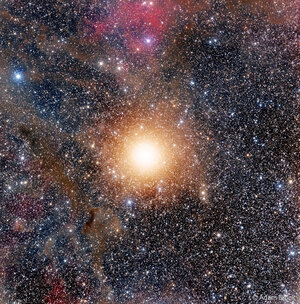
What’s behind Betelgeuse? Quite a few things as it happens. To wit:
One of the brighter and more unusual stars in the sky, the red supergiant star Betelgeuse can be found in the direction of famous constellation Orion. Betelgeuse, however, is actually well in front of many of the constellation’s other bright stars, and also in front of the greater Orion Molecular Cloud Complex. Numerically, light takes about 700 years to reach us from Betelgeuse, but about 1,300 years to reach us from the Orion Nebula and its surrounding dust and gas. All but the largest telescopes see Betelgeuse as only a point of light, but a point so bright that the inherent blurriness created by the telescope and Earth’s atmosphere make it seem extended. In the featured long-exposure image, thousands of stars in our Milky Way Galaxy can be seen in the background behind Betelgeuse, as well as dark dust from the Orion Molecular Cloud, and some red-glowing emission from hydrogen gas on the outskirts of the more distant Lambda Orionis Ring. Betelgeuse has recovered from appearing unusually dim over the past six months, but is still expected to explode in a spectacular supernova sometime in the next (about) 100,000 years.
*popcorn*
(Image: Adam Block, Steward Observatory, University of Arizona)