A short by Norwich-based animator and 3D illustrator A.J. Jeffries in which a pink horse struggles to exist.
That’s really all you need to know.



A short by Norwich-based animator and 3D illustrator A.J. Jeffries in which a pink horse struggles to exist.
That’s really all you need to know.
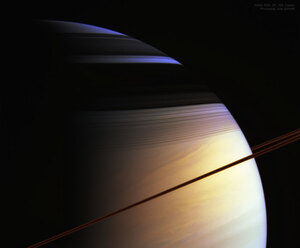 Behold: an only slightly exaggerated view of what one would see if hovering close to the ringed gas giant. To wit:
The image was taken in 2005 by the robot Cassini spacecraft that orbited Saturn from 2004 to 2017. Here Saturn’s majestic rings appear directly only as a curved line, appearing brown, in part, from its infrared glow. The rings best show their complex structure in the dark shadows they create across the upper part of the planet. The northern hemisphere of Saturn can appear partly blue for the same reason that Earth’s skies can appear blue — molecules in the cloudless portions of both planet’s atmospheres are better at scattering blue light than red. When looking deep into Saturn’s clouds, however, the natural gold hue of Saturn’s clouds becomes dominant. It is not known why southern Saturn does not show the same blue hue — one hypothesis holds that clouds are higher there. It is also not known why some of Saturn’s clouds are coloured gold.
(Image: NASA, ESA, JPL, ISS, Cassini Imaging Team; Processing & License: Judy Schmidt)
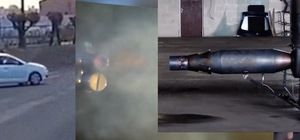

A very nifty edit of unrelated sequences by Donato Sansone linked to create a Rube Goldberg style sequence of apparently related events.


An experimental short by Turkish artist Muryat Sayginer using deepfake algorithms to present a scrolling gallery of famous faces.


Behold: the Krugger FD race car, created by Belgian motorcycle designer Fred Krugger – a one-off, snub-nosed, art deco masterpiece with an open cockpit and enclosed wheels inspired by vintage 1930s racing cars and powered by a 750bhp V12 from a Bentley Continental GT.
Can’t have one. Just for looking at.

A cartoon from Harper’s Magazine, published during the New York cholera epidemic of 1866.
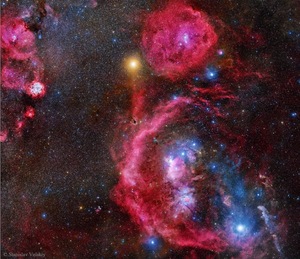

So much more than a belt of three stars, the constellation of Orion is rich in nebulae, as seen in this painstaking composite of extremely long exposures captured on clear nights in 2013 and 2014. To wit:
After 212 hours of camera time and an additional year of processing, the featured 1400-exposure collage spanning over 40 times the angular diameter of the Moon emerged. Of the many interesting details that have become visible, one that particularly draws the eye is Barnard’s Loop, the bright red circular filament arcing down from the middle. The Rosette Nebula is not the giant red nebula near the top of the image — that is a larger but lesser known nebula known as Lambda Orionis. The Rosette Nebula is visible, though: it is the red and white nebula on the upper left. The bright orange star just above the frame center is Betelgeuse, while the bright blue star on the lower right is Rigel. Other famous nebulas visible include the Witch Head Nebula, the Flame Nebula, the Fox Fur Nebula, and, if you know just where to look, the comparatively small Horsehead Nebula. About those famous three stars that cross the belt of Orion the Hunter — in this busy frame they can be hard to locate, but a discerning eye will find them just below and to the right of the image centre.
(Image: Stanislav Volskiy, Annotation: Judy Schmidt)


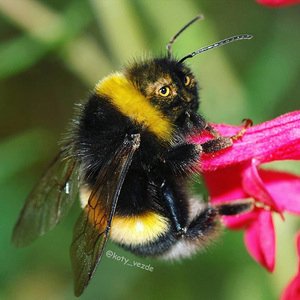
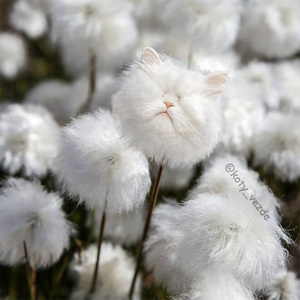




The vital ongoing work of Galina Bugaevskaya from Moscow’s Instagram account Koty Vezde (Cats Are Everywhere).


While the world waits for the next five episodes of series 4, here’s a gory subtitled Japanese version of Rick and Morty written and directed by Kaichi Sato for Studio DEEN in which a group of angry ninja Ricks set out to stop Rick WTM-72, who they think has captured Shogun Morty.