





Logos for the world we live in by Slovenian graphic designer Jure Tovrljan.







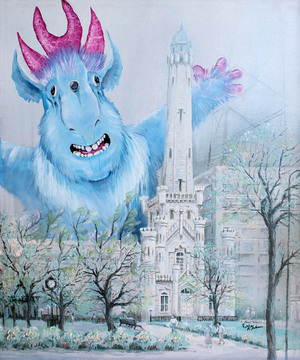

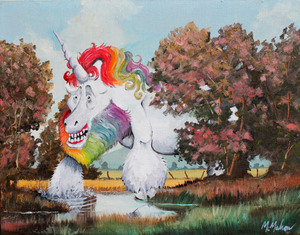

Artist Chris McMahon likes to buy twee, mass produced paintings and improve them, carefully matching the original style in acrylic and oil, adding monsters.
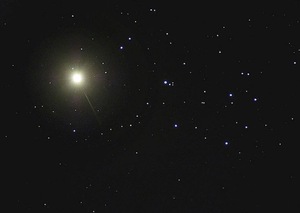


That especially bright star in the evening sky of late is actually the planet Venus. This evening, it will begin to cross the beautiful Pleiades or Seven Sisters star cluster. To wit:
This digital sky map illustrates the path of the inner planet as the beautiful conjunction evolves, showing its position on the sky over the next few days. The field of view shown is appropriate for binocular equipped skygazers but the star cluster and planet are easily seen with the naked-eye. As views from Earth (top pic, 2004), Venus again passed in front of the Seven Sisters (pic 2) 8 years ago, and will again 8 years hence. In fact, orbiting the Sun 13 Venus years are almost equal to 8 years on planet Earth. So we can expect our sister planet to visit nearly the same place in our sky every 8 years.
(Image: David Cortner, Digital image: Fred Espenak (Bifrost Astronomical Observatory)


Behold: the NMoto BMW R7 85th Anniversary Commemoration Limited Edition – a heavily customised BMW R nineT with around 150 custom fabricated body parts including platinum-plated panels with pink gold trim, a Louis Vuitton leather saddle and a Cartier clock set into the gas tank.
Each bike requires 4000 hours of construction. Only ten will be made and yours (because you’re a true American patriot who likes German motorcycles with French saddles and clocks) will cost around €227,000 (plus shipping).

Behold: the centre of the Milky Way galaxy – 26,000 light years from us toward the constellation of Sagittarius, glowing with every type of light we can see, and a few we can’t. To wit:
In the featured image, high-energy X-ray emission captured by NASA’s orbiting Chandra X-Ray Observatory appears in green and blue, while low-energy radio emission captured by SARAO‘s ground-based MeerKAT telescope array is coloured red. Just on the right of the colourful central region lies Sagittarius A (Sag A), a strong radio source that coincides with Sag A*, our Galaxy’s central supermassive black hole. Hot gas surrounds Sag A, as well as a series of parallel radio filaments known as the Arc, seen just left of the image center. Numerous unusual single radio filaments are visible around the image. Many stars orbit in and around Sag A, as well as numerous small black holes and dense stellar cores known as neutron stars and white dwarfs. The Milky Way’s central supermassive black hole is currently being imaged by the Event Horizon Telescope.
(Image: X-Ray: NASA, CXC, UMass, D. Wang et al.; Radio: NRF, SARAO, MeerKAT)









Twitter responds (with scant adherence to the stated rules) to a recent challenge by the J. Paul Getty Museum in Los Angeles.


Harry Byrne’s pub, Clontarf.
Maker unspecified.
Other LEGO pubs are available.
(Thanks Harry Byrne’s)



The Royal Ocean Film Society traces the popularity, resurgence and ultimate demise of 3D film from the late 20s to its first peak in the 1950s and equally short lived revival in the first decades of the 21st century.
Previously: The Tao Of Saul Bass


