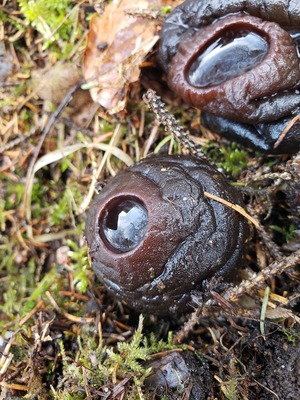

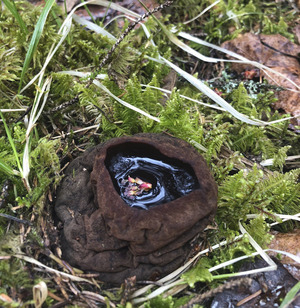
Behold: the rare and disturbing Witches’ Cauldron fungus (Sarcosoma globosum).
Pray you never fall in one.
(Pix: Nick Rajtar)



Behold: the rare and disturbing Witches’ Cauldron fungus (Sarcosoma globosum).
Pray you never fall in one.
(Pix: Nick Rajtar)
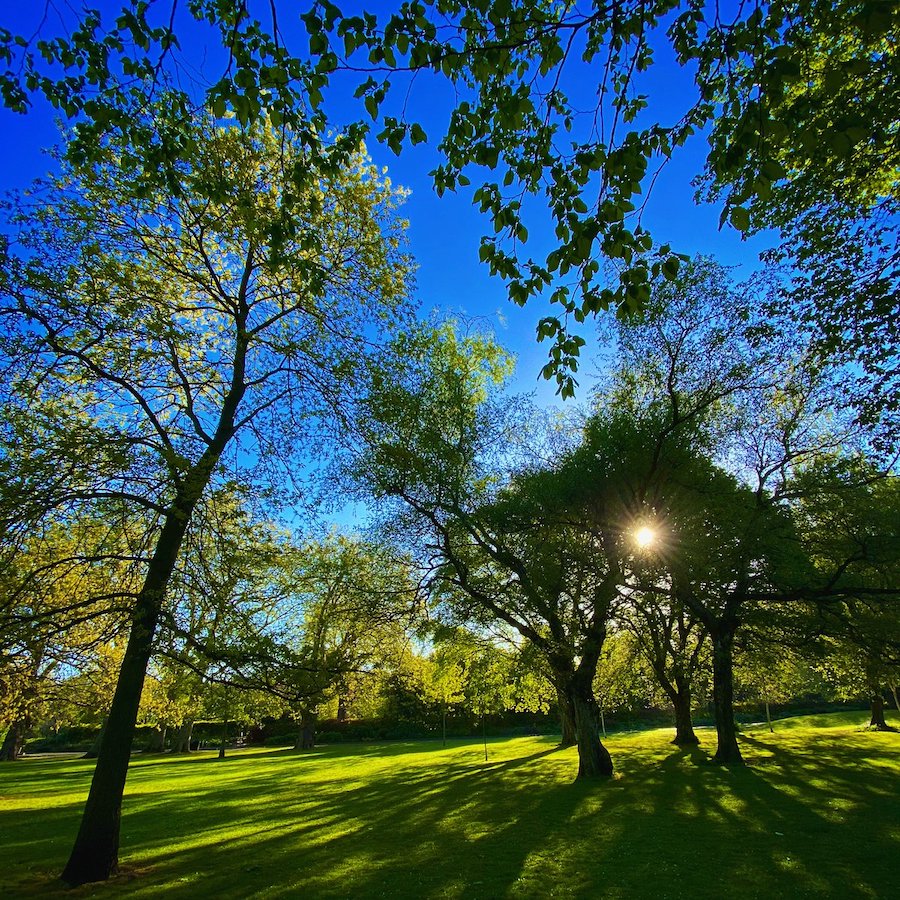
St Stephen’s Green, Dublin, yesterday morning.
Colum Cronin tweetz:
Komorebi, the Japanese expression for the sunlight as it filters through the trees, is made up of the kanji characters for tree (木), shine through (漏れ), and sun (日).

It’s all relative.
Behold: two very contrasting star clusters in a single field of view. To wit:
M35, on the lower left, is relatively nearby at 2800 light years distant, relatively young at 150 million years old, and relatively diffuse, with about 2500 stars spread out over a volume 30 light years across. Bright blue stars frequently distinguish younger open clusters like M35. Contrastingly, NGC 2158, on the upper right, is four times more distant than M35, over 10 times older, and much more compact. NGC 2158’s bright blue stars have self-destructed, leaving cluster light to be dominated by older and yellower stars. In general, open star clusters are found in the plane of our Milky Way Galaxy, and contain anywhere from 100 to 10,000 stars — all of which formed at nearly the same time. Both open clusters M35 and NGC 2158 can be found together with a small telescope toward the constellation of the Twins (Gemini).
(Image: CFHT, Coelum, MegaCam, J.-C. Cuillandre (CFHT) & G. A. Anselmi (Coelum)


An intriguing, unnerving short produced by Jacob Jonas (one of 15 pieces for the pandemic choreography project Films Dance) featuring a glitching, freezing, cloned performance by dancer Emma Rosenzweig-Bock.
Watch the other shorts here.



A 2018 graduation film by Nicolas Roth, Pirmin Bieri, Luca Struchen and Aira Joana of Lucerne School of Art and Design, Switzerland. To wit:
Troubled by the changes he’s going through, a restless backpacker seeks his place in the world. As he experiences a mysterious encounter in a concrete building, he hopes to have finally found such a place.










Because there are very few things in this world that can’t be improved with the addition of googly eyes.

Behold (in opposite corners of the stunning mosaic): the Horsehead nebula and the Orion nebula, 1500 light years away. To wit:
The familiar Horsehead nebula appears as a dark cloud, a small silhouette notched against the long red glow at the lower left. Alnitak is the easternmost star in Orion’s belt and is seen as the brightest star to the left of the Horsehead. Below Alnitak is the Flame Nebula, with clouds of bright emission and dramatic dark dust lanes. The magnificent emission region, the Orion Nebula (aka M42), lies at the upper right. Immediately to its left is a prominent reflection nebula sometimes called the Running Man. Pervasive tendrils of glowing hydrogen gas are easily traced throughout the region.
(Image: Roberto Colombari & Federico Pelliccia)


Behold: the 1956 Porsche 365 Speedster – an open-topped variant of the company’s first consumer car.
This vehicle – thoroughly restored to Concours d’Elegance condition in bright red over tan leather with a matching tan soft top – has a rebuilt 616/1 1955 flat-four engine bored out to 1,720cc.
With an impressive 25,750km on the clock, it’s yours from $176,000 (about €144,000) if you’re near Portland, Oregon any time today.