Storm light at Portmarnock, county Dublin, Sunday morning.
(Thanks Fran Cassidy)








Behold: the Harley Davidson ‘Electra Glide Revival’ – a modern homage to the iconic 1965 Panhead Electra Glide, complete with ‘Birch White’ fairing and saddlebags, two-tone stitched single-seat, old-school tank badge, and whitewall tyres.
Beneath the retro styling lurks all-new ride technology including a massive 1,868cc Milwaukee-Eight engine, an RDRS safety system and a GTS infotainment unit.
Only 1,500 bikes will be made and – if you happen to live in the states – yours is available now from $29,199 (around €24,000).

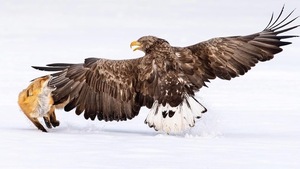


Snapshots of avian life from the cute to the Cretaceous by finalists of the 2021 Bird Photographer of the Year competition.

Behold: a stunning image of our own shaded planet taken 49 years ago. To wit:
From the unfamiliar perspective, the Earth is small and, like a telescopic image of a distant planet, the entire horizon is completely within the field of view. Enjoyed by crews on board the International Space Station, only much closer views of the planet are possible from low Earth orbit. Orbiting the planet once every 90 minutes, a spectacle of clouds, oceans, and continents scrolls beneath them with the partial arc of the planet’s edge in the distance. But this digitally restored image presents a view so far only achieved by 24 humans, Apollo astronauts who traveled to the Moon and back again between 1968 and 1972. The original photograph, AS17-152-23420, was taken by the homeward bound crew of Apollo 17, on December 17, 1972. For now it’s the last picture of Earth from this planetary perspective taken by human hands.
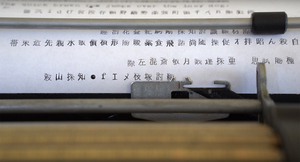


Behold: a rare 1940 index typewriter, the Toshiba BW-2112 – demonstrated here by New Orleans based Typewriter Collector – which uses horizontal cylinders with thousands of symbols to type in Japanese, Chinese and English.
In the mid 50s, when Toshiba switched to a Western style keyboard with Kana characters, the cylinder models were discontinued, making this a rare machine indeed. Of the device, which ordered characters in a manner similar to that found in a Japanese dictionary, Typewriter Collector sez:
They’re arranged phonetically by most common “on-yomi” (or kun-yomi in some cases) according to the kana syllabary (many homophones, of course)… Red characters help parse the readings. Last character to left of equal sign can be pronounced “kin” (exert) and the first character in next row “gin” (silver), then “ku” (suffer) in red followed by “kuu” (sky, empty), “kuma” (bear), “kun” (teachings, meaning [also the kun in kun-yomi]), “gun” (group), then “kei” (system) in red followed many, homophones of “kei”
Now for yiz.


A mere taste of the vast range of food-inspired hand candy from Dutch handbag designer Rommy De Bommy.





 Behold: the Rolls-Royce x Hermès Phantom Oribe – commissioned by Japanese billionaire Yusaku Maezawa, handcrafted by Rolls-Royce and Hermès specialists at the brands’ West Sussex and Paris workshops and envisioned as a “land jet” to complement the entrepreneur’s private aircraft.
The two-tone MZ Oribe Green and cream exterior references Maezawa’s collection of ancient Japanese ceramics (and the colour scheme of his private jet).
The interior features hand-stitched Enea Green leather upholstery and ‘Toile H’ canvas by Hermès and a ‘gallery installation’ echoing the brand’s Pierre Péron horse motif hand-painted on the open pore royal walnut dash.
The top end Phantom costs £446,000 (€513,720). This one probably cost a bit more.

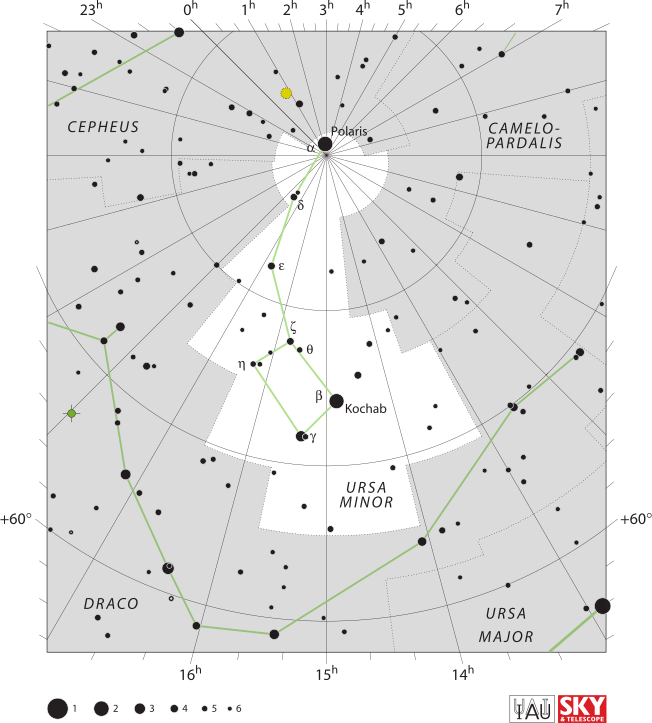
Behold: an image of Polaris – the North Star – digitally manipulated to suppress surrounding dim stars but accentuate the faint gas and dust of the Integrated Flux Nebula (IFN). Fair enough. But why is it called the North Star? To wit:
First, Polaris is the nearest bright star toward the north spin axis of the Earth. Therefore, as the Earth turns, stars appear to revolve around Polaris, but Polaris itself always stays in the same northerly direction — making it the North Star. Since no bright star is near the south spin axis of the Earth, there is currently no South Star. Thousands of years ago, Earth’s spin axis pointed in a slightly different direction so that Vega was the North Star. Although Polaris is not the brightest star on the sky, it is easily located because it is nearly aligned with two stars in the cup of the Big Dipper. Polaris is near the center of the eight-degree wide featured image (…/) The surface of Cepheid Polaris slowly pulsates, causing the star to change its brightness by a few percent over the course of a few days.
(Image: Bray Falls)

The ‘Healing Grid’ by Ryota Kanai was a finalist in the 2005 Best Illusion of the Year Contest. stare at the centre for about 20 seconds and the broken edges appear to repair themselves in your peripheral vision. Kanai sez of it:
This illusion seems to indicate the preference of the visual brain to see regular patterns.
Make of that what you will.