


Yeti Dynamics asks:
What if a giant banana was orbiting the Earth at the same distance as the International Space Station?
And now you are in possession of that knowledge.



Yeti Dynamics asks:
What if a giant banana was orbiting the Earth at the same distance as the International Space Station?
And now you are in possession of that knowledge.


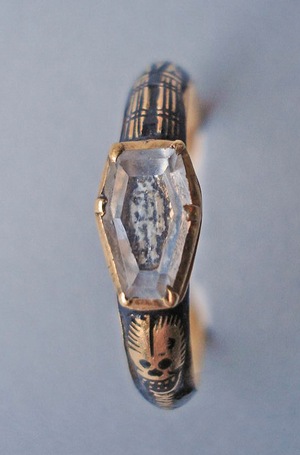


Or, as the Latin inscription in the top picture has it: ‘Hodie mihi cras tibi’.
17th century mourning rings from a collection at the British Museum via Kirsty Rolfe.

Behold: the ‘Leo Trio’. To wit:
This popular group leaps into the early evening sky around the March equinox and the northern hemisphere spring. Famous as the Leo Triplet, the three magnificent galaxies found in the prominent constellation Leo gather here in one astronomical field of view. Crowd pleasers when imaged with even modest telescopes, they can be introduced individually as NGC 3628 (right), M66 (upper left), and M65 (bottom). All three are large spiral galaxies but tend to look dissimilar, because their galactic disks are tilted at different angles to our line of sight. NGC 3628, also known as the Hamburger Galaxy, is temptingly seen edge-on, with obscuring dust lanes cutting across its puffy galactic plane. The disks of M66 and M65 are both inclined enough to show off their spiral structure. Gravitational interactions between galaxies in the group have left telltale signs, including the tidal tails and warped, inflated disk of NGC 3628 and the drawn out spiral arms of M66. This gorgeous view of the region spans over 1 degree (two full moons) on the sky in a frame that covers over half a million light-years at the trio’s estimated distance of 30 million light-years. Of course the spiky foreground stars lie well within our own Milky Way.
(Image: Francis Bozon)
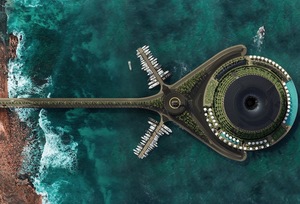


Behold: the Eco-Floating Hotel, designed by Turkish design studio Hayri Atak Architectural, soon to be located in the Persian Gulf off Qatar.
Powered by solar panels and wind turbines, desalinating and purifying seawater for use onsite, the hotel’s circular volume rotates once every 24 hours – generating power via tidal energy. The glass vortex-shaped roof of the 35,000m² structure doubles as a ‘rainwater collection’ system for greenery.
The project is due for completion in 2025.


A short story by Ala Nunu about living with – and as – a headless person. The question, posed in the context of a supportive relationship between a headless/non-headless couple is this:
Can you fix something that doesn’t want to be fixed?






Inspirobot – generating dubious but frequently superb motivational posters by algorithm.
Be inspired here.
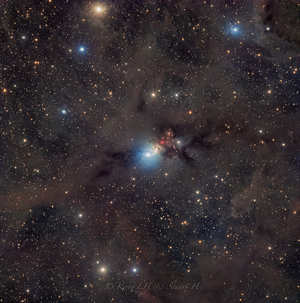
Stardust. That’s right, Joni Mitchell.
Behold: plumes of the stuff drifting across the Perseus molecular cloud 850 light years away. To wit:
Dusty nebulae reflecting light from embedded young stars stand out in the nearly 2 degree wide telescopic field of view. With a characteristic bluish colour reflection nebula NGC 1333 is at centre, vdB 13 at top right, with rare yellowish reflection nebula vdB 12 near the top of the frame. Stars are forming in the molecular cloud, though most are obscured at visible wavelengths by the pervasive dust. Still, hints of contrasting red emission from Herbig-Haro objects, the jets and shocked glowing gas emanating from recently formed stars, are evident in NGC 1333. The chaotic environment may be similar to one in which our own Sun formed over 4.5 billion years ago. At the estimated distance of the Perseus molecular cloud, this cosmic scene would span about 40 light-years.
(Image: Kerry-Ann Lecky Hepburn (TWAN), Stuart Heggie)



Ah here.
About an hour ago.
The Department Of Foreign Affairs, St Stephen’s Green, Dublin 2.
UPDATE: Two held after graffiti painted on Dept of Foreign Affairs (RTE News)
(Pix: Oisín Kane)


A fascinating Lament Configuration-looking device built by Rem-RC that can balance itself up on one edge or one corner using a controller, a gyroscope-accelerometer chip and three servo motors that spin wheels to maintain alignment.
That, or witchcraft.
