

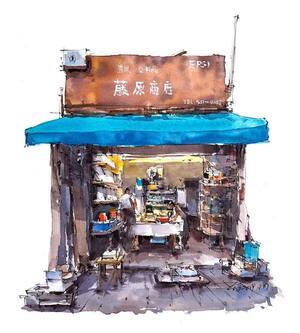

The evocative watercolours of Chinese painter Zhifang Shi who travels the world painting each of his subjects en plein air, focussing on architectural points of entry and, elsewhere, modes of transport.
His instagram is well worth a browse.


The evocative watercolours of Chinese painter Zhifang Shi who travels the world painting each of his subjects en plein air, focussing on architectural points of entry and, elsewhere, modes of transport.
His instagram is well worth a browse.
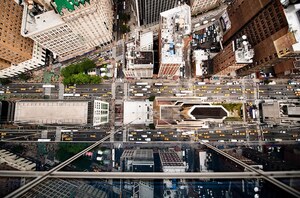


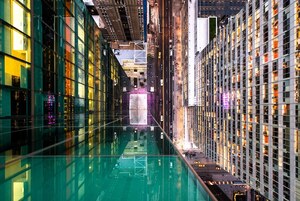
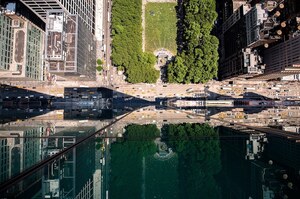


The Hidden City series of photographer Navid Baraty – vertiginous views of New York streets mirrored in the walls of glass buildings to give the impression of ‘a sort of hidden dimension or parallel universe’.


A sample of some of the monstrous edifices documented on the Ugly Belgian Houses Instagram account of Belgian blogger Hannes Coudenys.
More here, if you’ve the stomach for it.


1980s ‘woonball’ housing in the Dutch municipality of Hertogenbosch, north-west of Eindhoven.
Designed by the late Dutch artist and architect Dries Kreijkamp and still fully occupied 35 years on, the 5.5m diameter PVC bubbles of the ‘Bolwoningen’ sit on cast concrete plinths with an internal staircases connecting two bedrooms on the bottom floor, a kitchen and bathroom on the first and living space with a panoramic view up top.
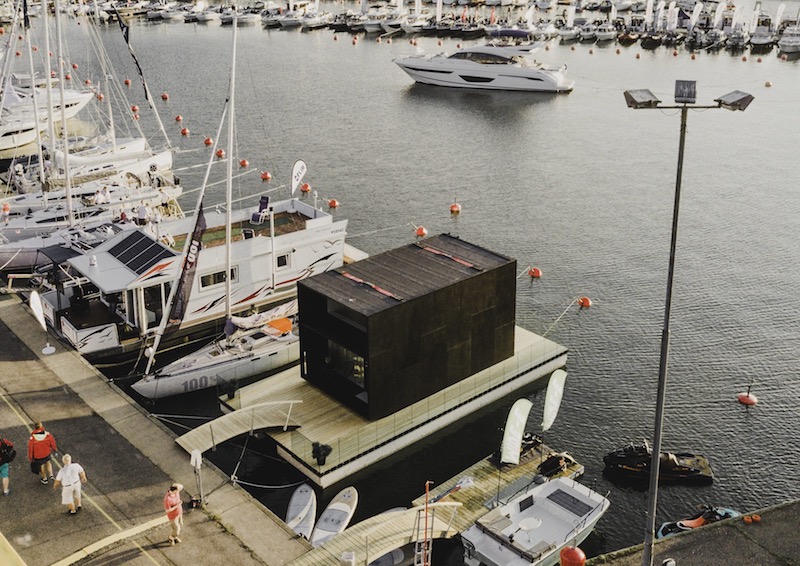


Behold: the Koda Light Float House – a zinc-clad dwelling surrounded by a generous deck on a pontoon raft connected to shore by a wooden bridge.
More house than boat (designed to be towed between locations), the minimal interior features double-height ceilings, an open living space, kitchen, and a lofted sleeping area from where to view the locale where you’ve chosen to dock.


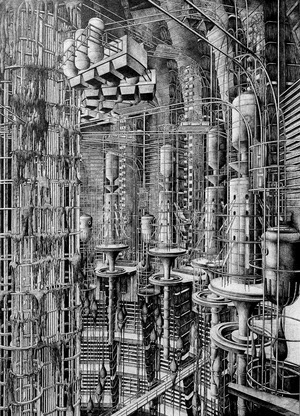

An illustrated project by architect and artist Yunil Nam in pencil, collage and photomontage – a combined ‘funerary venue’ and coral cultivation facility in the Indian ocean inspired by (a) a tradition of Indian Zoroastrianism and (b) Jules Verne’s ‘Twenty Thousand Leagues Under The Sea’. To wit:
Indian zoroastrianism… involves the depiction of an historical and religious funerary place called ‘tower of silence.’ this tower is told to have the purpose of revitalizing endangered vultures which prey upon the dead bodies of humans….the architect proposes a process of decay and regeneration in the form of visionary burials called ‘tectonic vultures.’ this system consists of such new techniques in body decomposition as freeze-drying and liquefaction, transforming the human body into nutrients in the forms of powder and liquid. coral, the urban infrastructure of marine life, is then fed by those processes and subsequently reverted back into its natural condition.
Take from that what you will.


The pleasing geometric patterns of coastal Barcelona, droned by Hungarian photographer Márton Mogyorósy.


The city of El Alto, 4,150m above sea level in the Bolivian Andes, is the world’s highest municipality and home to the distinctive buildings of architect and former bricklayer Freddy Mamani Silvestre.
Dozens of Silvestre’s multi-use structures tower above their more conventional neighbours, inspired not by Las Vegas (as many visiting North Americans suppose) but by the vibrant Incan art of Bolivia’s pre-Columbian history.


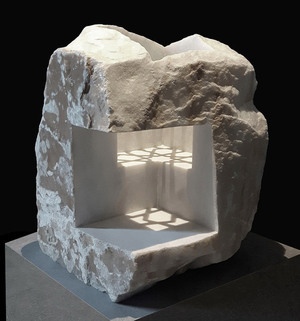


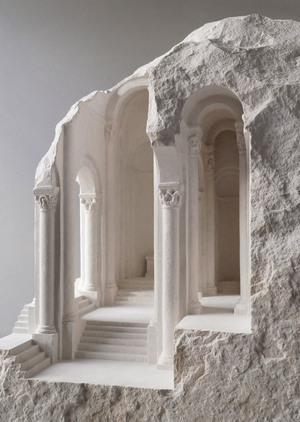

Medieval and ancient Eastern and Western architectural forms (some based on real buildings, others imagined) – all hand-carved into chunks of rock by British artist and stonemason Matt Simmonds.
The most complex piece, an incredibly detailed compartmental array entitled ‘Windows’ (top) took eight months to create.


With relaxation space on the lower level and sleeping quarters above, the Dolomite Treehouses, designed by architect Peter Pichler, are a series of (conceptual for now) triangular cabins envisioned as satellite suites for an existing hotel.
Sustainably clad in local fir and larch, they’re perched in a forest in North east Italy with spectacular views of the surrounding mountain range.