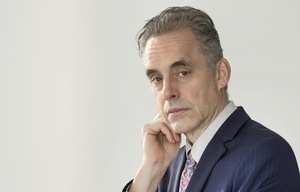
From top Jordan Peterson: Anthony Sheridan
The clinical psychologist Jordan Peterson is a brilliant wordsmith. Not only can he talk non-stop about issues close to his heart but he also possesses a powerful array of academic ideas and concepts which he employs to great effect during debates.
Unfortunately, Peterson does not use his extraordinary talents in a positive manner. Instead, he combines his academic abilities with his word power to create a storm of mostly incoherent but impressively sounding arguments that are primarily focused on deflecting challenges to his often bizarre opinions.
Many of his answers begin with the common cop-out strategy of: Well, it all depends on what you mean by…???…followed by a long bout of academic rambling invariably laced with the names of his favourite writers and philosophers such as Nietzsche, Jung or Dostoevsky.
We witnessed a good example of his modus operandi during a debate with British writer, lecturer and atheist, Susan Blackmore in 2018. The title of the debate was – Do we need God to make sense of life?
Accepting that he lived his life as though god exists Peterson said:
“It’s how you act, not what you say about what you think you think. What do you know about what you think? Seriously, I mean we wouldn’t need psychology, anthropology, sociology, the humanities if our thoughts were transparent to us [3:36].”
This may be true of many people but Peterson is a clinical psychologist, his job is primarily about thinking, coming to conclusion on information gathered and advising patients. Since becoming a global phenomenon he has done little else but tell the world about what he thinks in his books and lectures.
So, clearly, he knows very well what he thinks, about a whole range of topics, and is not in the least bit shy about expressing those views. It is therefore reasonable to assume that the bizarre opinion expressed above is nothing more than puerile bluster – In a word, Peterson is a bluffer.
This is particularly so when it comes to religion. It is clear that he believes in Christianity but is, for some reason, unwilling to openly declare that fact. It could be that he doesn’t want to attract ridicule from his academic peers or perhaps he fears he might be asked to prove the existence of a supernatural entity for which no evidence has ever been produced.
When asked did he believe in God, instead of speaking plain English, he reverted to type:
“Well, I don’t know what people mean when they say ‘believe’. What do they mean by ‘belief’ and what do they mean by ‘god’ and what makes you think that the question I’m answering is the same question you’re asking? This is not something you can say yes or no to in a straight forward manner. To answer the question requires books and lectures [2:20].”
The presenter, to his credit, managed to keep a straight face – I laughed out loud.
But, while entertaining, Peterson can also be a bit of a bully in debate. For example, in the same programme, Blackmore made the mistake of choosing the wrong word when making a point. She was explaining that the gratitude she felt for the wonders of nature did not come from religion [30:50]
Peterson, immediately realised that her choice of the word ‘gratitude’ gave him a lever with which to put her down. asking:
“Where do you think it [gratitude] comes from?”
Blackmore:
“I think it comes from a recognition from observing the inner consequences of different ways of confronting the world.”
At this point Blackmore should have realised she was using the wrong word, that she was entrapping herself. She could, for example, have substituted ‘gratitude’ with a more suitable word such as ‘appreciate’.
She continued:
“When I woke this morning I felt a gratitude for the universe. It’s not really god, it’s not the creator.”
Peterson sprung the trap:
“Why feel gratitude towards it?”
Blackmore:
“I don’t know but I…”
BOOM…when someone debating with a person like Peterson uses the fatal words…I don’t know…they’re finished – game over.
With a smirk of victory, he cut her off, patronisingly intoning – ‘That’s fine’, sounding like a tolerant mother forgiving a child for making a silly mistake [32:51].
During the debate Peterson accused the atheist Richard Dawkins of operating behind several walls [of denial] protecting him from having to deal with the [so called] truths of Christianity.
“You can’t do that, he thundered. You don’t understand what you’re talking about.”
Probably the best example in history of the pot calling the kettle black.
Anthony Sheridan is a freelance journalist and blogs at Back Garden Philosophy
Getty