
Oh.
Pete writes:
Complimentary tea/coffee machine at McCabe’s Pharmacy in Swords Pavillion… not being very complimentary.



Oh.
Pete writes:
Complimentary tea/coffee machine at McCabe’s Pharmacy in Swords Pavillion… not being very complimentary.

Noel Finn writes:
We’re kicking off a new weekly Genealogy and Family Tree night at the Franciscan Well Brewpub in Cork. Hosted by one of Cork’s most prominent historians and genealogists Dr. Paul MacCotter, the free event is a light, fun and enjoyable introduction to exploring your Family Tree.
The idea is to provide a basis for locals and tourists to kick off research into their family history and have a tasty beer or two while they do.

Education Minister Richard Bruton speaking on RTÉ Radio One at lunchtime
Audrey Carville, on RTÉ’s News At One, interviewed Minister for Education Richard Bruton earlier today.
The interview followed an earlier report by Conor McMorrow which included exchanges between Independents 4 Change TD Clare Daly and Taoiseach Enda Kenny in the Dáil this morning, ahead of tomorrow’s vote on Independents 4 Change TD Mick Wallace’s bill on fatal foetal abnormalities.
During her speech, Ms Daly said:
“You hide behind the advice of the Attorney General, advice we haven’t seen, advice which is substantially at variance with the advice of other Attorney Generals and disputed by a whole array of legal experts. Taoiseach, my question to you is: who do you think you are? That you believe that you can allow the continued violation of human rights. The constitution can never be used to deal with this. If you haven’t go the leadership or the guts to do it yourself, will you stop using your position to block the courts or the people from dealing with this.”
During the interview…
Audrey Carville: “Just, following on there from those exchanges [between Ms Daly and Mr Kenny], Clare Daly says your government, and others, have been repeatedly told by the UN and others that you’re violating women’s human rights. Is that acceptable to you?”
Richard Bruton: “No, it’s certainly not. I think the situation though is three times attempts have been made to change the Constitution in this area and three times they failed. Now they’re on different issues but it clearly shows that constitutional change needs careful preparation and that’s what the Citizens’ Assembly is designed to do. Now in the context of Deputy Wallace’s bill, the medical advise has been absolutely stark, that this bill would be of no value to mothers or to doctors who would be faced with the sort of difficult situation that Clare Daly described. The Attorney General’s view is also clear, that this bill conflicts with the constitution. So we are driven back to the situation that if we want change, we have to create an environment where the people can reflect on the change that’s needed and make a decision in due course in a referendum, that’s the only way which you can change a constitution which provides a protection, at present, for the unborn with due regard to the life of the mother.”
Carville: “Indeed, so why not just call the referendum? Everything else is a delaying tactic.”
Bruton: “That’s not the case. I mean, as I say, efforts have been made in the past to change the constitution and have failed and I think that experience that we have seen for example, in dealing with this issue when we were simply trying to legislate, as you know, for the Life in Pregnancy Bill in the last session, that the work of having a Citizens’ Assembly reflect or hearings, to reflect on the content and what changes were about was really important to getting the degree of support that was possible. This is really complicated when you go to the people. And people will have to be able to see when they are faced with a vote, what it is they’re voting on, what are the implications of the changes that are being proposed to them. And that will take careful teasing out. There are many cases that will have to be teased out. Fatal foetal abnormality and other situations like rape and incest where very difficult circumstances are consulted…”
Listen back in full here
Meanwhile…
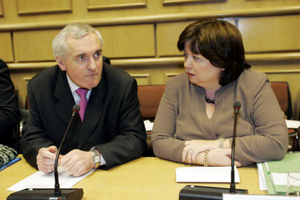
Former Taoiseach Bertie Ahern and former Tanaiste Mary Harney
In the Irish Times on September 11, 1999…
The newspaper’s then chief political correspondent Denis Coghlan wrote:
Publication of a Government Green Paper on abortion has reopened divisive debate and raised the prospect of serious friction between Fianna Fáil and the Progressive Democrats. In 1992 Albert Reynolds sought to roll back the Supreme Court judgment in the X case and dared Dessie O’Malley to risk a general election on the issue. This time, Bertie Ahern seems willing to face down Mary Harney.
Of course, we don’t know precisely what the Taoiseach has in mind. And he is unlikely to tell us in the short term. But the pre-election commitment he gave to the Irish Catholic in 1997 appears to lean towards a restriction of the X case judgment or a legislative restatement of the prohibition on abortion.
But nothing is static in politics, and the commitment given by the Fianna Fail leader in opposition could crumble in the face of internal and external pressures. The only certainty at this stage is that Mr Ahern and his backbenchers are the main comfort-providers to the anti-abortion lobby and are anxious to retain its support.
The Progressive Democrats are doing what they did in 1992: reluctantly going along with a process they do not relish.
On the first occasion, the collapse of the coalition government allowed Mr O’Malley to advocate legislation to deal with the implications of the X case, rather than the constitutional referendum put forward by Mr Reynolds. And there is no indication that party policy has changed under the Tanaiste.
Reaching a consensus on this issue within Cabinet appears as remote as the possibility of Brian Lenihan and his all-party Committee of the Constitution producing an agreed set of recommendations.
For the main Opposition parties are still firmly entrenched in the positions they took up in 1997, when Mr Ahern resurrected abortion as an election issue.
Yesterday Alan Shatter of Fine Gael dutifully reiterated the position adopted by John Bruton when he was Taoiseach. The party was opposed to a referendum, he said, because no constitutional wording could fully and properly address this difficult area.
And they were concerned that any legislation would have the opposite effect to that intended, when applied in practice or interpreted by the courts.
Rather than embark on another referendum, Mr Shatter said, the Government should expand counselling services for women in crisis pregnancies and reform the adoption laws and services so that adoption would be seen as a preferred alternative to abortion.
Ruairi Quinn took a similar line. The way to reduce the number ofabortions among Irish women was to reduce the number of crisis pregnancies through education on sexuality, personal responsibility and access to contraception.
As for the deliberations of the all-party Committee on the Constitution, Mr Quinn felt it was unlikely to come to a different conclusion from that reached by the Expert Committee on the Constitution in 1995.
That approach would require giving legislative effect to the Supreme Court judgment in the X case, and was the position favoured by the Labour Party.
The Government sub-committee that produced the Green Paper – Brian Cowen, Mary O’Rourke, John O’Donoghue, Michael McDowell and Liz O’Donnell – took the five recommendations of the expert committee and expanded them to seven.
Four of the recommendations were common: the insertion of an absolute ban on abortion in the Constitution; to legislate for the X case; to restrict the terms of the X case’ and to return to the pre-1983 position.
The fifth recommendation from the expert committee suggested amending Article 40.3.3 so as to legalise abortion in constitutionally defined circumstances.
This was reworked into two options by the Government sub-committee: amend the Constitution so as to restrict application of the X case, and retain the “status quo” with a legislative restatement of the prohibition on abortion.
Finally, the sub-committee suggested that abortion might be permitted on grounds beyond those specified in the X case.
The last referendum on abortion, in 1992, clarified one issue. A solid 35 per cent of the electorate opposed giving women the right to travel and information on abortion.
It was that constituency Mr Ahern courted as Fianna Fail’s new leader in 1995 when he allowed his backbenchers off the leash to oppose Michael Noonan’s legislation giving effect to the electorate’s decisions to permit travel and abortion information.
Having established his anti-abortion credentials, Mr Ahern went on to cultivate that constituency by establishing an expert group on abortion within Fianna Fail.
Two years later he promised a referendum and legislation in the run-up to the general election of 1997.
At the time, his announcement went down like a lead balloon with the Progressive Democrats.
More than two years after those promises were made, the public is no wiser about what precisely the Taoiseach has in mind.
An early notion about utilising Article 27 of the Constitution has been dropped. The status of a commitment to draft the heads of legislation that would be put to the people – as happened in the divorce referendum – is unclear.
The Taoiseach now appears to be taking cover behind the Oireachtas committee and collective Cabinet responsibility.
It is a delicate stage in the exercise. The next step will involve open-ended consideration by the all-party committee on the Constitution. If a miracle happens and agreement is reached there on a way forward, the matter will come back to the Government. There could then be further consultations, a White Paper and a referendum/legislation.
It should come as no surprise that in spite of pressure from the Independent TDs, Mildred Fox and Harry Blaney, few Ministers expect a referendum to be held in the lifetime of this Government.
But anti-abortion groups are determined to pressurise the Government and Fianna Fail backbenchers into completing the process by next summer.
They have a mountain to climb. Resistance to an outright constitutional ban on abortion is widespread within the political system. Mr Ahern may be anxious to retain their support in advance of the next general election.
But he may be neither willing nor able to deliver their demands.
Plus ça change.
Previously: ‘The People Decided To Keep That Reference In The Constitution’
Earlier: ‘It Sure As Hell Is Not Politics As Normal’
Pic: Richard Bruton

This afternoon.
Nigeman writes:
Sunset House, Ballybough pub [Dublin 3] where Michael Barr was shot dead in April, reopening under name of The Brendan Behan (Gannon’s)…
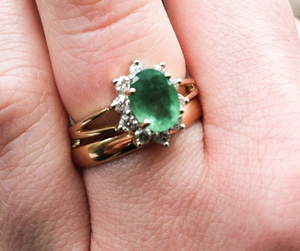
Lisa Quinn O’Flaherty writes:
I know you don’t normally do this but would you please share a picture of my engagement ring. I lost it yesterday evening, around Grand Canal Quay area.
I was at Lucio’s on Clanwilliam Terrace, the car park behind Clanwilliam Square, and I was also was sitting outside Café Bar H on the Grand Canal. I am hoping that if anyone finds it they would contact me! Thanks so much.
Anyone?
Meanwhile…

Brian Caulfield writes:
I was just wondering if any of your readers have seen my two-year-old daughter’s favourite teddy, Lanky! The photograph above is the best I can find.
He is a giraffe-type looking teddy, grey with black spots and a blue top nose. He has a black string hook coming out of his head.
We think we lost him on yesterday morning (Tuesday) somewhere between the Luas stop at Stillorgan and South William street, via Harcourt Street, Stephen’s Green and then to South William Street.
Long shot I know and thanks in advance.
Anyone?


Yesterday.
Co Monaghan.
Patrick Donohoe, of The Irish farmers Journal, writes:
Five heifers were allegedly shot by members of the armed forces on Tuesday as part of an alleged debt recovery exercise.
The Irish Farmers Journal has been contacted by the owners of the animals who allege that five of their heifers were shot by members of the army on a farm in Co Monaghan.
Watch: Cattle allegedly shot by army in debt dispute (Patrick Donohoe, The Irish Farmers Journal)
Farmer claims cattle should have been tranquilised rather than shot (Northern Sound)
Meanwhile..
The Hub Ireland writes:
Yesterday, The Hub – Ireland started to receive phone calls about animals being shot. From what we can gleam from emotional phone calls: in South Monaghan the farmer/owner was made bankrupt and the receivers moved in.
100 animals (beef bullocks and cows), well fed and well looked after were loaded onto a truck, six heifers could not be fitted in: bad loading: receivers kind of do that.
The owner said he would load the remaining 6, the answer was no.
Unsure of what to do he returned to his home: the next thing just amazes us. The remaining six animals they shot them dead with riffles,
And it get so much worse: like a plan comes together: They had a Licensed abottoir there to collect the bodies and cart them off to the market.
Aisling Nic Ardaile adds:
I can verify that yesterday at 11am the army surrounded the farm, opposite the family home. They were lined out in the field along the fence firing shots at the animals who tried to flee them. The owner was outside the house adjacent to one of the animals who had the army on the other side….
He tried to chase the animals so they wouldn’t get shot. Nearly getting himself shot in the process, but no matter, what help he could have tried to give the animal would have been useless as he was defenceless and trying to save his animals that he reared himself.
UPDATE: A ‘Military Exercise’

Free tomorrow?
Karen writes:
Kicking off the 7UP Free and Happenings collaboration will be a screening of the Tom Hanks classic Big (1988) on Thursday, July 7in the historic surroundings of The Law Society, Blackhall Place, Dublin 7. Movie goers will be treated to refreshing bottles of 7UP Mojito Free on arrival and can chill out on comfy billow bags as the sun begins to set.
Any excuse.

Spotted this morning, location unspecified.
Garsehole writes:
Double yellows and a pedestrian crossing, the one I taught my nine-year-old to use safely…
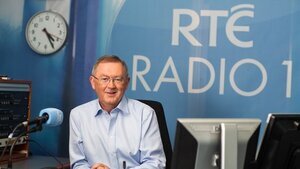
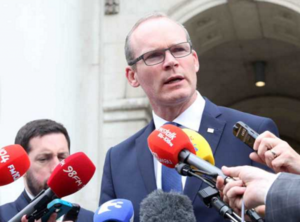
From top: RTÉ’s Seán O’Rourke and Fine Gael Minister for Minister for Housing, Planning and Local Government Simon Coveney
This morning.
RTÉ’s Seán O’Rourke interviewed Minister for Housing, Planning and Local Government Simon Coveney on his show Today with Seán O’Rourke.
They discussed the resignation of Joe O’Toole, from his position as chair of the Water Commission following his comments that people should pay their water charges; Independents 4 Change TD Mick Wallace’s bill on Fatal Foetal Abnormality; and housing.
During the interview, Mr O’Rourke appeared to be particularly riled by the promises made by Independent Alliance TDs Shane Ross, Finian McGrath and John Halligan that they will not vote with the Government and, instead, support Mr Wallace’s bill this week.
He described the three TDs’ actions as driving “a coach and four through the traditionally understood interpretation of the Constitution that’s there in black and white.”
From the discussion…
Seán O’Rourke: “Why didn’t you, as minister, say, ‘Joe, you overstepped the bounds of sensitive commentary here, you have to go’ instead of just hiding behind Fianna Fáil or looking over your shoulder at them?”
Simon Coveney: “I’m not hiding behind anything. I’m just telling you the truth. So, like, I’m not putting any political spin on this, Seán.”
O’Rourke: “Yeah but you seem to be suggesting that it would have been OK by you if he stayed.”
Coveney: “Yeah. Well I mean I asked Joe to do this job. I think he would have done a very good job. He’s very experienced politically. I think he did make a mistake in terms of being overly forthright in terms of his own views but he was asking, or he was answering questions that he was asked. What he wanted to do was get his own personal views out of the way early and then get on with being an independent and open-minded chair. Which I think he could have done.”
O’Rourke: “Do you know at this stage..”
Coveney: “I’m not going to start putting a spin on this, that I demanded he go or anything. I explained the position…”
O’Rourke: “But maybe you should have…”
Coveney: “Well, I mean, you can decide whatever you want but…”
O’Rourke: “But I’m asking you…”
Coveney: “I asked Joe to do a job. I think he would have done a good job. I was willing to support him through the comments that he’s made in the last number of days because I can understand the context around that. But others weren’t. And the important, this isn’t like a lot of other political decisions that I have to make as a minister. The Water Commission has to have the confidence, in particular of the two big parties that actually put it together in the Confidence and Supply agreement. And, also, I think, I hope it needs to have the support of other parties as well. Some of them would have been campaigning against water charges, who would at least have an open mind to the outcome of that commission report. And you know there was a lot of criticism of Joe because of the comments that he made. But I mean ultimately, you know, if I didn’t have the support of the other major party, that put this proposal together, with Fine Gael, well there was going to be a problem and I’m just being upfront about that, that’s what happened.”
O’Rourke: “So here we are, we have a situation where it’s Fianna Fail rather than you, as the minister responsible for his departure, you also have a situation where, we don’t need to go through it all, where you have partners in Government who refuse to abide by the principle of Cabinet collective responsibility, as outlined in the Constitution or they have refused as well, to accept the advice of the Attorney General. I just have a question for you about the viability and the strength of this Government. I mean, and I’ll put it in maritime terms because I know they’re ones you’re very familiar with, as somebody who is a seaman, but how would you feel about going around the Mizen in a Ford Seat with Shane Ross and company in your crew?”
Coveney: “Look, first of all, can I say that anybody who thinks that politics in Ireland should be politics as normal, as if the Government had a majority which a Government would normally have, doesn’t understand the new realities of politics. We are in a minority government, we’re trying to give leadership in that environment. Sometimes we have to negotiate with Fianna Fail as a main opposition party in areas where we have a Confidence and Supply agreement like on water for example. There are many other areas where we have no agreement with Fianna Fáil. And Fine Gael and our partners in Government will put policy together and we will debate it and implement it and…”
O’Rourke: “And that’s all perfectly understandable but what sure as hell is not politics as normal is where Cabinet ministers can drive a coach and four…
Talk over each other
O’Rourke: “Where Cabinet ministers can drive a coach and four through the traditionally understood interpretation of the Constitution that’s there in black and white.”
Coveney: “Yeah and this is not something that should happen often in Government. I mean what we have is…”
O’Rourke: “Often? It should never happen, surely.”
Coveney: “Seán, could you let me answer the question. What’s happened here is arguably the most sensitive political issue, which is around abortion, termination of pregnancy in areas or in circumstances where we have a tragic diagnosis of Fatal Foetal Abnormality. And where we have two independent opposition TDs bringing forward a bill that in our view, in Government, is unconstitutional, on the advice of the Attorney General and that is why Fine Gael’s position on this is absolutely clear. We have an agreed Government approach to trying to resolve this issue through a Citizens’ Assembly that will make recommendations that Fine Gael has agreed to have a free vote on at the end of that process, to try and bring a more permanent and real solution to this problem. In my view, what Mick Wallace is doing here is proposing a piece of legislation that will have no effect whatsoever in terms of outcome should it be introduced because it is unconstitutional and therefore won’t work. We have a Chief Medical Officer, to the Government and to the Department of Health, saying that this bill will not work and so, what Fine Gael wants to do is actually address this issue in all of its complexity and have an outcome that can help women who are in crisis. Unfortunately, what’s happened here is there’s a difference of opinion in Government…”
O’Rourke: “Yes but…”
Coveney: “The Independent Alliance, most of their members have already voted for this legislation when it was previously brought before the Dáil a number of months ago…”
O’Rourke: “And that’s all been well rehearsed, that’s well understood minister but essentially what the position here now seems to be, because it is such a sensitive issue, those ministers and members of your partners in Government, be they Cabinet or just beneath Cabinet level, are being told, ‘ok, because it’s so sensitive, you can do that on this occasion’ but they’ve been given a stern warning as to future behaviour but sure nobody will take that seriously.”
Coveney: “Well I think they will take it seriously because if we’re going to have a coherent government, you do need to take collective Cabinet responsibility seriously. And it’s important that the Government sticks together. And I think, you know, with what the Taoiseach said this week and I support him very strongly, you know, in a minority situation, in particular in a minority situation, a Government needs to stick together, you need to have collegiality and a Government needs to take a collective approach but there are circumstances and we have them this week, on an issue like Fatal Foetal Abnormality, and a piece of legislation relating to it where the independents feel that they want the freedom to be able to vote according to their conscience, is what they would say…”
O’Rourke: “Have you got assurances from them…”
Talk over each other
Coveney: “When the work of the Citziens’ Assembly is done and when those recommendations are made to the Oireachtas and when we are voting on those recommendations, at some later point, which won’t be the far distant future, Fine Gael will also have no whip in that situation because people will be allowed to vote according to their conscience…”
O’Rourke: “Right, but just before we move on…”
Coveney: “The difference here is that there is an expectation being built up that, actually, this bill can solve problems for women and, in our view, it can’t which is why we’re voting against it and we’re going to have a process underway that can deal with this in a more comprehensive and more sensible way.”
O’Rourke: “Have you, and has the Taoiseach more importantly, got an assurance from Shane Ross that the principle of Cabinet collective responsibility, or collective Cabinet responsibility, will be adhered to into the future after this one-off exception?”
Coveney: “Well I think there’s an understanding that this a one-off exception. I don’t think we’re going to have a repeat of this very often. And I think there’s an understanding across the Cabinet…”
O’Rourke: “A one-off that won’t be repeated very often doesn’t sound like a very reassuring kind of understanding.”
Coveney: “Well I’m just, I’m just telling you that any, there’s nothing in writing here but I think the Taoiseach made it very clear, the responsibilities that members of Government have…”
O’Rourke: “Yeah, it shouldn’t actually need to be in writing.”
Coveney: “…that is protected by the Constitution and it’s our job as a Government to actually act in a way that’s consistent with the Constitution so, you know, what’s happening this week is not going to be a regular occurrence, I can assure you.”
Listen back to the interview in full here
Previously: ‘If This Is Let Slide, It Will Be Very Serious For The Attorney General’