Category Archives: Misc

cloud

Clouds above Dublin yesterday

Finally.

Dr Jessamyn Fairfield explains:

Dubliners have been treated to an amazing sight the last two mornings: rainbow clouds, just before dawn. Their delicate beauty captures the imagination, but how do they form?

Clouds are made up of tiny droplets of water, or in the winter, ice. So clouds can spread sunlight into different colours, the same way you’d see different colours in a rainbow, when light passes through water droplets in the air. This happens due to an optical process called diffraction: when light passes from air into a medium like water, it bends because the properties of water are different than the properties of air for an electromagnetic wave-like light which is passing through.

Different colours of light bend different amounts, giving us the splaying of colours as if from a prism…

Polar stratospheric clouds occur in the far north and south of the globe, where ice crystals in clouds are common, and are also called ‘nacreous clouds’ for their resemblance to mother-of-pearl… Another even rarer winter sky phenomenon to keep an eye out for is ‘sun dogs’. Diffraction in ice crystals in clouds can bend the light from the sun so much that it appears to be in multiple places at once!

Rainbows Clouds And Diffraction (City Of Physics Dublin)

Earlier: Sky Breaking News

Yesterday: Is This Normal?

Thanks Sophie

90407094 90407095

This afternoon

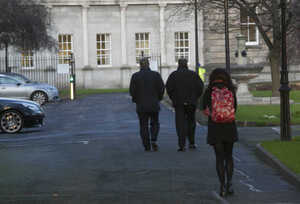
Leinster House, Kildare Street, Dublin 2.

Sinn Féin launches a General Election 2016 billboard attacking Fine Gael’s spending plans.

They argue that the €12.7bn of available ‘fiscal space’ does not allow for “demographic pressures, public sector wage increases and capital spend”.

Leaving the real amount of space at a snug €8.6bn.

Fight, etc.

Second pic from left Sinn Fein President Gerry Adams, Councillor Micheal Mac Donncha,  Pearse Doherty TD, Senator Kathryn Reilly and  Spokesperson for Social Protection Aengus O Snodaigh.

Sinn Féin

Leah Farrell/Rollingnews

Screen Shot 2016-02-02 at 12.48.00Screen Shot 2016-02-02 at 12.48.06

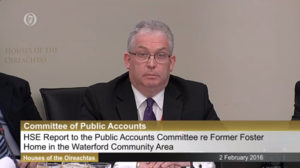
The director general of the HSE Tony O’Brien is appearing this afternoon before the Public Accounts Committee in relation to the abusive foster home in Waterford.

Earlier Fine Gael’s Waterford TD John Deasy repeatedly asked him if people who were involved in the foster home are still working in the HSE.

Mr Deasy also asked him what, if any, disciplinary action has been taken against those people.

Mr O’Brien repeatedly stated that he was hampered in answering questions at PAC because of a request by An Garda Síochána not to go into the detail of two reports on the home.

John Deasy: “Cut to the chase here. Outside of Garda investigations, outside of Commissions of Investigations, there are people still in the system, whom by that I mean the HSE, who have graduated to other organisations dealing with child protection. And their work and their involvement in this, in some cases, goes back to the 1990s. They’re still in the system and they’re still dealing with children, making very serious decisions at a very senior level when it comes to children. What are you doing about that? What are you doing…no, I actually want you to answer this, considering you’re the Director General of the organisation. What are you doing? You must have concerns that if there are people in there who are responsible for this, for the neglect, as you put it, the poor care, the failings, I mean surely the most basic and obvious step would be to have those people step aside until any investigation is concluded. Because the public interest dimension of this now requires, in my opinion, those people to step aside while an investigation is concluded.

“I mean what’s not tolerable, in the public, at this point, is for those people who are responsible for this to continue in their jobs based on the fact that they have still senior positions dealing with child protection in this country. If your organisation doesn’t understand that, you understand nothing. And that’s really, I think, the kernel of this today. And I think that you probably should have addressed it in your opening statement and I’m surprised you didn’t. Before you leave these committee rooms, I think you’re going to have to address that and satisfy the members of this committee that the individuals involved, responsible for this, account for themselves. That’s critical, it’s necessary it’s obvious.”

Tony O’Brien: “In relation to the events of the 1990s, the individuals concerned are no longer in public service. In relation to subsequent events, the Conall Devine Report was commissioned specifically to identify…”

Deasy: “Are you sure not all of them are in public service? Are you absolutely sure about that?

O’Brien: “The three who made the decision that I referred to…”

Deasy: “That’s not what you said, I’m not talking about that specific decision, I’m talking about people in the HSE and the health board who are involved in that foster home, who made decisions around that foster home – they’re still in public service, correct?”

O’Brien: “Let me answer the question.”

Deasy: “No, no, answer that question.”

O’Brien: “If I had been unclear in my first answer, I need to restate it, I hope that you will allow me to do that?”

Deasy: “OK.”

O’Brien:I referred in my first answer, when you asked me what I was apologising for, to a specific decision that was made to leave Grace in that foster home in the 1990s. That was made by a three-person panel, for want of a better word, and those three person are no longer in the public service. So just to be clear about that. The Conall Devine Report was commissioned specifically in order to lay out in full, unvarnished detail who did what and when and would be the basis upon which any action in the disciplinary space would be taken. From the outset of its commencement there was close liaison with An Garda Síochána and it was always understood and intended that the report would be published and available for whatever action may be necessary. However, since its conclusion, in 2012, it has not been possible to use it for that purpose and that is why no disciplinary action has been proceeded with on foot of the Conall Devine Report…”

Deasy: “That’s not sufficient. I understand, this has gone on for 30 years.”

Later

Deasy: “With regard to the reports, what’s curious for people is the invocation of one of the health acts so that the minister and junior minister involved can finally request the reports – finally – after all this time. And it’s curious and problematic for us that, after years, months, of being told there’s no way we can read these reports, they finally have the reports. And all they had to do is read and act and, say, well, the definition of the act does allow us to get these reports. You’ve basically, you’ve got to let me finish. Again, the kernel of this is, and there is the public interest dimension of this, now that you’ve admitted the mistakes and failings and we know the detail involved and the allegations. And we know that the people who are still within the system in many cases, some of them have moved on to other organisations dealing with child protection. The reality is that a Garda investigation, a previous one, collapsed. This may not go anywhere, the second one. And a Commission of Investigation takes time, people retire, they leave the system, the people who are actually charged with making these mistakes, they’ve access to files, emails, they’re in situ, they’re sitting on potentially evidence, and that’s a big issue. If you’re so frustrated legally, if you’re, ‘my god I can’t do anything, these people, they’, you know. Well, have you asked anyone if there needs to be a change of course with regard to your powers internally? I mean if it’s the case that you’re going crazy at not being able to deal with this, and not being actually able to make these people account for themselves, have you just given up and left it at that, is that effectively the answer to the committee here today?”

O’Brien: “No, deputy it’s not….I’m not stonewalling you. I’m prepared to answer any question I can that doesn’t involve me effectively publishing the two reports that An Garda Síochána have asked me not to do. So I want to be clear, that’s the only reason they’re not published.”

Later

Deasy: “Now that you’ve read the reports, Mr O’Brien, do you have any concerns that the people involved making these mistakes – neglect, poor care – that you’ve described yourself in writing to this committee, are still involved in child protection?”

O’Brien: “There are a wide number of people whose actions are detailed in the report, it’s clear from my reading of the report that there were many instances, missed opportunities but not all of the people covered were on, shall we say, the downside of that. I am concerned that there is an ongoing delay to enable us to publish the reports which would enable each of those involved, each of the people implicated as it were, to have an opportunity to answer what it says in the report, so that those do have something to account for, can account for it and that those who are blameless can have their name restored as it were.”

Later

O’Brien: “There were occasions upon which there was information available which, had it been treated differently, would have removed Grace from that situation earlier that she was. And, on the basis of what is alleged to have happened, that she would have therefore been protected from the egregious abuse that is alleged to have occurred.”

Deasy: “These people are still working in the HSE?”

O’Brien: “There are many people who were involved in different ways in those processes. One of the features of this is the disagreements that occurred at different times as to what should have occurred and different people on different sides of those disagreements. Some of those people are still working in either the HSE or Tusla.”

More to follow.

Watch live here

Previously: ‘Poor Quality Of Service’

UPDATE: Other abuse cases ‘may have happened’, O’Brien tells PAC (RTE)

90407065-1

Michael-Taft

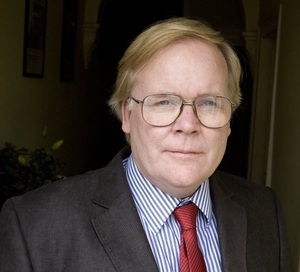
From top: Enda Kenny at government buildings this morning to convene his last cabinet meeting of this government term; Michael Taft

What many won’t say:

The road ahead is bumpier than you think.

Michael Taft writes:

So the economy is back in recovery mode but under the Government projections we are not going to bounce back to pre-recession levels of living standards.

Lower your expectations, sisters and brothers, the recovery is setting in. Let’s take a historical look at two indicators of living standards.

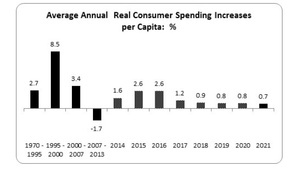
1) Consumer spending:

Between 1970 and 1995, a period covering two slump periods punctuated with growth, real consumer spending averaged 2.7 percent annually per capita.

Between 1995 and 2000 (the good phase of the Celtic Tiger, based on investment, manufacturing and exports), real consumer spending averaged 8.5 percent annually per capita. That was a strong performance, with employment rising, increasing wages and the ongoing shift to a modern enterprise base.

Between 2000 and 2007 (the bad speculative phase) real consumer spending averaged 3.4 percent per capita. A little better than the pre-Celtic Tiger period but as we know, unsustainable.

Then the recession hit and consumer spending fell by over 10 percent. However, as always happens, the economy recovered. In the textbook alphabet, there would be a burst coming out of the recession, representing pent-up demand, and then things would settle back down to past trends.

If the Government projections come true, this will not be the case.

1

We are in the middle of a bump which should continue into this year. However, the Government estimates that it will fall off rapidly in 2017 and remain below 1 percent into the next decade.

It is worth noting that while in 2015/2016 consumer spending increases by €1,000 for every man, woman and child, by 2020/2021 consumer spending increases by less than €300.

2) Public spending:

But this might not be so bad if the Government increased its spending on public services, or government consumption. If, for instance, the Government introduced affordable childcare, reducing fees by half, then the savings to the households could be redirected to other areas of consumption; similarly with free health care.

Let’s look at Government spending on public services.

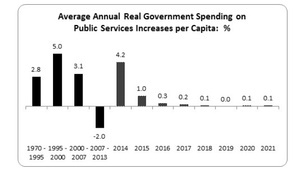
Between 1970 and 1995, real government spending on public services averaged 2.8 percent annually per capita.

Between 1995 and 2000, real government spending on public services averaged 5.0 annually per capita.

Between 2000 and 2007, it rose by 3.1 annually in real terms.

Recession time and public service spending fell by 16 percent up to 2013.

So what is the government projecting going forward?

2

In 2014, government consumption rose by 4.2 percent but this was largely a statistical fluke, factoring in productivity gains from the Lansdowne Agreement. In subsequent years there is effectively no increase at all.

Therefore, there are three principles that should guide the next government.

First, investment; driving investment increases productivity and enterprise expansion which, in turn, increases wages and employment. This is a more sustainable approach to consumption. Pumping consumer spending through tax cuts in the hope that this will increase investment (through business confidence, etc.) is misplaced – as Michael Burke shows here. Pumping consumption in a small open economy like Ireland’s is even more problematic; without stronger export growth, this can lead to reduced growth due to imports.

Second, prioritise public services over tax cuts. If the state provides free healthcare, this reduces costs for many households which can redirect the saving into other areas. It also makes this service more accessible to people who otherwise couldn’t afford costs in the private market. This makes for a more equitable approach to consumption.

Third, redistribute: if you take €100 million from higher income groups and redirect it to low income groups, consumer spending will rise as the latter spends almost everything they get. Therefore, prioritise income supports for those out of work and the low-paid.

There is rising uncertainty in European and international markets. If anything can see us through this, it is a programme that focuses on our economic infrastructure, provides services collectively (reduced cost, greater participation) and promotes income equality. This is a long-term approach.

Right-wingers, Fine Gael in particular, are proposing to reduce our tax base while starving economic and social investment.

If this short-termist, electorally-populist formulation isn’t a recipe for instability it is hard to know what is. And as a set of policies designed to enhance living standards, it is a bust. Progressives should put forward a different, more economically responsible programme.

Investment, public services and equality: how’s that for a campaign theme?

Michael Taft is Research with Unite the Union. His column will appear here every Tuesday. He is author of the political economy blog, Unite’s Notes on the Front. Follow Michael on Twitter: @notesonthefront

Screen Shot 2016-02-02 at 12.31.39

This morning.

A short timelapse video of polar stratospheric clouds in Dublin by Ian Carruthers.

Ian writes:

“A brilliant sight to witness, dancing across the sky like a rainbow at sunrise.”

Meanwhile…

unnamedScreen Shot 2016-02-02 at 15.40.17

Bray, Co. Wicklow, 9.30 this morning.

(Thanks Marsupial)CaNRcIPWIAAuNid

Alan Morton tweetz:

“Nacreous clouds and the church of the Holy Trinity, Dublin.”

90407067

Merrion Street, Dublin 2 this morning.

Yesterday: Is This Normal?

mailo:lucindaPodcastCover Tunein

From top: Renua candidate Mailo Power with party leader Lucinda Creighton; William Campbell

Waterford Renua candidate and hotel owner Mailo Power talks to William Campbell of the Here’s How [current affairs] podcast on her party’s controversial flat tax plan.

William writes:

Mailo Power defends her party’s plans for taxation. People on six-figure salaries will get huge tax cuts, someone on €200k get an extra €45k in their pocket. People lower down the scale? They get an incentive to work harder…

Fight!

Listen here

Screen Shot 2016-02-02 at 11.16.08

Mattress Mick

Humans of Dublin is an ongoing project by photographer Peter Varga comprising portraits and short quotes about anything from passers by on Dublin streets

Pete recently photographed Dublin bedding baron Mattress Mick who proved his humaneness with the following:

“When I was in my late teens I met a girl, and she became very, very special to me. She was my first love. We were together for quite a while, but I guess we were just too young… We met too early. She wanted to do other things, so she decided to go different ways. We kept in touch on and off for a long time, but after that, I hadn’t seen her for years.”

“I knew she got married, I knew she had children. Some of her friends kept in touch with me, so I always knew what was going on. She was always very special to me, and never really left my thoughts. A few years later somebody told me she developed cancer.”

“I actually met her about two years before she died. Her friends organised a reunion but I didn’t think it’d be the last time I saw her. One Sunday afternoon, out of the blue, a friend of hers called me and said, ‘Hi Michael, I have someone here that wants to talk to you.’ She said, ‘Hi, it’s me, Kathy. I just would like to say goodbye. I know I’m going to die soon, and I wanted to let you know you were very special in my life too.'”

“Every time I think about that phone call I get very sad. It was the nicest phone call I have ever received in my whole life. It meant so much to me. That someone who knew they were terminally ill and hadn’t a lot of time could actually think about me, and tell me that… I guess it is true, it’s never too late to tell somebody how you feel. She died that week, but she’ll always be in that very special place in my heart.”

Mattress Mick (Humans of Dublin)

Meanwhile…

-1

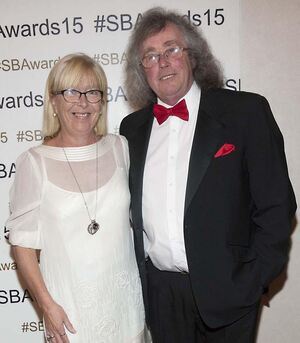
Mattress Mick and Mrs Mick, happily married for over 30 years.

Until she read the above

Mmf.

Pic: VIP magazine