

Category Archives: Misc

90397852rory

From top: Pro choice activists take the ‘abortion pill bus’ in September, 2015; Dr Rory Hearne

Time to end Ireland’s ‘out of sight, out of mind’ hypocrisy on abortion, bring us into the 21st Century and Repeal the 8th Amendment.

Dr Rory Hearne writes:

Ten women (and some with their partners) will have to take a plane or ferry today and travel to England to have an abortion.

Last year over 3,700 women had to travel to the UK while over 150,000 have had to take a plane or boat to England or another country to have an abortion so that Catholic Ireland can remain guilt free while her traumatised women and their partners are forced to take the journey of shame to another country

This is the reality of hypocrisy Ireland.

Women and their partners and families face a personal crisis; whether it is a deeply tragic pregnancy such as fatal foetal abnormalities or becoming pregnant because of rape or a crisis pregnancy, this ‘great little nation’ deals with it by offering no support but to export the ‘problem’.

The Irish constitution and the failure of the state and governments to provide supportive legislation has turned our personal difficulties into a criminal act. It is the Eighth Amendment (Article 40.3.3 of the Constitution) which criminalises abortion as it gives the right to life to the foetus and places it on equal footing with that of the woman.

It is actually illegal for a woman in Ireland to have an abortion even if the foetus she is carrying will not survive outside the womb.

· In 2014, 140 Irish women travelled to the UK to have abortions for this reason.

It is also illegal for a woman who gets pregnant from rape to have an abortion in Ireland.

A total of 197 women and girls who went to rape crisis centres in 2013 were pregnant as a result of rape. One in four chose to have an abortion. They had to travel abroad for an abortion or take abortion pills illegally in Ireland.

Up until 2013, women had no legal right in Ireland to an abortion even if their life was at risk. We saw the result of this when Savita Halappanavar was allowed to die in October 2012. After the public outcry and protests the Government responded by enacting the Protection of Life During Pregnancy Act but this retained the criminalisation of abortion on all but one ground (when a woman’s life is at risk). So women having an abortion or a doctor, or anyone helping a woman have an abortion outside of that circumstance faces a prison sentence of up to 14 years.

The right to travel abroad for abortion allows official Ireland to get on with business as usual irrespective of the mental, financial and sometimes physical suffering imposed on these women and their partners.

They add layer after layer of control and punishment because those who travel to have an abortion can’t talk about it – not even to closest friends and family – not even amongst themselves.

But thankfully this is changing. The silence is being broken The stigma of abortion is being broken down as more and more people such as journalists like Roisin Ingle and comedian Tara Flynn speak publicly, to their friends and family about their experience.

New websites are being set up to share stories about abortion (for example ShareYourAbortionStory) or the X-ile project which is an ongoing online gallery to give a much-needed face to women who have effectively been exiled from Ireland and ignored due to unduly strict abortion laws and demonstrate that those who choose to travel to have an abortion are responsible, ordinary women and are our neighbours, friends, colleagues, mothers, daughters and partners.

Kitty Holland has written in the Irish Times about women undertaking abortions at home with imported medication from a website in the Netherlands.

One women she spoke to explained how she was ‘working part time and trying to get college projects finished’ and ‘the thought of having a child on a meagre wage, living in an apartment I share with my mother . . . I wouldn’t be able to finish my education or look for work. What kind of start would that be for a baby?”  She was afraid to seek follow-up medical advice after taking the abortion medication at home.

A few weeks ago, Fergal Malone, the head of the Rotunda Maternity Hospital spoke on the RTÉ’s Late Late Show about the tragedy of parents of babies with fatal foetal abnormalities having to “courier” their child’s remains home because of Ireland’s restrictive abortion laws.

Opinion polls (including Newstalk’s latest poll last week) are consistently showing that a majority (67%) favour decriminalising abortion and a substantial majority (80%) in cases of foetal abnormalities or rape while a majority (75%) also favour holding a referendum to repeal the Eighth Amendment.

Those favouring access to abortion as women chose has doubled in the last decade (with a majoring of 25-34 year olds in favour) while those opposed in all circumstances has halved and is now down to just 7%.

op1

Changing attitudes to abortion in Ireland: Various Opinion Polls 1997-2015

Amnesty’s #notacriminal campaign (see below) shows how difficult it is to get a legal abortion in Ireland.They highlight that the lack of legal abortion is a denial of women’s human rights and the choice to have an abortion should be an entirely private matter decided between a girl or woman and her doctor.

op2

An important factor in building support for the Repeal the 8th Amendment is for men to speak out in support and tell their stories about experiences of abortion.

Restriction of abortion is a broader human rights issue that discriminates and hurts men as well.Men face criminalisation for helping their partner or are often unable to travel with and support their partner due to difficulties paying for a second set of flights. The Irish constitution denies them the ability to be with the person they love, and playing an active role in being present to support their partner during a medical procedure.

This change in the public mood in favour of de-stigmatising and decriminalising abortion and ‘Repealing the 8th Amendment’ is being led by thousands of pro-choice activists and campaigners across the country.

The numbers attending the Annual ‘March for Choice’, held in September for four years now, have been growing with 10,000 attending in September 2015. While The Coalition to Repeal the 8th Amendment, includes over 50 organisations including feminist, human rights and pro-choice organisations, NGOs, trade unions, and political groups. It has written to all General Election candidates to pledge to calling for a referendum to repeal the 8th Amendment.

Ireland is changing.

We are realising that equality means actually implementing equal rights for everyone.

And that includes women’s reproductive rights to have control over her own body – including the right to abortion in Ireland.

So when a politician comes knocking on your door in the next few weeks make sure you ask them what their position is. Let them know Ireland is changing and that its time for safe and legal abortion in Ireland so that women’s lives, health and choices are respected and protected.

Dr Rory Hearne is a Senior Policy Analyst with TASC, the Think-Tank for Action on Social Change. He is also an independent candidate for the Seanad NUI Colleges Panel. His column appears here every Wednesday and he writes in a personal capacity. Follow Rory on Twitter: @roryhearne

You can sign the petition in support of a referendum to repeal the 8th Amendment to the Constitution of the Republic of Ireland here


90347700anne-marie-291x300

From top: left holding the baby; Ane Marie McNally

In the OECD 12% of a family’s income is spent on childcare.

In Ireland that figure is 35%.

Time for a little subsidiarity.

Anne Marie McNally writes:

You’ll have no doubt heard lots of talk this week from both sides of the tax versus spend debate. On the face of it tax cuts sound lovely don’t they? Oh look, an extra few quid back in my pocket, nice.

Then you hit a point in your life where you find you need to access a basic public service. It could be childcare, it could be the health service, and it could be education…whatever.

You suddenly find that the measly few extra quid you got in your pay packet that time the Government wanted to try and bribe your vote out of you suddenly doesn’t look like such a good deal.

Apart from the fact that you find you have to fork out your hard earned cash for the essential service you’re also likely to find that the service you get will be, at best, second rate. An extra 3 quid a week in your pocket is really not going to make much difference if you find yourself or a loved one in need of medical care.

What would make a massive difference is if those cumulative 3 quids had been invested into building a modern, fit for purpose, universally accessible health service that could ensure you get timely treatment and in a dignified manner. That is the concept of subsidiarity and it creates an overall more healthy and happy society. Who doesn’t want that?

But there’s no point in claiming that’s the society you aspire to while at the same time talking about slashing €4-€5 billion euro from the tax base by saying you’ll abolish USC.

In doing so you not only abolish USC you also abolish the possibility of using that €4-€5 billion euro to strategically invest in quality public services that ultimately reduce the cost of living in a very real way on a day to day basis.

Take childcare as an example. In the OECD, on average, 12% of a family’s income is spent on childcare. In Ireland that figure is 35%. Over double the OECD average. Not only are we paying more but we’re getting an inferior service. In many cases parents are paying ridiculously inflated prices for factory type childcare out of necessity rather than desire.

The choice as to whether to work or stay home should always remain just that – a choice. Most parents these days however don’t have that luxury.

Therefore surely it makes eminent sense to invest heavily in creating a State subsidised childcare system, where standards are ensured, early years education is built into the system, and a maximum cap on the amount parents will be asked to pay is assured.

By guaranteeing a full year’s paid parental leave you free up parents to make the choice as to whether they stay home during the vitally important first year of a child’s life rather than forcing them back to work against their will in many circumstances and jeopardising the ideal development scenario for the children.

Now you may be past the years of child rearing, you may never want to face the horror/joy of it and you may be thinking sure none of that affects me. Actually, it does and in a very real way.

Back to subsidiarity here folks. The children of today are the adults of tomorrow when you and I are in our more senior years.

They are the ones who’ll be tasked with building and safe-guarding society as we pass the mantle over to the generation below us. Doesn’t it make sense to put in place systems that ensure the best outcomes for society as a whole rather than a generation of young adults dealing with the consequences of stressed out parents, poor early years education and overall societal malaise?

The same points can be made about investment in so many other services. Stop thinking about things as individuals and look to the collective and I can guarantee you we all benefit in a far more substantial and real way in both the short and long term.

Anne-Marie McNally is a political and media strategist working with Catherine Murphy TD and is a candidate for the Social Democrats in the Dublin West constituency in the forthcoming General Election. Follow Anne-Marie on Twitter: @amomcnally

Screen Shot 2016-01-26 at 15.28.32

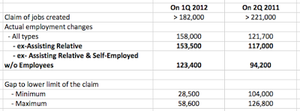
A table in relation to job creation claims in Ireland by Constantin Gurdgiev

Further to the recent claims from a junior minister that the Fine Gael/Labour coalition have been creating more than 1,000 jobs a week

Adjunct assistant professor of finance at Trinity College Dublin, Constantin Gurdgiev writes on his True Economics blog:

There is a simple matter of arithmetic.

Recall that the current Government came into power at the end of 1Q 2011. Let us suppose the Government really got down to ‘creating jobs’ by 1Q 2012. Which means the Government has been at its jobs game for roughly 14-15 quarters through 3Q 2015 or, at the lower end 3 years and a half.

That means that the Government should have created “over” 182,000 jobs in that period. This benign to the Minister claim, because if we are to look at the record of the entire duration of the Government, his claim would have equated to roughly 221,000 jobs created.

Keep the two numbers in your mind: we are told that the Government has ‘created’ either more than 182,000 or more than 221,000 jobs over its tenure, depending on where one starts to count.

Now, consult CSO QNHS database – the source of official counts for numbers in employment.

Between the end of 1Q 2012 and 3Q 2015 (the latest for which we have data), total employment rose 158,000. But wait, these are not all jobs. 4,500 of that increase is in the category of Assisting Relative. And 121,200 of these additions are employees, including schemes. Beyond this, the above increase also includes 30,100 new (added) self-employed with no employees.

It is hard to assume that the Government can claim it ‘created’ self-employment jobs where there is not enough activity to hire staff, or that it increased the need to help relatives.

Numbers speak for themselves. By the very best metric, Government is more than 1/2 year shy of the lowest end of the claim of ‘more than 1,000 jobs created per week’. It is more than 1/2 year shy of the claim that there were ‘1,000 jobs created per week’.

‘More than 1,000 jobs per week’ Government Claims v Reality (True Economics)

90406301

Environment Minister Alan Kelly at a housing development in Glasnevin, Dublin yesterday

You’ll recall how, last week, the minister for housing Paudie Coffey appeared on Claire Byrne Live following the broadcast of documentary My Homeless Family on RTÉ One – saying:

“In the last year as well, this Government and, you know, this society has provided 13,000 additional housing units for people. That’s up 86% on previous years…”

The claim prompted criticism online.

Further to this…

Environment Minister and deputy Labour leader Alan Kelly was interviewed by Seán O’Rourke on RTÉ Radio One this morning.

At the start of their discussion, Mr Kelly was asked about the 13,000 social housing figure.

Alan Kelly: “We’ve used every avenue possible to us to ensure 13,000 keys were given over to people. That’s up 86% on the previous year by the way. And it breaks down, we put a huge interest in voids which are social housing units that are boarded up. People around the country, and particularly those listening in Dublin, know what I’m talking about – 2,700 of those done this year, about 2,500 done the year before. And ‘buy and build’ was over in excess of 1,000, the CALF (Capital Advance Leasing Facility) scheme which is funding which is given out through AHBs (approved housing bodies) 350…”

Sean O’Rourke: “Sorry there’s a bit of alphabet soup there that I don’t understand and…”

Kelly: “Basically, it’s funding that’s given to approved housing bodies to go out and build different units.”

O’Rourke: “And how many came from that?”

Kelly:350.”

O’Rourke: “Right.”

Kelly: “Regeneration, about 112. About, from leasing, about just under 2,000 and, from the Housing Assistance Payment, just under 6,000. So that’s how you get your…”

O’Rourke: “Yeah because they make the point that when you take the figure of 13,000, that these units are in now way new social housing units – many are pre-existing households in receipt of rent supplement, you’re simply moving them to new schemes.”

Kelly: “That simply isn’t true and it doesn’t bear facts. For instance, all those voids which are boarded-up units weren’t in existence. They were the quickest way in which we could turn around units and create new units. Where we’re leasing units and buying units, they are new units, they’re available in stock as well. And actually the 13,…”

O’Rourke: “But they’re taking units out of the market and making them available to other people.”

Kelly: “Yeah but in some cases, that’s necessary and in other cases, we don’t chases the market. But in some cases, there’s good value out there as well when you’re buying. I mean there’s no point in building some units in parts of the country when it’s actually cheaper to buy. These figures are actually conservative because, you know, the local authorities themselves, this is the units that are directly funded through my department. The local authorities themselves do a lot of work. There’s also the natural amount of progression you have in houses whereby social housing units pass on from one person to the other because of various different reasons, people moving away, people passing away, etc. So the number of people’s houses is more than that.”

Listen back in full here

Previously: How Few?

‘Plain Cockamamie’

Related: From social housing annihilation to made-up stories (Be Your Own Reason)

bouts

Bouts – Allies

A new video from Dublin band Bouts [Barry Bracken, Colin Boylan, Daniel Flynn and Niall Jackson] directed by Eoin Heaney of Highly Stimulating Productions.

Allies is part of a 5-track EP called, Unlearn released as a limited edition 100 cassette run (with digital download included) on February 29. Pre-order here now.

Bouts (Facebook)