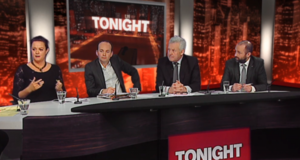
Sunday World crime correspondant Nicola Tallant, Anti-Austerity Alliance TD Paul Murphy, Fine Gael TD Fergus O’Dowd and John Devine, of Transparency International Ireland on TV3’s Tonight with Vincent Browne last night
Further to the recent reports that GSOC accessed the telephone records of three journalists without their knowledge or consent – and this morning’s reports that 62,000 applications for access to landline, mobile phone and internet records were made over five years, the majority by Gardaí…
Last night’s panel on the Tonight with Vincent Browne show, presented by Michael Clifford of the Irish Examiner, discussed the matter.
On the panel were Sunday World crime correspondant Nicola Tallant, Anti-Austerity Alliance TD Paul Murphy, Fine Gael TD Fergus O’Dowd and John Devine, of Transparency International Ireland.
They discussed last year’s RTE reports about how Paul Murphy was to be charged, the relationship between some gardaí and some members of the media and Nicola Tallant’s own complaint to GSOC about gardaí allegedly accessing her phone records.
Grab a tay.
Michael Clifford: “You work in the area of crime, what do you think of this story? How it’s being handled?”
Nicola Tallant: “Yeah, you just mentioned there that obviously the fight against crime, when you see it in the courts, obviously surveillance and phone records and all that are vital. I think before 2011, when the powers came to the gardaí, that they could, anyone over Superintendent level could sign off to get anybody’s phone records. It was actually dealt with…”
Clifford: “Chief superintendent, I think…”
Tallant: “Under the Terrorism Act. So that is how it has transferred now, it has gone from, it had been dealt with under the Terrorism Act when it didn’t exactly have to be an act of terrorism that you were investigating but it had to be pretty high up. It’s now transformed to if, it’s a culmination I think of this data protection plus the 2005 Garda Síochána Act which makes it illegal for a member of the guards to pass on leaked information that causes harm. You know, the information cannot just be, it’s not illegal for them just to…”
Clifford: “But any confidential information, and most of which guards would have, when you says causes harm, I don’t think there’s any provision that passing on information has to cause harm. How do you define harm?”
Tallant: “Well they do define the harm actually, in the act, and they define it, it is actually quite, there’s a list of things that are defined as harm and they include collapsing trials, that kind of…”
Clifford: “Reputation?”
Tallant: “There’s a few, you know, identifying a witness who has given information in confidentiality, they’re quite strict actually…”
Clifford: “Yeah.”
Tallant: “And I think it has probably been misused a little bit by guards as a bit of a fishing exercise to see who’s talking to the media.”
Clifford: “And is there not also a question, to be fair, that an awful lot of the information that flows from Garda sources to the media is tittle tattle, is invasive of people and, basically, in terms of any test in the public interest, it doesn’t pass it?”
Tallant: “Well some of it is and some of it is very relevant…”
Clifford: “Some of it is but a lot of it isn’t.”
Tallant: “Well, I mean, what, it depends on what you consider to be tittle tattle, what you consider to be in the public interest…”
Clifford: “I’ll give you an example – Paul Murphy beside you. Paul you’ve the issue whereby there was a leak to the media about the fact that you were going to face prosecution – and we’re not touching the substance of the prosecution, but just in terms of how that came about. How did that come about?”
Paul Murphy: “Yes, the first I heard that myself and 20 something other people would be charged with false imprisonment and other charges related to the protests last year was on RTE Radio from Paul Reynolds, the crime correspondent. That was when we heard we were going to be charged, then nothing actually happened for weeks and weeks. And then the day before we actually were charged, as far as I remember, I got a call, again from Paul Reynolds, at 5.55pm, to say that he was going on Six One, headline news, and to tell us that we were going to be charged.”
Clifford: “And it’s also, just to put a bit of context on it from recollection. Two days before that first, news report on RTE, I think there was a newspaper report suggesting that you wouldn’t be charged and one could surmise that somebody somewhere felt it might be necessary to get word out there to the contrary and suddenly, it appears in RTE.”
Murphy: “Correct, and that whole experience for me raised a significant question mark over the relationship between the gardaí, or some gardaí, and some journalists and the reality that some journalists act, in some way, as an extension of the Garda Press Office. They give a Garda line on certain stories in exchange for which they get information and I think that’s extremely damaging from the point of view of public debate, from the point of view of our reputation because I think there was a purpose for that being leaked which contradicts the previous story and also to soften opinion for what was a shocking event: the idea that people were being charged with false imprisonment…”
Clifford: “Well it’s conjecture whether that was, yeah, fair enough. John [Devine], what do you think of Paul’s assessment of that relationship?”
John Devine: “Yeah, we’ve pointed out in the wake of the Garda whistleblower controversy that there seems to be two cosy relationships between some journalists and the gardaí. And it’s not something that just affects media in Ireland. Elizabeth Filkin and Lord Leveson in the UK reported on the cosy relationship between the Metropolitan Police and the British press which were subject to investigation by Leveson and found that, in many cases, payments were being made to police officers for information, they were being wined and dined, they…”
Clifford: “I don’t think there’s any evidence whatsoever that that goes on in this jurisdiction..”
Devine: “I’m not, it’s not to say that there’s anything of, to that level, happening here but, at the same time, many of our journalists are dependent on the gardaí, for the information that feeds their stories. And Leveson and Filkin pointed out that this is an incentive for journalists to toe the line, to be uncritical, to not question police decisions and to turn a blind eye to abuses and, in some cases, by…”
Clifford: “What do you think of that Nicola?”
Tallant: “There seems to be this kind of myth that is growing all the time, that crime correspondents are just fed a line from gardaí or they go down to headquarters and are given a story. My experience, and I’ve been at it 20 years or more, is that a guard wouldn’t know a story really if it hit them in the face. Now a journalist, a journalist knows a story, a journalist goes after a story and they have various sources of information. A lot of them get information on the ground on stories. People covering a daily beat. We have that body in the suitcase there this week that would be, the daily journalists are following that every day. They’re out on the crime scene.”
Devine: “We do know some crime journalists are favoured and this isn’t an Irish phenomenon, this is in the UK, it’s in the United States, there are some journalists who will have information that their colleagues will not have and that’s by virtue of the fact they’ve nurtured a relationship with their contacts in the police.”
Clifford: “And there is one other dynamic there, Nicola, in terms of GSOC and these phone records. GSOC have been at loggerheads with the gardaí on a number of occasions over the last few years and I think it would be fair to say that, in a number of incidences, reportage of that dispute was skewed very much in favour of the gardaí and against GSOC. And now we’ve a scenario where GSOC have apparently these untrammelled powers and they well be targeting the very journalists they might believe are targeting them, all of course, none of it intentional but I think it would be fair enough to surmise that there will be no love lost there, in those quarters.”
Tallant: “I actually think GSOC have done all of us a favour in journalism by the fact the very fact that they have focused this. They have gone in, they have been given these powers and they’ve gone into it like bulldozers and they have really made it very obvious what they were doing with the phone records. I’ve spoken to some of the journalists who are involved in it and it was just quite astounding how obvious they’ve made it. You see the guards have been doing this for years but they’ve been doing it much sneakier…”
Clifford: “Clare Daly made the point today and it was pretty valid. Us in the media, including myself we didn’t pay a hell of a lot of attention to it until the focus was turned on journalists.”
Tallant: “Well I paid attention to it because I made a complaint actually about my phone, about gardai accessing the records from my phone way back, from 2010, but I made the complaint to GSOC who were very positive about it in the beginning and came back to me just before Christmas to say there wasn’t anything that they could do, the guards couldn’t answer them…”
Related: No widespread snooping on private citizens (RTE)
Earlier: How Many?
Previously: “Come Back When You’re Sober”
Watch back in full here