

Irish Rail advertises city breaks to “places like Galway, Limerick and Cork”.
Why not to Dublin?John Talty,
Cork.
Anyone?



Irish Rail advertises city breaks to “places like Galway, Limerick and Cork”.
Why not to Dublin?John Talty,
Cork.
Anyone?

Katie writes:
“Saw this on Facebook yesterday – classic nutritious meal of sausage rolls and Tayto for €2… :( Who said anything about a national obesity crisis? If our self-control is that unbelievably useless, don’t we need to tax the crap out of this sort of food?”
FIGHnomnomnomnomnom…

Today’s Irish Daily Mail
The Irish Daily Mail (not online) is reporting this morning that Tánaiste Joan Burton is facing a motion of no confidence today over her appointing former head of the Irish Congress of Trade Unions David Begg as chair of the National Pensions Authority.
The position did not go through the public service advertising or the appointments process.
In addition, the paper reports Ms Burton appointed Ita Mangan as chair of the Citizens Information Board, also without advertising the post.
The Independent Alliance has tabled the motion.

Office of the Garda Síochána Ombudsman Commission on Abbey Street Upper, Dublin
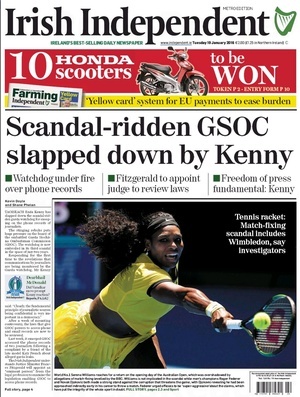
Further to the Garda Síochána Ombudsman Commission accessing journalists’ phone records as part of investigations into alleged leaks to media, the Irish Council for Civil Liberties has created a ‘handy guide to phone number snooping powers’.
It explains…
Is GSOC allowed to gain access to this information under Irish law?
Yes. Both the Gardaí and investigators with GSOC can access phone records and other personal information, if it is needed to assist them with an investigation of a possible crime. In this instance, GSOC has the same powers to investigate the Gardaí as the Gardaí would have if they were investigating anyone else on suspicion of an offence.
How? In what circumstances?
The key here is that a Garda who leaks confidential information could be guilty of an offence. Under section 62 of the Garda Síochána Act 2005, it is an offence to disclose information received in the course of duties as a Garda if the Garda knows that the information is likely to have a “harmful effect”. This includes, for example, information that is published and relates to the victim of a crime or a witness to a criminal trial, or leads to a serious infringement of a person’s right to privacy (as well as other issues).
The same piece of 2005 legislation (section 98) gives members of GSOC the same powers as Gardaí if they are investigating a potential offence.
And, since 2011, Gardaí have the power to access phone records (Communications (Retention of Data) Act 2011).
It follows that, because GSOC investigators are looking at a potential offence – the leaking of confidential information – they also have the power to access personal records, including those of third parties like journalists.
Sounds a bit like Big Brother. Is there no protection for our right to privacy?
Yes there is, but it’s weak.
GSOC investigators would have to get sign off by one of the three members of the Garda Síochána Ombudsman Commission. That’s all.
How about authorisation from an external body? I thought there was “judicial oversight”?
No, both the Gardaí and GSOC can obtain sign off for these powers without referring to any external body.
A judge does not need to give permission for these records to be obtained.
However, a judge reviews the access requests made by State agencies and gives a report to the Taoiseach, at least every year. The judge can also investigate cases.
Also, if you have reason to think that your data has been requested by the Gardaí, GSOC or other State body, you can make a complaint to the “Complaints Referee”.
Do GSOC and the Gardaí have other powers to gather private information?
Yes, since 1993, the Gardaí have had a lawful power to intercept telephone calls and, since 2009, to engage in hidden surveillance. In 2015, both of these powers were also extended to GSOC investigators.
Again, the privacy safeguards surrounding these activities by GSOC and the Gardaí are weak.
What about protection of journalists’ sources?
A journalist’s right to protect sources or, journalistic privilege, is a key pillar of the freedom of the press. This is protected under Article 10 (freedom of expression) of the European Convention on Human Rights (ECHR) and has been acknowledged formally as a constitutional principle by the Supreme Court in Mahon Tribunal v Keena and Kennedy. This does not mean that journalists can never be forced to reveal their sources, but any order to do so must be proportionate, and subject to strict oversight, for example by a judge.
What does the ICCL think should happen now?
We agree with the Minister for Justice and Equality that there needs to be a full review of all of these powers. That review must be independent, transparent and use human rights standards around data protection and privacy as key benchmarks. Particular attention should be paid to the case law of the European Court of Human Rights under Article 8 (right to privacy) of the European Convention of Human Rights, as well as relevant case law of the European Court of Justice. The recommendations must be published and acted upon promptly, with a clear implementation schedule.
Cabinet to discuss GSOC access of journalists’ phone records (RTE)
Previously: They Snoop To Conquer
Mark Stedman/Rollingnews.ie

Pro-refugee demonstration in Dublin, September 2015
When we offered a helping hand,
To thousands from a foreign land,
We expected plenty,
But only got twenty,
The rest said “Don’t bother, you’re grand.”
John Moynes
Sam Boal/Rollingnews










MORE to folly

Economic refugees. How are ye?
Niall McCarthy writes:
“Ireland has the highest percentage of people living abroad out of all OECD countries. One out of every six Irish-born people currently resides in another country, illustrating the devastating and enduring impact the global financial crisis has had on the country. Emigration has fallen slightly in Ireland but remains high with 35,300 people leaving in the 12 months to April 2015, a 13 percent drop on the previous year…”
The Countries With The Most People Living Overseas (Statista)

Archbishop of Dublin Diarmuid Martin
Patsy McGarry, in the Irish Times, reports:
Speaking at a Mass in Lucan Co Dublin marking the 10th anniversary of suicide support organisation Pieta House, [Archbishop Diarmuid Martin] said it would not be right not to accept the church’s role in fomenting such taboos.
“It would not be honest for me to stand here this afternoon and not recognise that the Church in Ireland and farther afield contributed greatly to the level of taboo which surrounded suicide,” he said.
He continued that “a Church which loses the sense of the priority of mercy gets trapped in a priority of rules, and loses the meaning of those rules. The preaching of Jesus was constantly directed against those who imposed burdens on others and never lifted a hand to help.
“That rigidity and hypocrisy remains always a temptation. It will not be combated simply by homilies and critique, no matter how important they are.”
Church ‘contributed greatly’ to taboos on suicide – Martin (Irish Times)
Sam Boal/Rollingnews.ie

Gulp.
Potatoes and stout.
Mick Skelly writes:
After months of prep some friends of mine at Postcard Brewing Company will be launching their third beer, a 6% potato stout, this Thursday in Harry Byrnes [Howth Road] in Clontarf from 7pm. I didn’t even know potato stout was a style, but if it’s a patch on their last two beers it’ll be a knockout!
Fight!
