Category Archives: Science

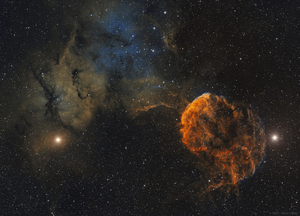
Behold: IC 443, aka The Jellyfish Nebula -n a galactic supernova remnant about 5000 light years from Earth. To wit:

…the expanding debris cloud from a massive star that exploded. Light from the explosion first reached planet Earth over 30,000 years ago. Like its cousin in astrophysical waters the Crab Nebula supernova remnant, the Jellyfish Nebula is known to harbor a neutron star, the remnant of the collapsed stellar core. An emission nebula cataloged as Sharpless 249 fills the field at the upper left. The Jellyfish Nebula is about 5,000 light-years away. At that distance, this image would be about 300 light-years across.

(Processing: Dave Milne)

apod


Two gigantic superbubbles – each one thousands of light years across – near the centre of spiral galaxy NGC 3079.

Hot? They’re so hot they emit X-rays that can be detected by NASA’s earth-orbiting Chandra X-ray Observatory. To wit:

Since the bubbles straddle the center of NGC 3079, a leading hypothesis is that they were somehow created by the interaction of the central supermassive black hole with surrounding gas. Alternatively, the superbubbles might have been created primarily by the energetic winds from many young and hot stars near that galaxy’s center. The only similar known phenomenon is the gamma-ray emitting Fermi bubbles emanating from the center of our Milky Way Galaxy, discovered 10 years ago in images taken by NASA’s Fermi satellite. Research into the nature of the NGC 3079 superbubbles will surely continue, as well as searches for high-energy superbubbles in other galaxies.

apod

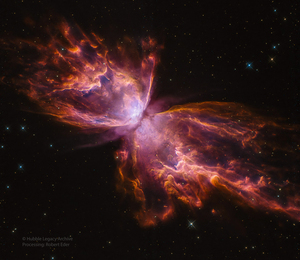
Behold: NGC 6302, also known as the ‘bug’ or ‘butterfly nebula’  – a vast planetary dust cloud with a dying central star 4,000 light years from Earth in the Scorpion Constellation. This enhancement is based on an especially sharp image recorded by the Hubble Space Telescope in 2009. to wit:

Cutting across a bright cavity of ionized gas, the dust torus surrounding the central star is near the center of this view, almost edge-on to the line-of-sight. Molecular hydrogen has been detected in the hot star’s dusty cosmic shroud.

(Pic: Robert Eder)

apod

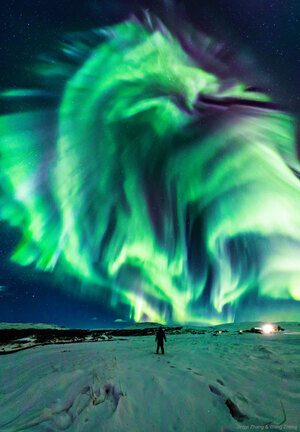
A spectacular manifestation of the Aurora Borealis this month in Iceland. The Medieval Vikings might have interpreted this as a sign from the gods. But no: science. To wit:

The aurora was caused by a hole in the Sun’s corona that expelled charged particles into a solar wind that followed a changing interplanetary magnetic field to Earth’s magnetosphere.

Still.

Sky Dragon!

(Pic: Zingyi & Wang Zang)

apod


A new animation from German educational design studio Kurzgesagt explains why. To wit:

Everybody feels lonely sometimes. But only few of us are aware how important this feeling was for our ancestors – and that our modern world can turn it into something that really hurts us. Why do we feel this way and what can we do about it?

Previously: Horrible, Horrible Mars

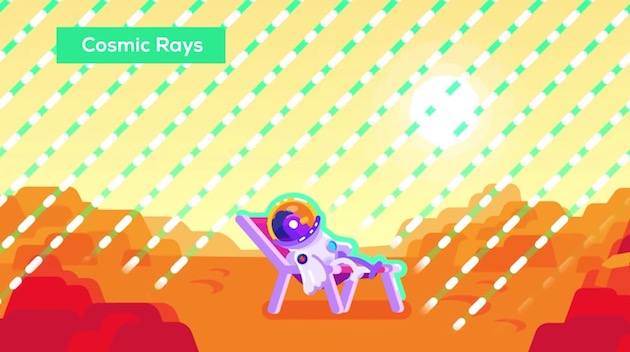
German educational design studio Kurzgesagt explores the many, many obstacles in the way of a functioning human base on the Red Planet. Lethal radiation, minimal energy sources, pesky dust clouds. Those kinds of things. To wit:

Humans love to explore. Strangely enough even horrible places – like Mars. Let’s see how building a Mars base could work and how insanely nerve-wracking exactly it would be.

Previously: In Fareness

An appulse is an apparent conjunction of two celestial bodies caused by perspective only – in this case, the Moon and (to its apparent left) Venus, viewed in the early morning from the darkness of a crater on the Hawaiian island of O’ahu by Alex Dzierba. To wit:

The Moon was in a crescent phase with its lower left reflecting direct sunlight, while the rest of the Moon is seen because of of Earthshine, sunlight first reflected from the Earth. Some leaves and branches of a foreground kiawe tree are seen in silhouette… Appulses involving the Moon typically occur several times a year: for example the Moon is expected to pass within 0.20 degrees of distant Saturn on March 1.

apod