
Founder of Claddagh Watch Arthur Carr, centre, with Claddagh Watch volunteers

This morning.

On RTÉ’s Today with Seán O’Rourke.

Arthur Carr, founder of Claddagh Watch, spoke to Mr O’Rourke.

Claddagh Watch is a group of volunteers who carry out night-time patrols on the bridges and waterways of Galway city with the intention of preventing accidents and deaths.

During their discussion, Mr Carr said that he and his colleagues found a suicidal young man by the River Corrib twice in one hour last Friday night.

The man had been tended to by gardai after the first incident.

Mr Carr explained that he and his colleagues went out to patrol the river at around 10.30pm on Friday night.

He said one of the members of Claddagh Watch had been approached by a relative of the man and told that the man had intended to take his life by entering the River Corrib, and that he had left a suicide note.

Not long after being told this information, Mr Carr said they found the man sitting on a 12-foot wall by the river and that he was in a “distressed and bad state”.

Mr Carr said the man attempted to jump into the river but the Claddagh Watch volunteers “manhandled him back to safety” and called 999.

Members of An Garda Síochána then took the man to be assessed, Mr Carr said.

However, Mr Carr couldn’t say who assessed him.

Within an hour, Mr Carr and his colleagues were tending to the man again by the River Corrib.

He explained:

“It is like a revolving door, really and truly. But her arrived back on the bridge, to our volunteers and again we had to engage with this person and we had to try and calm him down and we got him to a safe place.

“We got him actually into a hotel which is adjacent to the bridge, Jury’s Hotel there in Claddagh, and he still was not in any state to engage with a family member at the time and it took a bit of talking an persuasion for him to realise that what we were trying to get him to dosas far more beneficial than what he was trying to achieve for himself, which was to take his own life.

“And, eventually, we did make headway and he did engage with a family member and as far as we are aware, she brought him down to the psychiatric unit where he said he would be prepared to go in and get some help for himself.

“He then realised that he does need psychiatric help.

“Now, after that, we don’t know because for our own safety, we don’t get involved with people once we hand them over, we walk away. And we don’t engage with the person anymore unless they want to engage with us.”

Mr Carr added:

“When they’re brought away, they’re being assessed but they’re being put back out onto the street, more or less immediately after, because there is nowhere for them.”

Asked if it’s happened before where Claddagh Watch would encounter the same person twice in one night, Mr Carr said:

“It is fairly regular I have to say.”

“….when you have someone that has been taken down [from a bridge], if they have alcohol on them, the psychiatric services don’t want to know, if they have drugs on them, they psychiatric services don’t want to know.

“But, when you look at it, there’s probably 80 per cent of the people that present to us on the bridges, or on the waterways, have either drugs or alcohol or even both. And they are wiping their hands of them. They don’t want to know. 

“There is no care for them and it’s people, like us, that are directing them from entering the water and when we do that, the frustration is that it’s a high percentage that they’re going to be back and we’re going to have to deal with it again.

“And the whole cycle starts again. There is nowhere for them.”

“…like if somebody wants to jump 15 feet into a water that is running that quickly [17.5kph], they are not in a good place and the least they deserve is a chance to get back on their own two feet and they’re not going to do that by being put back out onto the street in their own care within an hour.”

Meanwhile…

Tonight, the NUIG Psychological Society is hosting a table quiz in aid of Claddagh Watch from 7.30pm at Massimo bar in Galway.

Claddagh Watch

Samaritans: 116 123

Pieta House: 01 6010 000

Aware: 1890 303 302

Previously: Watching Out

An Avoidable Death

Um.

Last night.

Dublin Rental Watch tweeted:

Last week I posted a studio for 3 at 156 Parnell St. for €1,450pm.

Today another studio at this location but each bed is €600pm, 2 singles & a double. Photos suggest non-compliance with minimum standards.

Previously: Dublin Rental Watch on Broadsheet

Meanwhile…

From Fine Gael’s election manifesto on what the party promises for renters…

“Fine Gael introduced the legislation to bring in a 4% annual cap on rent increases within designated Rent Pressure Zones (RPZs).

This legislation is due to expire in 2021.

To protect tenants from rental inflation, we will extend these provisions, if necessary.

In addition to the introduction of RPZs, Fine Gael has significantly improved tenant protections and is moving the Irish rental market towards the rental model found in other European states, with rent certainty and security, and longer leases.

Building on this, we will introduce legislation to provide for tenancies of long-term or indefinite duration, which will provide for much greater stability and security for tenants.

We will continue the Residential Tenancies Board (RTB) change programme, transforming it into an independent and strong regulator for tenants and landlords.

This will build on the powers introduced last year and new rent transparency measures to come later this year.

Encouraging landlords to provide long-term tenancies Fine Gael is committed to a
comprehensive review of the tax treatment of landlords.

This will ensure that smaller landlords, who provide most of the rental stock, are
not unfairly treated compared with larger, institutional landlords.

We will encourage landlords to provide long-term tenancies, offering greater
stability to renters.

We will develop cost rental for our cities and large towns. Fine Gael has
initiated two cost rental projects in Dublin.”

Hmm.

Fine Gael 2020 general election manifesto

Residents of Legan in Co Longford meet last Friday night after a fire destroyed a family home in the area

This morning.

Lisa McCormack, from Legan in Co Longford, writes:

“On Saturday, January 18, our community were left devastated after our neighbours’ home was left uninhabitable after a fire destroyed it.

This has left the Mazurek family – Mickola, Wiola, Patrizia, Mia and Philip – without their belongings as everything was damaged during the fire.

Fortunately they were not harmed in any way and it didn’t take long for the community of Legan to rally around and assist them in any way possible.

We held a community-based meeting with a massive attendance and all agreed that to help provide the basic necessities for the Mazureks, we would host a fundraising 5K walk in Legan to help raise as much funds as possible.

We invite our neighbouring communities, parishes, friends and family to attend this.

All proceeds will go directly to the Mazureks and will help them out as much as possible until they find their feet.

This fundraising event will take place on Sunday, February 16th at midday, meeting at Legan GAA grounds with the walk to follow.

Refreshments will be served and a raffle afterwards.

We ask all our friends and family to join us and show that our community spirit can make a positive impact and difference to alleviate the misfortune this family have endured.”

Thanks Lisa

So subtly rendered.

You’d never have guessed.

This morning.

Twitter has launched a General Election 2020 election emoji which  will be ‘triggered’ by the  hashtag #GE2020 and by the Irish language election hashtag; #Togh2020.

Twitter’s Ronan Costello says:

‘’The emoji is specific to the Irish electorate in design and, like many of the products we launch, is guided by how people are already using Twitter – the hashtags that activate it have been adopted by the community and are trending each day of the campaign.

‘’We want to help people to have healthy, open, and safe civic discussion on Twitter. make it easy for those on the service to engage with and follow the national conversation”.

FIGHT!


Yesterday.

The Dublin Cycling Campaign and their supporters held a “slow cycle” along the quays of the River Liffey “due to ongoing delays in developing the Liffey Cycle Route”.

They write:

The current official plans for the Liffey Cycle Route wouldn’t see the project implemented until 2024 at the earliest – that would be 13 years after the project was first proposed!

Liffey Cycle Protest (Dublin Cycling Campaign)

Pics: David A Karlström

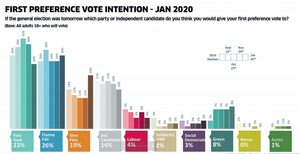
From top: Red C poll results in yesterday’s Sunday Business Post; Ireland Thinks poll results in yesterday’s Irish Mail on Sunday; newspaper panel on RTÉ’s Weekend on One;

Yesterday.

On RTÉ Radio One’s Weekend on One.

Brendan O’Connor was after speaking to the show’s newspaper panel about yesterday’s most recent general election poll results when he referred to a “narrative” of the election that “this country is not doing well”.

During the newspaper panel section, Mr O’Connor spoke to the former leader of Fine Gael and former chairman of IBRC, formerly Anglo Irish Bank, Alan Dukes; political scientist at UCC Theresa Reidy; political reporter at The Irish Times Jennifer Bray; director of the ESRI Alan Barrett and Anna Marie McHugh, of the National Ploughing Association.

During their conversation, Mr O’Connor referred to an article by Richard Colwell, the CEO of Red C Research, in yesterday’s Sunday Business Post entitled ‘Youthquake a possibility as younger voters flock to Sinn Féin’.

He then had the following exchange with Mr Barrett.

Alan Barrett: “Very often, it’s digging down into the poll is as interesting as the poll itself and just to distil a number of themes. I suppose, as an economist, it won’t surprise you that I sort of, you know, focus on the economics bit on this and let me explain what I’m thinking the following way.

“Do you remember the phrase ‘it’s the economy, stupid’? And this was a mantra I think a lot of political people thought was a pretty sound way of running elections. This is really, really interesting.

“Because what we have in Ireland at the moment is, we have and economy that’s doing extremely well and we also have a poll which is telling us that the people actually trust the governing party, in this case, Fine Gael, most on the economy.

“And I think, and I’m looking at Theresa [Reidy] now, as the political scientist, in most countries in the world, if you have those sorts of numbers. There’d be a very high probability that the governing party was going to be re-elected. But in Ireland, we’re in this situation now that it looks like this will not be the case…”

Brendan O’Connor: “A narrative has emerged here…”

Barrett: “It has…absolutely…”

O’Connor: “That this country is not doing well. And a lot of people in the country are not doing well and that’s been the narrative of this election.”

Barrett: “It has and obviously it’s getting traction, ok? But if you look at things like, you know, the standard things we look at, in terms of employment and wage growth – they, very, very often, those are really sort of the main drivers in this sort of situation.”

Later

Barrett: “Let me come back to what I was saying, for fear there was a misunderstanding. All I was saying is, across the globe, ok, it tends to be the case, when the economies are going well, governing parties get elected.”

O’Connor: “But that’s what I’m asking. What’s the disconnect here?”

Barrett: “Well, clearly, clearly we do have major challenges in the area of health and housing, there’s absolutely no doubt about that, the childcare issue I think has been…you know, I think we all understand it and we all know that these issues are in play and they’re very, very challenging.

“And clearly then the way, the narrative of the election is sort of unfolding is that people are attracted to the parties whom they feel over more hope in these areas and that’s a perfectly reasonable and understandable thing.”

Later

Alan Dukes: “First of all on the childcare issue, yes there are problems, yes there are problems of cost and availability. The fact remains…”

O’Connor: “It’s a problem of childcare, commuting and housing, it’s those three things coming together.”

Dukes: “Yes and when you look at the current state of provision and compare it with what was in 2011, for example, the improvement is huge. It’s certainly not at the point that suits everybody but the improvement is huge…”

Later

O’Connor: “Why have Fine Gael lost control of the narrative then? Why are they not able to get the narrative you’re just talking about there?”

Dukes: “Because I think…”

O’Connor: “Longer life expectancy, lots of good health outcomes, unemployment way down. Where has that got lost in all of this?”

Dukes: “Because I think there’s a natural tendency in all of us to take the progress that’s been made for granted and to want more.”

Listen back in full here

Gulp.

Saturday.

Summerhill, Dublin 1.

Seth McGuinness writes:

Here is a snapshot of what is regularly going on from the people living in the ‘apartments’ in Summerhill.

For years people have pleaded with Dublin City Councilcouncil to do something about it (after all they’re the council), but nothing has been done.

It is happening in broad daylight with no attempt to hide the activity.

As I’ve said, this is a snapshot, the level of on street dumping in the north of the city is astonishing and the place is turning into a slum.

People should be held to account.

Anyone?

Broadsheet.ie