
A rather adorable short by Max Mörtl and Robert Löbel in which we observe the fictitious denizens of an island as they undulate, vocalise and engage in charming rhythmical shenanigans though the course of their day.



A rather adorable short by Max Mörtl and Robert Löbel in which we observe the fictitious denizens of an island as they undulate, vocalise and engage in charming rhythmical shenanigans though the course of their day.


Ouch.
Seriously.
Aughrim street, Stoneybatter, Dublin 7, North Dublin City (Daft)
Earlier: Modern Living
Thanks DD


This afternoon.
Government buildings, Dublin 2
Josepha Madigan, Minister for Culture, Heritage and the Gaeltacht officially announcing five new Cultural Ambassadors under the Government’s Global Ireland 2025 program.
They are, top from left; architect Shelley McNamara, actress Ruth Negga, fiddler Martin Hayes, Mrs Madigan and architect Yvonne Farrell.
Earlier: Herself

Petrified.
A new episode of the HORROR drama podcast from Peter Dunne and Liam Geraghty.
Aaaaahhhh!
Liam writes:
A writer investigating a woman’s death is given a bag of cassette tapes belonging to the deceased which contain terrifying recordings.
Starring Michelle McMahon, David Fennelly and Donncha O’Dea.
Easily-spooked listener discretion advised.

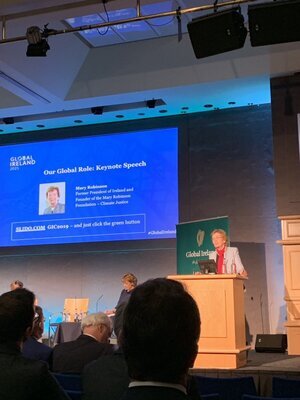
Former Irish President Mary Robinson at the #GlobalIreland conference: the 3 issues facing humanity today:
1) climate change 2) stalled nuclear disarmament 3) fading support for multilateralism #GIC2019 pic.twitter.com/DpKW6DIOGv— Pascal Koenig (@PKoenig1776) January 7, 2019
Ah Hoya here.
This afternoon.
Mary Robinson, fresh from her Dubai rescue mission, addresses The ‘Global Ireland 2025: Making it Happen’ conference.
Dublin Castle, Dublin 2.
The climate really has changed, amirite?
Robinson ‘had nothing to do’ with press ban on her speech (Independent.ie)


Wistman’s Wood – a forest of lichenated dwarf oak trees on the eastern slopes of the West Dart River in southern Devon.
Described as ‘the most haunted place on Dartmoor’ and captured above in all its mystical gloom by Neil Burnell.

Starting tonight!
Across the capital.
All things bright and David.
Eugene Connolly writes:
Dublin Bowie Festival’19 kicks off this evening [until the 13th] at The National Concert Hall [Dublin 2] with a World Premiere of Bowie’s debut album Space Oddity (& other somgs from the Bowie universe), performed by I Heart Bowie in association with The Trinity Orchestra & various well known guest vocalists. This event is sold out but there are 31 further events to choose from throughout the week (at link below).

 From top: Taoiseach Leo Varadkar TD speaking to the media outside Government Buildings after the first cabinet meeting of 2019 last week; Bryan Wall
The comments made by Leo Varadkar before Christmas were not a mistake made by some gaffe-prone politician. As I wrote previously, he says what he means and he believes what he says.
He is a neo-liberal stalwart whose policies could have been taken directly out of the works of countless neo-liberal ideologues posing as objective economists. For him, the poor are of no concern. Neither are those soon to lose their home to rapacious landlords, banks, or vulture funds.
The slow degeneration of our basic services continues whilst he looks on, occasionally making a comment that is copied and pasted by the mainstream media. A deeper analysis is lacking given the common understanding that one is not meant to question the government, especially its leader.
Consent in this regard is manufactured as to try to parse any of the statements made by Varadkar is to go beyond the acceptable limits of discourse.
What do we find when we place his comments into their rightful context, however?
Perhaps the most potent tactic that capitalism has developed over the previous two centuries has been its uncanny ability to isolate people from each other.
A divide et impera of the general population has been effective in pre-empting dissent for the most part. Division of labour was concomitant with a social and political division. The former could not function without the latter.
One of the best ways to do this is to not only turn people into willing consumers, both materially and ideologically, but is to turn them against each other.
The poor are played up as leeches on the system who contribute nothing whilst the “squeezed middle” toils in order to provide for those who neither appreciate or deserve what they receive from them.
Thusly isolated, the poor can be ignored or removed from sight completely depending on which is more conducive to political success.
Take the government’s initiative on clamping down on welfare fraud that was launched with great publicity in 2017. On the surface it was portrayed simply as a morally upright idea that would also result in the state saving money.
In total, according to The Irish Times, welfare fraud amounted to €38.4 million in 2017. Given that the social protection budget in 2017 came to €19.9 billion – €6.3 billion of which was to service the national debt – €38.4 million is a minuscule number.
Add to this the fact that it was mostly the result of mistakes made by the Department of Welfare itself and we have a non-issue that was given the appearance of systematic fraud in order to make it an issue.
We might ask, for what reason? An answer is obvious given who the government is and who leads it.
To isolate and denigrate those considered as not worthy of care or attention is a common feature of our societies. They can be utilised to shore-up government support in the sense that they are convenient scapegoats for whatever issue is decided upon. In 2017 it was welfare fraud.
Social protections can be made more difficult to access and in some cases cut back given their “generous” nature and those who take unfair advantage of them by committing fraud.
With those dependent on social welfare out of the way the government can focus on supporting and giving back to its own political patrons. This is the real business of government.
Accordingly, when something is said by the government or Leo Varadkar it is to be assumed truthful. So, when the latter claims that we have turned a corner on homelessness and housing it is to be accepted without debate. To question such a statement is deemed uncouth.
But it is nonetheless a signifier in political discourse and how wider society is to be dealt with: What I say is the truth. To deny its truthfulness is to deny reality. And after all, those who deny reality are obviously insane and can therefore be ignored.
So in their proper context, his comments about turning a corner are meant to do nothing more then isolate, and subtly denigrate, those who continue to see homelessness and housing as issues.
And given that they are the major issues of our time, they must be downplayed, ignored, or deflected in whatever manner possible. If this entails the Taoiseach telling journalists that the issue is in the process of being solved, alongside pushing faulty statistics regarding house construction, so be it.
Public relations — or more appropriately, propaganda — does not come cheap. The Taoiseach’s spending in this sense is not unique. Over one million euro being spent by the Taoiseach’s propaganda wing is indicative of his need for a mechanism by which to influence others via traditional and social media.
From here the message is parlayed that everything is on the up and up. What happens when this message is challenged? Denigration mixed with hysteria is another tool in the arsenal of the powerful.
When Pearse Doherty made comments referring to the violence inflicted on the family in Roscommon before Christmas by a mercenary force hired by KBC Bank to evict them, Varadkar was unmoved. Instead, he went on the offensive, telling Doherty that “it doesn’t take long for your balaclava to slip.”
For the Taoiseach, defending one’s self against state-sanctioned violence is beyond the pale. Of course this is unsurprising, but it is nonetheless informative to see such comments made publicly.
Again, it seeks to isolate those who are victims of state-violence, be it structural or physical, in order to better ensure that the market orthodoxy can reign accordingly. In our case it means making sure that the cries of those under the boot of market discipline are cast aside. This is a must if the continuing shock therapy of the country is to proceed as planned.
Isolation is a form of torture. In prisons the hugely negative effects – both mental and physical – of solitary confinement on a person are well-known. Perhaps for this very reason its use continues to be sanctioned. In our own country we are seeing isolation on a mass scale. It has been generalised to the wider population.
When Leo Varadkar insists that things are getting better or that we have turned a corner, he is enforcing isolation on wide swathes of the population.
The poor, the homeless, the mentally ill, and the sick are all isolated from each other, from those who are happy with the domination of the two-party status quo, and from those occupying higher rungs on the socioeconomic ladder. This is not an accident.
How can this be anything but a form of torture? Shock, isolate, and denigrate. These are the policies of the government and its leader that are directed at people who are not commensurate with the needs of the state and its backers.
Any resistance to this can be met with the necessary violence. People sometimes must be reminded of their place in the system.
For a lot of us in Ireland in 2019, our position puts us in a situation where rents are unaffordable, homelessness is rampant and a very real possibility for many, and the healthcare system is collapsing on its way to full privatisation. Combating the immiseration of an entire country is not a simple undertaking.
On the other hand, we have nothing to lose but our chains.
Bryan Wall is an independent journalist based in Cork. His column appears here every Monday. Read more of his work here


