


MORE to folly



MORE to folly



Yikes,
Tonight.
Dawson Street, Dublin 2
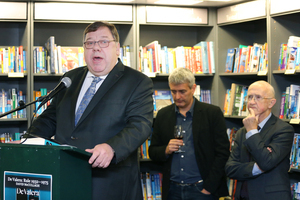
Former Taoiseach and Fianna Fáil leader Brian Cowen launching RTÉ journalist David McCullagh’s new book ‘De Valera: Rule 1931 -1975’ at Hodges Figgis.
As he is perfectly entitled to do.
FIGHT!
Sasko Lazarov/Photocall Ireland


This afternoon.
Helix Theatre, Dublin City University.
Edward Snowden , US National Security Agency (NSA) whistleblower and increasingly worried Russia-based computer security consultant speaking at the EU Cyber Summit via video.

Yesterday’s Fine Gael photo opportunity to support Michael D Higgins’ re-election in Grafton Street, Dublin 2 close to where the homeless are served soup and tea
This is the most perverse ‘photo-op’ @campaignforleo @MurphyEoghan and @ReginaDo have ever done. It’s disgusting! They’ll pour tea for votes for @MichaelDHiggins but not the homeless! The homeless depend on volunteers for their tea. Ill-conceived or sadistic? #RaiseTheRoof pic.twitter.com/SBoDH7sVo0
— Dublin Rental Investigator (@RentalProperty8) October 24, 2018
Yesterday: Cosy

Called on the UK Government to uphold its commitment to introduce an Irish Language Act if power-sharing institutions are not restored within six months.
I understand this is the first time the Irish language has been spoken in the @HouseofCommons chamber.#NorthernIrelandBill pic.twitter.com/dlcEnaCR8Q
— Liz Saville Roberts AS/MP (@LSRPlaid) October 24, 2018
This morning/afternoon.
Irish Language was spoken apparently for first time in the UK House of Commons as Plaid Cymru MP Liz Saville-Roberts asked the Northern Ireland Secretary of State Karen Bradley:
“Is cearta daonna iad cearta teanga agus tá cothrom na féinne tuilte ag lucht labhartha na Gaeilge (Language rights are human rights and the Irish speaking community are entitled to equality)
Under the St Andrews Agreement of 2006 the British government pledged to introduce an ‘Irish Language Act based on the experiences of Wales and the Republic of Ireland’.
Will the Minister uphold its commitment by introducing an Irish Language Act if power-sharing institutions are not restored within six months?”
Dr Niall Comer, President of Irish language campaigners Conradh na Gaeilge, who lobbied Ms Saville Roberts, says
“We wish to thank those MPs who have listened to our community, and especially those who are prepared to act and speak in favour of equality, respect and language rights, in particular Plaid Cymru MP Liz Saville-Roberts who historically addressed the House of Commons as Gaeilge today as part of her questions on the Irish language Act, following engagements with Conradh na Gaeilge. All we are asking is to be brought into line with the other indigenous language communities on these islands.”
Updataï:
Thomas O’Donnell did it in 1901, you may be a close second 117 years later though 😁
— Richard McC (@ric_mcc) October 24, 2018
Oh.


‘sup?
This afternoon.
Glasnevin, Dublin 9
Just some of the hundreds of transformed pumpkins currently exhibiting at the Botanic Gardens until Halloween.
In fairness.


From top: Mick Clifford; Frances Fitzgerald writing in the latest Sunday Independent and The Last Stand podcast
Irish Examiner journalist Mick Clifford appeared on Eamon Dunphy’s podcast The Stand to discuss the media’s response to the publication of the Charelton Report.
In particular the ‘vindication’ of Frances Fitzgerald.
Eamon Dunphy: “Mick, I listened to The Marian Finucane Show on Sunday, which hundreds of thousands of people listen to every Sunday, it is broadcast by RTÉ , the national broadcaster, funded by the public and last Sunday it was said by Marian Finucane repeatedly that Frances Fitzgerald, the former Minister for Justice, who had to resign over this business, had been ‘completely vindicated’ by the Charelton Tribunal…
…A wrong in other words had been done to Frances Fitzgerald. Now this wasn’t a throwaway comment. The Finucane Show spent at least twenty minutes on this and it was in the light of what i read in the report, outrageous….I have read the report, you have read and written about it. The report does not completely vindicate Frances Fitzgerald, does it?”
Mick Clifford: “…I heard that show and I was quite taken aback by it… now it has to be said that a certain amount of discussion was around a piece by Frances Fitzgerald penned herself for the Sunday Independent, but let’s put things in context.
Frances Fitzgerald did not and I never for a second suggested it and as far as I know the vast majority of anybody who had anything to do with this story suggest that she had in any way a nefarious motive toward Maurice McCabe, that she in any way set out to do him ill, that she was in any way aligning herself to anyone who was trying to smear him. That was never suggested.
Now, a couple of politicians brought that up in the Oireachtas. They may have issues there on whether they should apologise or not, but ultimately that was not the reason that she was forced to resign and the impression that is put out there is that everything that preceded it is suddenly washed clean by the Charelton Report and, quite frankly, that is not the case.
…Frances Fitzgerald was minister when the O’Higgins Commission was on. At the beginning of that commission, a row blew up. The solicitor for the senior Gardai described it as ‘political dynamite’.
It effectively involved an attack or challenge to Maurice McCabe’s motivation and credibility. They all realised this was a big deal because in public the Minister and the Commissioner had been praising Sgt MCCabe yet in private his motivation and credibility was going to be attacked.
Now, the bare bones of that was communicated to the Minister. There was a lot of communication with the Department [of Justice], with the Attorney General’s office, with the Gardai but the bare bones of it was communicated to the Minister. She was aware of that.
Now, Charelton did say there was no way she could have remembered it However, a couple of months later, RTÉ’s John Burke put in questions in relation to it and there was suggestion conveyed through the Department that he was questioning why an aggressive stance was taken against McCabe.
Now, the Minister was going on radio and she was told you can say Sgt McCabe has the full confidence of yourself and the commissioner yet being told that was not necessarily the case in terms of what was going on behind closed doors. So she had an awareness there
Roll on to May 2016, when the O’Higgins report was published and when the Examiner broke the story that this row occurred. She appeared on Prime Time and she answered questions in the Dáil.
Nowhere at that point did she convey the reality that she had been aware something had gone on. She gave the impression that this was the first she had heard of anything. And subsequently Leo Varadkar, on her behalf, said that in the Dáil.
So we go forward to November/December 2017 when this blows up (again). Alan Kelly, presumably on the basis of information he received, started submitting questions to the department of Justice and what occurred then was a drip feed,.
He didn’t get the answers he required, he put in more questions, it spread into the Dáil, Micheál Martin took up the cudgels and he started asking questions and it became effectively a runaway train. That is the nature of politics. What happened thereafter was political.
Then it emerged these emails that showed she had been informed back then and she had knowledge of it. Nobody was suggesting she was out to get McCabe. What it became was it showed she knew about these issues and she had said nothing and it effectively had to be dragged out of her.”
Previously: Charelton Report on Broadsheet


Jobstown trial aftermath in June 2017; media analyst Niamh Kirk
Yesterday.
In the Dublin Inquirer.
Media analyst, PhD researcher and educator Niamh Kirk, wrote:
Legal minds are looking at what the future might bring for Irish citizen media, at reshaping the law in a way that might support, but also complicate, reporting by citizen journalists.
Central to this is the issue of who should be able to rely on the defence of absolute privilege in court reporting.
A recent Law Reform Commission issue paper highlights problems around who current defamation laws serve.
….Currently, the law is that journalists and citizens covering courts have an absolute defence from defamation actions, provided what they published was a “fair and accurate report of proceedings”. It applies to any platform, from an established news website to Twitter.
A report can be anything from a few words or a summary to a detailed account. It applies to anyone publicly discussing an ongoing trial in Ireland, Northern Ireland and certain international courts. However, this may change.
The commission has been collecting views on whether the “fair and accurate” absolute privilege should remain a defence for both professional journalists and citizen journalists such as social-media users and bloggers.
…It hasn’t made recommendations, yet. It’s looking at options.
But it raises the possibility that some citizen media may be able to rely on privileges, while others might not.
Who then, aside from professional journalists, might count as “prescribed persons”?
Read in full: How Should Courts Handle the Rise of Citizen Journalists? (Niamh Kirk, Dublin Inquirer)
Previously: Hacks Have No Agenda


