Yikes.

Pilots union tells Ryanair that strike notice stands (RTE)

Previously: The Scratchcard Revolt

Please Assume The Bracing Position

Rollingnews

Lidl’s ‘controversial’ water-hogging bathing pool.

Sold out within MINUTES.

Water FIGHT!

Tuesday: Everyone Stay Pool

President of the Epidemiology and Public Health section of the Royal Society of Medicine Dr Gabriel Scally who is carrying out a scoping inquiry into the CervicalCheck scandal

The Health Service Executive has confirmed that the number of women affected by the CervicalCheck controversy has increased from 209 to 221.

HSE Director General John Conaghan told the Public Accounts Committee, in response to questions from Labour’s Alan Kelly, that a further 12 cases have been identified.

Mr Conaghan said that so far three cases have been settled, 35 are active and there are two potential cases.

In relation to the review of 3,000 smear tests which has yet to begin, Mr Kelly said it will be impossible for the Scally Review to be completed by the end of August….

Number of women affected in smear test scandal rises to 221 (RTÉ)

Meanwhile…

Social Democrats co-leader Róisín Shortall TD accused the HSE of “deliberately delaying” the release of the slides for review by independent cytologists by holding up a crucial protocol for their release.

Ms Shorthall said:

“The lack of urgency being shown by the HSE in allowing women to get access to their smear tests is incredibly alarming.

The only conclusion that we can draw at this stage is that the HSE is deliberately foot-dragging on this issue to impede women’s efforts to seek legal redress.

…I am also increasingly concerned that the scoping inquiry headed by Dr Gabriel Scally is being frustrated by its lack of access to the lab data it needs to fulfil its important mandate.

Dr Scally’s inquiry has already faced difficulties in getting documentation in searchable formats.

The data on the accuracy rates of screening by individual labs is the key information needed.

Why is there a delay in making this available to Dr Scally? The Minister must step in to ensure there is no further delay in releasing this information.”

Meanwhile…

Meanwhile…

This morning.

On Today with Sean O’Rourke, presented by Miriam O’Callaghan, Vicky Phelan was asked for her reaction to Fergal Bowers’ report that not even one of the 3,000 cervical smear slides being reviewed have been looked at yet.

Ms Phelan said:

“Justine McCarthy actually wrote about this in The Sunday Times – it was actually a couple of weeks ago, on the 17th of June. Because she had been in touch with me beforehand, before she published it, to see if I had heard anything different.

“So, you know, she had highlighted this back then and she had got the statement from the college of gynaecologists [Royal College of Obstetricians and Gynaecologists] who confirmed that the review wouldn’t be completed until later in the year.

“So I’m not sure why that wasn’t highlighted at the time, you know, a couple of weeks ago that it’s only kind of coming to the attention of the HSE today. I’m a bit surprised to be honest.”

Review of cancer labs’ tests ordered by Simon Harris has yet to begin (Justine McCarthy, The Sunday Times, June 17, 2018)

Rollingnews

Denis O’Brien; The Story So Far broadcast last night on RTÉ One

Last night.

Twitter reaction to RTÊ documentary, Denis O’Brien: The Story So Far.

Yesterday: Your Last Malta Teaser

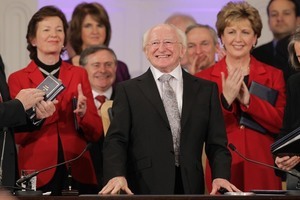
From top: President Michael D. Higgins during the Presidential Inauguration ceremony at Dublin Castle on November 11, 2011 with former Presidents’ Mary Robinson( (left),  Mary McAleese (right) and Leo Varadkar (back far right); Dan Boyle

If a public election is to take place this year for the position of President, it will only be the eighth such election in the eighty year history of the office.

Of our nine Presidents to date three have been appointed without public election. One of those, Patrick Hillery, secured a second term of office without having to undergo public examination.

Two other Presidents, Séan T. O’Kelly and Mary McAleese, rolled over into second terms after securing their first terms through public election.

Only the polarising figure of Éamon de Valera has had to endure public elections to secure his first and second terms of office. His second election was a very tight squeeze, with De Valera winning by a tiny margin of 10000 votes, less than 1% of those who voted.

De Valera was 76 years of age when he first put himself forward for the position of President, a year younger than our current President is now. Of all the inhibiting factors that would question a presidential candidacy, age should be the least of them.

Michael D. Higgins, should he, as appears likely, seek a second term, would face greater criticism for going back on a promise made during the 2011 campaign not to seek re-election if elected.

There should be little concern about this if a public election takes place. The electorate then gets to decide if our President is fit, able and suitable when compared to another candidate of experience and ability.

A public election is best mechanism to achieve this. However, in the absence of alternative candidates who might be seen to do the job as well, there should not be an election for the mere sake of it.

But there should be an election. The need is to encourage a credible candidate to bring such an election about.

I was involved in a similar circumstance in 2004. Mary McAleese would have easily secured re-election had an election had transpired then. Fianna Fáil and Fine Gael had no appetite for an election. Neither had then Labour leader, Pat Rabbitte, who slapped down Michael D Higgins’ attempts to then to be a candidate.

Into the gap came Eamon Ryan. I became his campaign manager of sorts. There was never any belief that his candidacy would see him end up in the Áras. What was hoped for was an ability to influence a national debate while accruing a creditable vote.

Two factors worked against Eamon then. The first was an interview with Marian Finucane where he candidly admitted he had smoked cannabis, an admission that nowadays wouldn’t cause a ripple.

The second factor was uncertainty Eamon felt that he may not have had the united support of his party, without which a campaign may have floundered. Ironically gaining the required 20 Oireachtas signatures had proceeded more easily and would have been achieved.

And so a Presidential election did not take place in 2004. In 2018 those who have identified themselves as being President electable, are far from that. Would that someone would appear from the outgrowth and provide us with the choice we need.

I’m still likely to vote for Michael D though.

Dan Boyle is a former Green Party TD and Senator. His column appears here every Thursday. Follow Dan on Twitter: @sendboyle

Rollingnews

Tonight.

At 9.35pm, on RTÉ One.

RTÉ’s business editor David Murphy presents a documentary profiling troubled tycoon and Malta resident, Denis O’Brien.

*popcorn*


Broadsheet.ie
