

Take it away, easy listening guys.



Take it away, easy listening guys.

Further to the ongoing CervicalCheck scandal.
Dr Primum Non Nocere writes:
I wanted to add my thoughts on the CervicalCheck scandal from the perspective of a doctor working outside of Ireland.
Without wishing to state the obvious I think that the handing of the cervical cancer audit is very poor by both CervicalCheck and the Government. The Government is doing damage limitation but I’m not sure they really understand the following:
Medicine is inexact. Smear tests are a screening programme. There will be misses.
CervicalCheck are at fault for the following reasons.
Fault 1: They should have told women there was a miss rate. Informed consent is important. Also, knowledge of the miss rate is a crucial part of the cervical cancer prevention process.
Knowledge of the miss rate stops women from ignoring symptoms in the belief that nothing can be wrong as their last smear test raised no issues. It also gives women the option of opting for more frequent smear tests, free elective colposcopy or HPV testing as a back-up.
Fault 2: In addition to informing women that there was a miss rate, Cervical Check should have been able to provide these women with an accurate miss rate.The CervicalCheck website currently states:
“A cervical screening test is not a diagnostic test. As with all screening tests, cervical screening may not always be 100% accurate. There is a small risk that cell changes will not be picked up in a test. However, any cell changes will usually be picked up in future tests. This is why it is important to have regular cervical screening tests.”
This doesn’t cut it in terms of information which should be provided to women. The words “usually be picked up” do not reflect the normal miss rate for cervical smear tests worldwide, which is significantly higher than this. No wonder these women weren’t concerned.
Fault 3: CervicalCheck wasn’t honest. If they were going to do an audit, they should have decided in advance what they would do with the outcome.
If they didn’t know, they could have looked to their colleagues in the United Kingdom. When an audit into cervical screening practices in Leicestershire disclosed that fourteen patients had died after missed smear tests, the NHS held a press conference, and published the results. Publication of cervical smear test audits disclosing false negative smears is standard practice in the UK.
Not every country can afford yearly screening, HPV testing or free elective coloscopies. It is a cost-benefit issue.
However informing women that medical tests are not infallible, that there is a miss rate for smear tests and providing them with an accurate miss rate prevents them from disregarding symptoms and gives them the information that they need in order to decide whether they should voluntarily opt for additional testing.
It is a crucial part of the screening process and its goal of saving lives.
Dr Primum Non Nocere is a doctor qualified in Ireland, currently practising abroad.
Yesterday: When Sorry Rings Hollow


From top: Together For Yes campaigners outside the Bang Bang Café; Eamonn Murray and Anne Phelan
This morning.
Phibsborough, Dublin 7.
#knittersforrepeal writes:
Maser’s Repeal is on its way back into Temple Bar this afternoon and this time it won’t be painted over because Local T4Y campaigner, Anne Phelan, has only gone and knitted it!
Hanging on ‘knitting needles’ fashioned from broom handles (carved by another Phibsborough local, master craftsman, Eamonn Murray) a group of local T4Y supporters gathered this morning outside Bang Bang Café for its ‘unveiling’ before being transported to its new home.
In fairness
Previously: Monday Morning Coming Down

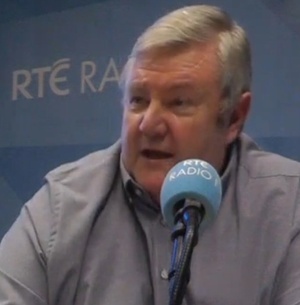
From top: Pro-life campaigner Maria Steen and Solidarity–People Before Profit TD Brid Smith on last night’s Claire Byrne Live; Derek Mooney
On the morning after the night before’s hyped-up 8thRef Claire Byrne debate: committed Yes campaigners are insisting that the Yes side won it while staunch No activists are declaring with equal ferocity that their side prevailed.
In my own view, neither side significantly moved the dial among undecided voters with the real loser in the whole sorry mess being public sector broadcasting.
This was not the fault of the presenter/moderator Claire Byrne or any of the lead speakers for the Yes or No sides, but of the folk in RTÉ who decided that having daytime TV style confrontation in front of a cheering crowd was the best way to discuss a fraught, complex and emotionally charged issue.
What was needed was a calm, respectful and reflective discussion, in its place we got a he said/she said wall of noise. It needed Jeremy Vine, we got Jeremy Kyle.
All that was missing to make the Jerry Springer Show effect complete were lurid chyrons running across the bottom of the screen screaming the titles of upcoming shows: I get turned on by number 1s, but not number 2s or Spoiler Alert: they’re topping the poll.
OK, I exaggerate, though the Brid Smith versus Maria Steen encounter, complete with audience boos and hisses, did make me wonder if Steve Wilkos and a team of black t-shirted security staff were waiting just off camera.
So, what was the problem with the format? It was the audience. Not any one individual or even a group of individuals, but rather the constant and incessant cheering and clapping for speakers on their side and the hectoring of those on the other.
No doubt, each side will claim that the other one went further in heckling or shouting down the other, but that doesn’t matter.
The question is why the debate was formatted and structured in such a way as to allow them to do it. Actually, if I was really bad minded, I might even wonder if is was structured in such a way as to encourage it?
Think back to any of the US presidential debates of the last decade or so. In each of them, the moderator has opened proceedings by setting out the debate rules, as decided by the US agency that arranges the debates: The Commission on Presidential Debates.
The host then explains that the audience must remain absolutely silent for the duration of the debate, with the exception of welcoming both candidates out on to the stage, so that people at home can focus on what the candidates are saying.
Opening the second presidential debate of the 2012 campaign between President Obama and Mitt Romney, the moderator CNN’s Candy Crowley, announced:
“The audience here in the hall has agreed to be polite and attentive — no cheering or booing or outbursts of any sort.”
The format of this debate was what American broadcasters call a town hall. There ordinary voters ask their questions of the candidates directly, but that audience is made up of uncommitted voters chosen by independent pollsters.
Much of last night’s audience were chosen by the two campaigns. Both of whom seemed more interested in getting as many loud and vocal people there as possible.
I know that I am at risk of sounding po-faced, or even hypocritical. I have not been averse, in the past, of doing a bit of fairly boisterous heckling at political discussions – not all of them involving other parties.
Like many politicos of my vintage this also included a few stints in the audience of the grand old dame of Irish TV political debates Questions and Answers.
There I would attempt my faltering impression of an innocent member of the public. It was unconvincing. Indeed, the only thing worse was my dire impression of an electable politician, but we live and learn.
I know that political shows can be boring or tedious and need a bit of showbiz and spectacle from time to time. I realise that listening to a procession of TDs and Senators drone on can be a ratings killer. But going the opposite way is not the answer.
The secret is knowing when the time is right and how far to go. Last night was an example of getting the mix wrong – and it is not the first time.
We saw the same format deployed to equally unsatisfactory effect almost seven years ago in the 2011 presidential election debates – though that night had the added frisson of dodgy tweets.
Surely the only lesson they learned in the intervening time cannot just be: don’t read out the Tweets?
While we do not need to go as far as setting up a dedicated quango dealing with debates, be they presidential, Dáil or referendum along the lines of U.S. Commission on Presidential Debates, the decision on formats should not rest with the broadcasters alone.
There should be a role for an independent electoral commission, charged with overseeing our electoral process.To be fair, this government is looking at setting up such a commission.
The 2016 Programme for Government states:
A) Establishing an Electoral Commission
We believe that Ireland needs an independent electoral commission, as a matter of priority.
The new commission should examine the voter registration process and in particular the possibility of the PPS system being used to automatically add people to the electoral register once they reach voting age.
It should also look at ways to increase participation in our political process through voter education and turnout.
The new commission could also:
Assume the role of Registrar of political parties
Regulate political funding and election expenditure
Oversee the Referendum Commission, which would be a sub-section of the commission
The newly established Electoral Commission would be independent of Government and directly accountable to the Oireachtas.
As with many things the promise is there, it’s the action that is missing. The last time the electoral commission issue was raised with Taoiseach in the Dáil appears to have been back in October 2017.
Back then he said:
“There is no timeframe for it. It is very much a long-term project.”
Given that this government’s remaining time in office can be best measured in months, not years, we see that 2011 and 2016’s “priority” is today’s: “Meh, we may get around to it.”
To be fair, in the hierarchy of this Government’s broken promises this one does come a fair bit down the list, but that does not excuse its lethargy.
With a little bit of political will and Dáil time the legislation could be processed speedily. A nascent Electoral Commission could be in place for a presidential election later this year.
Much of the preparatory work has already been done. The various reports, consultation and scoping documents are already there. I understand that the Department of Environment has been preparing a Regulatory Impact Analysis for a draft Bill.
The aims and intentions of James Lawless’s Online Advertising And Transperancy Bill could be rolled into it too, so that electoral fairness is not depending on the largesse of the IT giants.
So, what’s the delay? Must we wait for Russian interference to finally act?
Derek Mooney is a communications and public affairs consultant. He previously served as a Ministerial Adviser to the Fianna Fáil-led government 2004 – 2010. His column appears here every Tuesday Follow Derek on Twitter: @dsmooney
Watch Claire Byrne Live here
Top pics: RTÉ

#DisclosuresTribunal Charleton says the matters he’s examining are “deadly serious” and he expects people to be “absolutely straight” with him.
— broadsheet_ie (@broadsheet_ie) May 15, 2018
This morning.
Dublin Castle, Dublin 2
The Disclosures Tribunal has resumed with further evidence being taken from former Garda press officer Dave Taylor (top) into his role in the alleged smearing of whistleblower Sgt Maurice McCabe.
Specifically his contacts with journalists.
Olga Cronin is live tweeting from the castle here.
More to follow.
Rollingnews


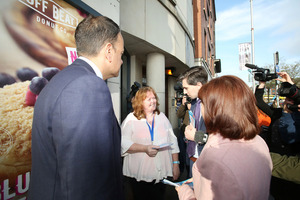

This morning.
Dublin 2.
Taoiseach Leo Varadkar and cabinet colleagues gathered outside Tara Street Dart Station before taking a walk through the city towards Government Buildings to canvas for a Yes vote in the referendum on the Eighth Amendment on May 25
Pic 3, from left: Minister for European Affairs Helen McEntee, Leo Varadkar , Senator Ctaherine Noone, Minister for Health Simon Harris , Minister for Finance Paschal Donohoe and Minister for Education Richard Bruton.
Sam Boal/RollingNews

Over 15,500 human remains incinerated to heat UK hospitals over 2-year-period. http://t.co/h2eA6NjVB3 #800babies #outrage @amnesty
— Cora Sherlock (@CoraSherlock) June 7, 2014
Renewable Energy: Cora Sherlock’s Excellent Suggestion
We must stop giving it away for nothing
– our greatest natural resource –
the Department of Finance estimates
Tallaght Hospital could heat itself
entirely on foetuses properly burnt
in one of those state of the art
energy efficient furnaces that are
all the rage in Sweden.
Within the lifetime of this government
every hospital in the country could be fuelled
by the unwanted contents of visiting wombs.
The minority of cranks aside,
the average foetus would be delighted
to make this small contribution towards
society’s continued warmth.
And when the ban on contraceptive devices
is re-introduced; every last diaphragm,
IUD, cock-ring, and bit of rubber
ribbed for your pleasure incinerated
in a field outside Ballinspittle,
after a blessing by Mother Teresa,
(specially flown in from
the black beyond)
and the conception rate soars
back towards
the traditional twelve
pregnancies per lifetime, two thirds,
we estimate, resulting in terminations,
we can start talking
about the export market.
Economists say the uteruses
of the greater Dublin area alone
could light the living rooms
of a medium sized British city,
such as Bradford.
Education is key.
To get the lady parts of the country
conceiving as they’ll have to,
every pubescent girl,
on her fifteenth birthday,
will be shown her way around
the first twenty pages of the Kama Sutra
by a fully qualified curate
under the age of seventy.
This policy’s success
will abolish talk of deficits
and oil prices. Instead,
we’ll debate furiously
whether to blow our vast surplus
on a few thousand more
unemployed tin whistle players
with the hint of an English accent,
or free nose jobs and tummy tucks
for the wives of the wealthy—the biggest
plastic surgery project in world history
since NASA’s unsuccessful attempt
to build another Joan Rivers.
Kevin Higgins
Rollingnews

Ireland have been eliminated in bizarre, controversial fashion at the U17 Euros after goalkeeper Jimmy Corcoran was shown a second yellow card for moving off his line too early during the penalty shootout https://t.co/O48xsGehPh pic.twitter.com/yroYmS84ca
— RTÉ Soccer (@RTEsoccer) May 14, 2018
Last night.
Chesterfield, England.
Ireland cruelly eliminated from the final eight of the U17 Euros.
Tom Dillon writes:
Unreal shenanigans…absolute bull crap.
Meanwhile…
Is the Dutch keeper Koorevaar off his line when he saves from Adam Idah? 🤔 pic.twitter.com/LtfTBBT4dm
— RTÉ Soccer (@RTEsoccer) May 14, 2018
Ah here.


