




The Swedes are becoming more like the Irish rather than the other way around, argues Michael Taft (above)
I was at a meeting a few days ago where a torrent of good news on the equality front was expressed; in particular, how Irish equality is reaching Swedish levels (some friends have also told me this is an increasing theme among some journalists and commentators).
Sweden, of course, is the popular benchmark for equality. So if Ireland is reaching those levels, surely we must be doing something positive on the egalitarian front?
Or are we looking at data without context, without reference to what we are measuring? We may be in a stat duel with calculators at dawn. So what is the story behind this data?
Income Inequality
In 2016, the ratio of the top 20 percent to the bottom 20 percent was 4.5 for Ireland and 4.3 for Sweden. In other words, the top 20 percent received 4.5 and 4.3 times the bottom 20 percent, respectively. That comparison looks pretty good. However, if we graph it historically a different story emerges.
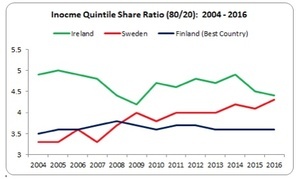
In 2004 Ireland was considerably more unequal than Sweden. By 2016, the two countries were almost the same. However, a disproportionate amount of this gap-closing came not from a better Irish performance but a seriously deteriorating Swedish situation where the ratio rose from 3.3 to 4.3.
The best performing EU country over this period was Finland where income inequality didn’t rise. If anything, the Swedes are becoming more like the Irish rather than the other way around.
At-Risk of Poverty rates
In 2016, Irish and Swedish at-risk of poverty rates were almost the same – 16.6 and 16.2 percent respectively. But, again, the historical numbers tell a more nuanced story.
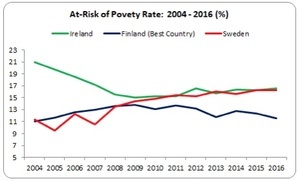
Irish at-risk of poverty rates fell between 2004 and 2009 – from 20.9 percent to 15 percent – while at the same time Swedish rates rose. However, since 2009 both Irish and Swedish rates have been rising, with the latter rising slightly faster. Again, we see a deteriorating Swedish performance largely contributing to a dove-tailing of the two countries (with Finland, again, being the best performer).
In-Work Poverty Rates
In this measurement we see Ireland performing much better than Sweden. In 2016, 3.7 percent of Irish workers were at-risk of poverty compared to 5.8 percent in Sweden. Irish rates are still above 2009 levels (the first year both countries report) while Swedish rates have fallen. But other data tell different stories.
In 2016, 2.7 percent of Irish workers were in severe material deprivation; only 0.5 percent of Swedish workers suffered this. Irish rates are still above 2009 levels (but they have fallen from a high of 5.3 percent in 2012) while Swedish rates more than halved.
In 2013, the earnings ratio between the top 10 percent and lowest 10 percent was 2.28 in Sweden (the last year they report). In Ireland it was 3.86 and it has increased in the three subsequent years – to 3.99. This measures employees’ earnings.
Two Other Welfare Measurements
Throughout society, Swedish severe deprivation rates are the lowest in the EU – at less than 1 percent. In Ireland, the figure is 6.5 percent. In measuring general deprivation (a slightly lower benchmark than ‘severe’) Sweden stands at 3.7 percent; Ireland performs far worse at over 15 percent, though thankfully this has fallen from a high of 25 percent in 2012.
In measuring living standards – actual individual consumption – average per capita spending in Sweden was €23,700 in 2016; in Ireland it was considerably lower at €20,800. Irish levels are still below crash-levels.
* * *
What does all this mean?
Sweden and Ireland remain poles apart on many measurements concerning equality, deprivation and living standards. Where they are starting to converge, it appears due to a deteriorating Swedish performance rather than an improvement in Ireland’s.
But this is less a story about the comparative data between Sweden and Ireland. Rather, it is a story of how data – isolated from the totality of information we have and the historical performance – can give us a misleading impression. This is a universal lesson, applicable to all information, all debates.
In short, data tells you what it tells you; what we have to look out for is how it used in any story-line.
Michael Taft is a researcher for SIPTU and author of the political economy blog, Notes on the Front. His column appears here every Tuesday
Top pic: Shutterstock


The Darkest Colour – a photo series by self taught 23 year old Gabonese photographer Yannis Davy Guibinga. To wit:
The series is set in front of a matte black background and features two nude models whose skin has also been painted black. The works seek to unpack the negative aspects of the both the colour and its symbolism.
More of his work here.

Hugh Grant and Renée Zellweger in Bridget Jones: The Edge Of Reason (2014)
I know this is sad, but it’s true
That a popular actor named Hugh
Has now reached the stage
Where his advancing age
Means starring in rom coms won’t do.
John Moynes
Pic: Universal
All 4:1
at
The Brandywell, last night.
Ciaran Tierney tweetz:
Solidarity with the people of
#Palestine from#Derry. A city where they know a thing or two about State forces who massacre unarmed protesters.


MORE to folly
Tyre Straits
at

This afternoon.
Park West Avenue, Clondalkin, Dublin 22
Pat Flanagan writes:
Is this Dublin’s saddest bike? It’s been chained to a lamp post for the past week along with a car tyre. Anyone?


A stop motion animation by Scottish animator Ainslie Henderson turns meta as the animator’s creations break off, fashion their own instruments from workbench detritus and form their own short-lived electronica band.
Mmf


Palestinians in Gaza border clashes today
Palestinian officials say at least 41 people have died in the latest round of protests.
A mass attempt by Palestinians to cross the border fence separating Israel from Gaza quickly turned violent, as Israeli soldiers responded with rifle fire.
Monday quickly became the bloodiest single day since a campaign of demonstrations began seven weeks ago, to protest Israel’s economic blockade of Gaza.
At least 1,700 Palestinian demonstrators were also wounded along the border fence with Gaza, the Health Ministry reported, as the mass protests that began on March 30 and that had already left dozens dead erupted again.
The relocation of the United States Embassy to Jerusalem from Tel Aviv was set for Monday, timed to the 70th anniversary of the formation of Israel — a move that many Israelis have celebrated but that has enraged Palestinians….
At Least 41 Palestinians Killed in Protests as U.S. Opens Jerusalem Embassy (New York Times)
Pic: getty